Map of Wales showing where the Morganti arms are recorded
The Morganti arms were recorded in Cardigan, c. 1558.
Cardiganshire was west Welsh coastal country of small farms and coastal trade. Its landed families were modest and numerous, and each holding brought its own claim to arms.
This is where the arms were entered in the register. Families often moved to other parts of the country, so the same name can turn up in more than one region.
The body that granted and recorded arms in Wales in this period.
Mary I
Sovereign of the period
Mary I
1553–1558
Reigning in Wales when the Morganti arms are first recorded.
How Arms Worked in Wales
English heraldry allowed arms to be shared by all legitimate descendants of the original owner. These symbols were treated as personal property that moved through the generations to all children. While the eldest son kept the original design, other family members could use the same shield without needing to change it or register their own unique versions.
Granting authority
The College of Arms in London has regulated the use of coats of arms throughout England and Wales since 1484.
How they got arms
Families typically obtained their coats of arms through a formal grant from the Crown or by proving their ancient right to them.
Where arms were recorded
All official coats of arms are recorded in the registers kept at the College of Arms, which date back to the fifteenth century.
The family's standing
Recorded among the armigerous families of Cardigan.
Origin & History of the Morganti Family in Wales
The Morganti family name holds a unique place in the history of Cardigan, Wales, where records confirm their presence as early as 1558. While the name itself has strong roots in Mediterranean regions, its appearance in the coastal town of Cardigan suggests a history of migration and integration during the Tudor period. At that time, Cardigan was a bustling maritime hub, and it is likely that early family members arrived through trade routes that connected Welsh ports to broader European markets. Once settled, the family became part of the local social fabric, adapting to the Welsh language and customs while maintaining their distinct identity. By integrating into the local community, the Morganti family transitioned from newcomers to established residents, leaving a lasting mark on the regional history of Ceredigion.
Coat of Arms & Family Crest Details
Symbols on this shield
bendDefence, and the scarf of a commander
fleur de lisPurity, light, and the sixth son
cinquefoilHope and joy
Colours
Silver (Argent)Means: Peace and sincerity
Black (Sable)Means: Constancy
Historical info
Source
Sir Bernard Burke, The General Armory of England, Scotland, Ireland and Wales, London: Harrison & Sons, 1884
Blazon (the actual original written record)
“Ar. on a bend cotised sa. a fleur-de-lis betw. two cinquefoils of the field”
WorcesterLittle Comberton · Worcester, c. 1569
Digital archive packCoat of arms PNG, gold border print PDF, vector SVG and the certificate of authenticity. Sent to your email in minutes.
Map of England showing where the Morganti arms are recorded
The Morganti arms were recorded in Worcester, c. 1569.
Worcestershire was orchard and farming country with a scattering of old manors. Its gentry were middling rather than great, but a manor was a manor, and holding one was what brought arms.
This is where the arms were entered in the register. Families often moved to other parts of the country, so the same name can turn up in more than one region.
The body that granted and recorded arms in England in this period.
Elizabeth I of England
Sovereign of the period
Elizabeth I of England
1558–1603
Reigning in Wales when the Morganti arms are first recorded.
How Arms Worked in England
English heraldry allowed arms to be shared by all legitimate descendants of the original owner. These symbols were treated as personal property that moved through the generations to all children. While the eldest son kept the original design, other family members could use the same shield without needing to change it or register their own unique versions.
Granting authority
The College of Arms in London has regulated the use of coats of arms throughout England and Wales since 1484.
How they got arms
Families typically obtained their coats of arms through a formal grant from the Crown or by proving their ancient right to them.
Where arms were recorded
All official coats of arms are recorded in the registers kept at the College of Arms, which date back to the fifteenth century.
The family's standing
Recorded among the armigerous families of Worcester.
Origin & History of the Morganti Family in England
The Morganti family name has roots that reach back into the social fabric of sixteenth-century England. While the name is often associated with Italian origins, historical records confirm that members of the family were established in the city of Worcester by 1569. During this period, Worcester was a bustling center of trade and religious life, situated along the River Severn. Families living in the city at this time were often involved in local crafts, merchant guilds, or the administration of the cathedral town. The presence of the Morganti name in these early parish and legal documents suggests that the family was integrated into the local community, participating in the daily economic and social activities that defined life in Elizabethan England. By settling in such a prominent regional hub, the early Morgantis became part of the long history of migration and settlement that shaped the demographic landscape of the English Midlands.
Coat of Arms & Family Crest Details
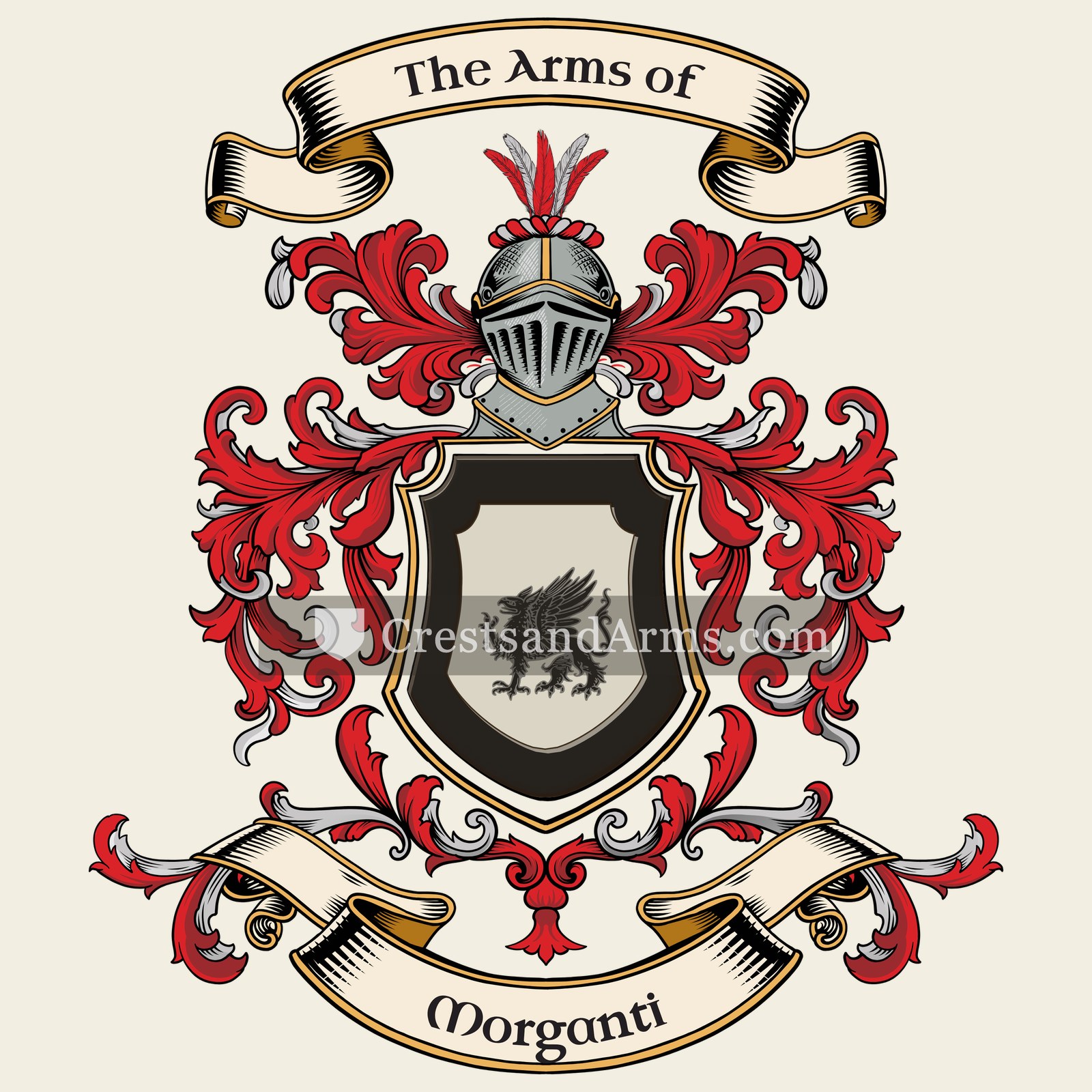
Symbols on this shield
bordureA difference between branches of one family
griffinValour and vigilance, guarding great treasure
Colours
Silver (Argent)Means: Peace and sincerity
Black (Sable)Means: Constancy
Historical info
Source
Sir Bernard Burke, The General Armory of England, Scotland, Ireland and Wales, London: Harrison & Sons, 1884
Blazon (the actual original written record)
“Ar. a griffin segreant sa. armed, beaked, and forelegged gu. a border of the second”
DublinDublin, c. 1619
Digital archive packCoat of arms PNG, gold border print PDF, vector SVG and the certificate of authenticity. Sent to your email in minutes.
Map of Ireland showing where the Morganti arms are recorded
The Morganti arms were recorded in Dublin, c. 1619.
Dublin was the seat of government in Ireland and the place where grants were sought and recorded. Families with business at the castle or the courts settled nearby, and settling there put their arms on record.
This is where the arms were entered in the register. Families often moved to other parts of the country, so the same name can turn up in more than one region.
The body that granted and recorded arms in Ireland in this period.
James VI and I
Sovereign of the period
James VI and I
1603–1625
Reigning in Wales when the Morganti arms are first recorded.
How Arms Worked in Ireland
The Ulster King of Arms granted coats of arms to individuals who proved their social standing and good character. These symbols were typically inherited by all legitimate descendants of the original holder. If a family branch wanted a unique look, they could apply for a specific change to their design through the office to ensure their identity remained distinct.
Granting authority
The Ulster King of Arms acted as the official body that regulated and issued all coats of arms throughout Ireland.
How they got arms
Families obtained their arms through formal grants issued by the office after proving their eligibility and paying the required fees.
Where arms were recorded
All official grants were recorded in the registers held by the Ulster King of Arms starting from the year 1552.
The family's standing
Recorded among the armigerous families of Dublin.
Origin & History of the Morganti Family in Ireland
The Morganti family name has a distinct presence in Irish history that begins long before the modern era. While the name is widely recognized as having Italian roots, records confirm that members of the family were established in Dublin as early as 1619. During this period, Dublin was a bustling center of trade and migration, attracting individuals from across the European continent who sought new opportunities in the city. The presence of the Morganti family in these early records suggests they were part of a small but influential group of continental settlers who integrated into the local urban economy. Over the following decades, these early residents helped shape the name’s legacy in Ireland by participating in the social and commercial life of the capital. Their transition from newcomers to established city dwellers reflects the broader history of migration that defined Dublin during the seventeenth century.
Related Branches & Arms
Root word
Morgan
Derived from the Old Welsh elements for sea and circle or chief.
This name
MorgantiA patronymic surname meaning son of the sea-born or sea-chief.
also spelled
Morgen
Morrgan
Morgann
Morgaine
Morgant
Documented Sources
Sir Bernard Burke, The General Armory of England, Scotland, Ireland and Wales, London: Harrison & Sons, 1884
National Library of Wales, Ceredigion Quarter Sessions Records, 1558
Lewis, Samuel, A Topographical Dictionary of Wales, 1833
Lloyd, John Edward, A History of Wales from the Earliest Times to the Edwardian Conquest, 1911
Digital archive packCoat of arms PNG, gold border print PDF, vector SVG and the certificate of authenticity. Sent to your email in minutes.


 stagPeace and harmony, and one who will not fight unprovoked
 serpentWisdom, healing and prudence
 stagPeace and harmony, and one who will not fight unprovoked
 serpentWisdom, healing and prudence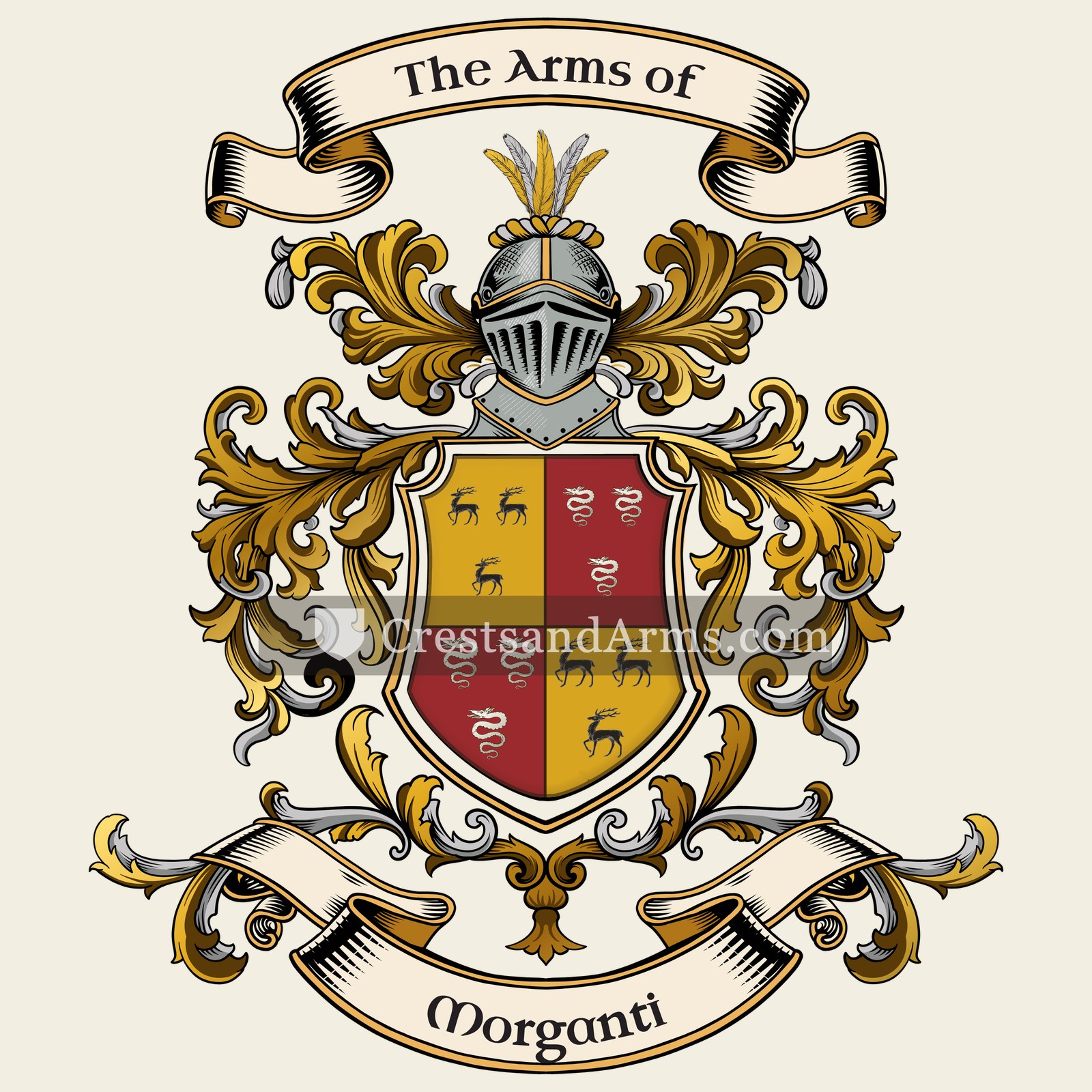


 bendDefence, and the scarf of a commander
 fleur de lisPurity, light, and the sixth son
 cinquefoilHope and joy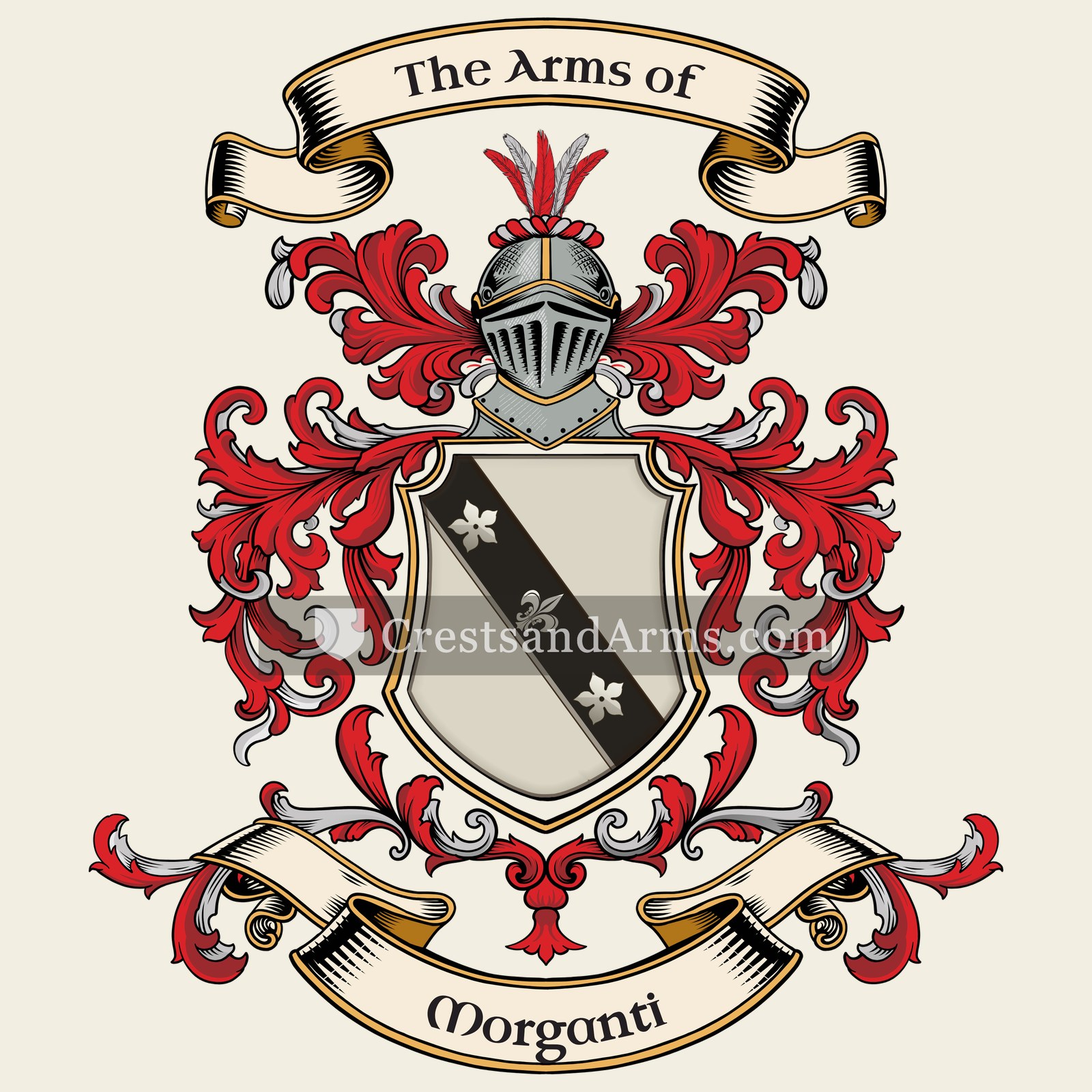

 bordureA difference between branches of one family
 griffinValour and vigilance, guarding great treasure