Map of England showing where the Morison arms are recorded
The Morison arms were recorded in London, c. 1620.
This is where the arms were entered in the register. Families often moved to other parts of the country, so the same name can turn up in more than one region.
The body that granted and recorded arms in England in this period.
James VI and I
Sovereign of the period
James VI and I
1603–1625
Reigning in England when the Morison arms are first recorded.
How Arms Worked in England
English heraldry allowed arms to be shared by all legitimate descendants of the original owner. These symbols were treated as personal property that moved through the generations to all children. While the eldest son kept the original design, other family members could use the same shield without needing to change it or register their own unique versions.
Granting authority
The College of Arms in London has regulated the use of coats of arms throughout England and Wales since 1484.
How they got arms
Families typically obtained their coats of arms through a formal grant from the Crown or by proving their ancient right to them.
Where arms were recorded
All official coats of arms are recorded in the registers kept at the College of Arms, which date back to the fifteenth century.
The family's standing
Recorded among the armigerous families of England.
Origin & History of the Morison Family in England
The surname Morison, often spelled Morrison, has deep roots that trace back to the medieval period in Britain. By the time members of the family were documented in London during the early 1600s, the name had already established itself as a patronymic, meaning it was originally formed to identify a person as the son of a man named Maurice or Morris. In the bustling environment of 17th-century London, families with this name were part of a growing urban population that included merchants, tradespeople, and skilled laborers. These early residents were often involved in the city's expanding trade networks, taking advantage of the economic opportunities that defined the era. As the family integrated into English society, they contributed to the diverse social fabric of the capital, leaving behind records in parish registers and legal documents that highlight their presence during a time of significant national change.
Meaning of the Morison family crest colors & symbols
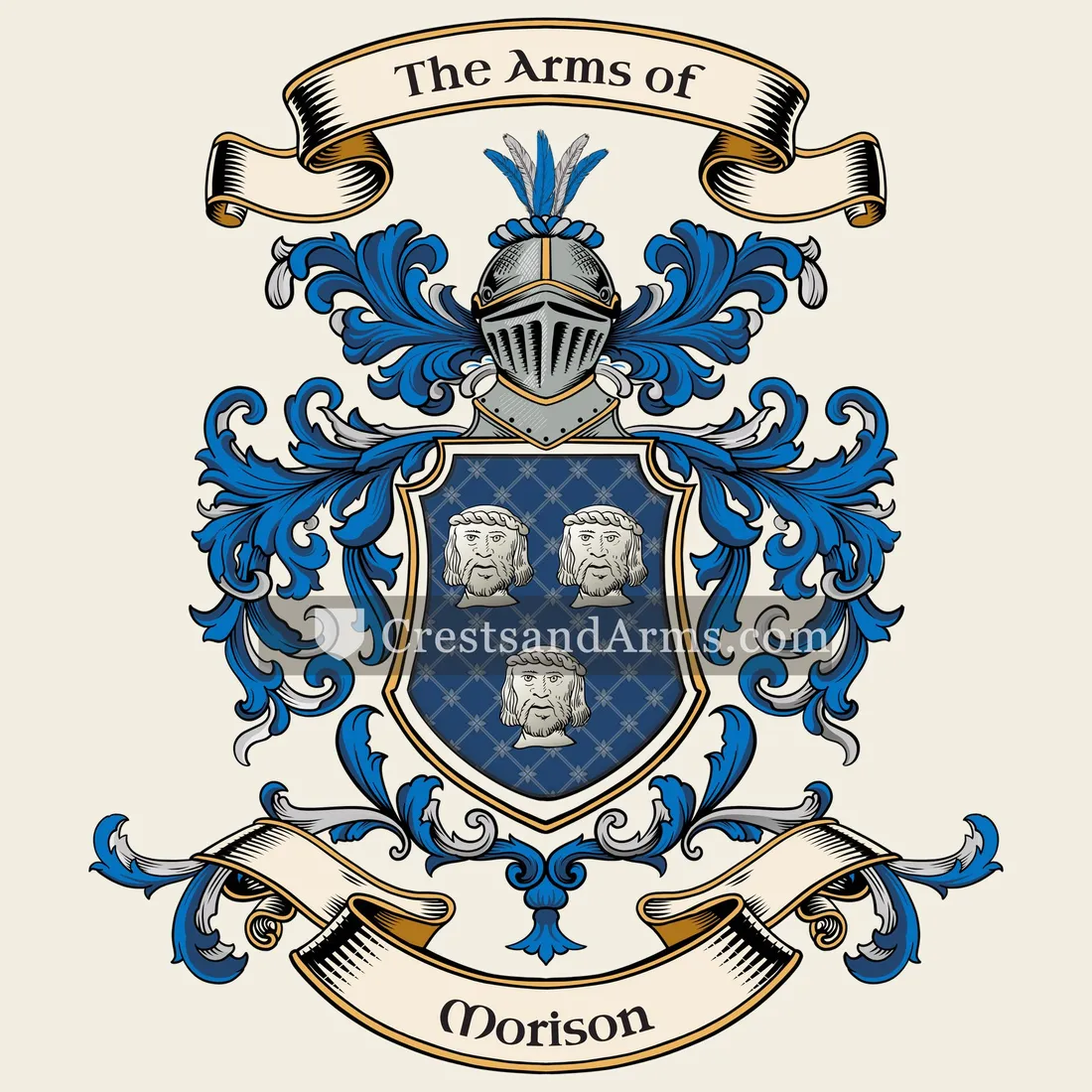
Symbols on this shield
saracens head affronty coupedA crusade fought, and an enemy met in the field
Colours
Blue (Azure)Means: Loyalty and truth
Historical info
Source
Sir Bernard Burke, The General Armory of England, Scotland, Ireland and Wales, London: Harrison & Sons, 1884
Blazon (the actual original written record)
“Az. three Saracens' heads erased, conjoined in one neck, and wreathed with laurel ppr. the faces looking to the chief, dexter, and sinister sides of the shield”
FifeDairsie · Fife, c. 1748
Digital archive packCoat of arms PNG, gold border print PDF, vector SVG and the certificate of authenticity. Sent to your email in minutes.
Map of Scotland showing where the Morison arms are recorded
The Morison arms were recorded in Fife, c. 1748.
Fife was farming country between two firths, with royal palaces and old burghs along its coast. Its landed families were numerous and close to the court, and closeness to the court brought arms.
This is where the arms were entered in the register. Families often moved to other parts of the country, so the same name can turn up in more than one region.
The body that granted and recorded arms in Scotland in this period.
George II of Great Britain
Sovereign of the period
George II of Great Britain
1727–1760
Reigning in England when the Morison arms are first recorded.
How Arms Worked in Scotland
Scottish heraldry is unique because it treats a coat of arms as a piece of personal property protected by law. Only one person can own a specific design at any given time. When a family grows, the head keeps the original shield while other relatives must apply for their own distinct version with slight changes to prove their specific identity.
Granting authority
The Court of the Lord Lyon acts as the official body that regulates and controls all heraldic matters throughout Scotland.
How they got arms
Individuals obtain a legal right to their arms through a formal petition process that confirms their identity and family connection.
Where arms were recorded
All valid coats of arms are officially entered into the Public Register of All Arms and Bearings starting from 1672.
The family's standing
Recorded among the armigerous families of Fife.
Origin & History of the Morison Family in Scotland
The surname Morison has deep roots in Scotland, where it emerged as a patronymic name meaning son of Maurice or son of Morris. While the name appears in various regions across the country, families bearing this name established a notable presence in the Kingdom of Fife by the mid-eighteenth century. By 1748, records show Morison families living and working within this historic region, which was a central hub for Scottish trade and agriculture at the time. These early ancestors were part of a society that was rapidly changing due to the influence of the Enlightenment and the shifting economic landscape of the Scottish Lowlands. As they settled in Fife, the Morisons became integrated into the local community, contributing to the development of the area through their daily labor and social connections. Their presence in the historical record during this era provides a clear link to the broader story of how Scottish families established their identities and livelihoods during the eighteenth century.
Morison Meaning & Related Branches
Root word
Mauricius
Derived from the Latin word for a dark-skinned Moor or inhabitant.
This name
MorisonPatronymic form indicating a descendant of the son of Maurice.
also spelled
Morisoun
Morisun
Related arms
Grantrecorded with Morison, same area
Sadleirrecorded with Morison, same area
Documented Sources
Sir Bernard Burke, The General Armory of England, Scotland, Ireland and Wales, London: Harrison & Sons, 1884
Reaney, P.H. and Wilson, R.M., A Dictionary of English Surnames, 1991
Bardsley, Charles Wareing, A Dictionary of English and Welsh Surnames, 1901
The National Archives, Prerogative Court of Canterbury and Related Probate Jurisdictions: Will Registers, 1384–1858
London Metropolitan Archives, Church of England Parish Registers, 1538–1812
Digital archive packCoat of arms PNG, gold border print PDF, vector SVG and the certificate of authenticity. Sent to your email in minutes.


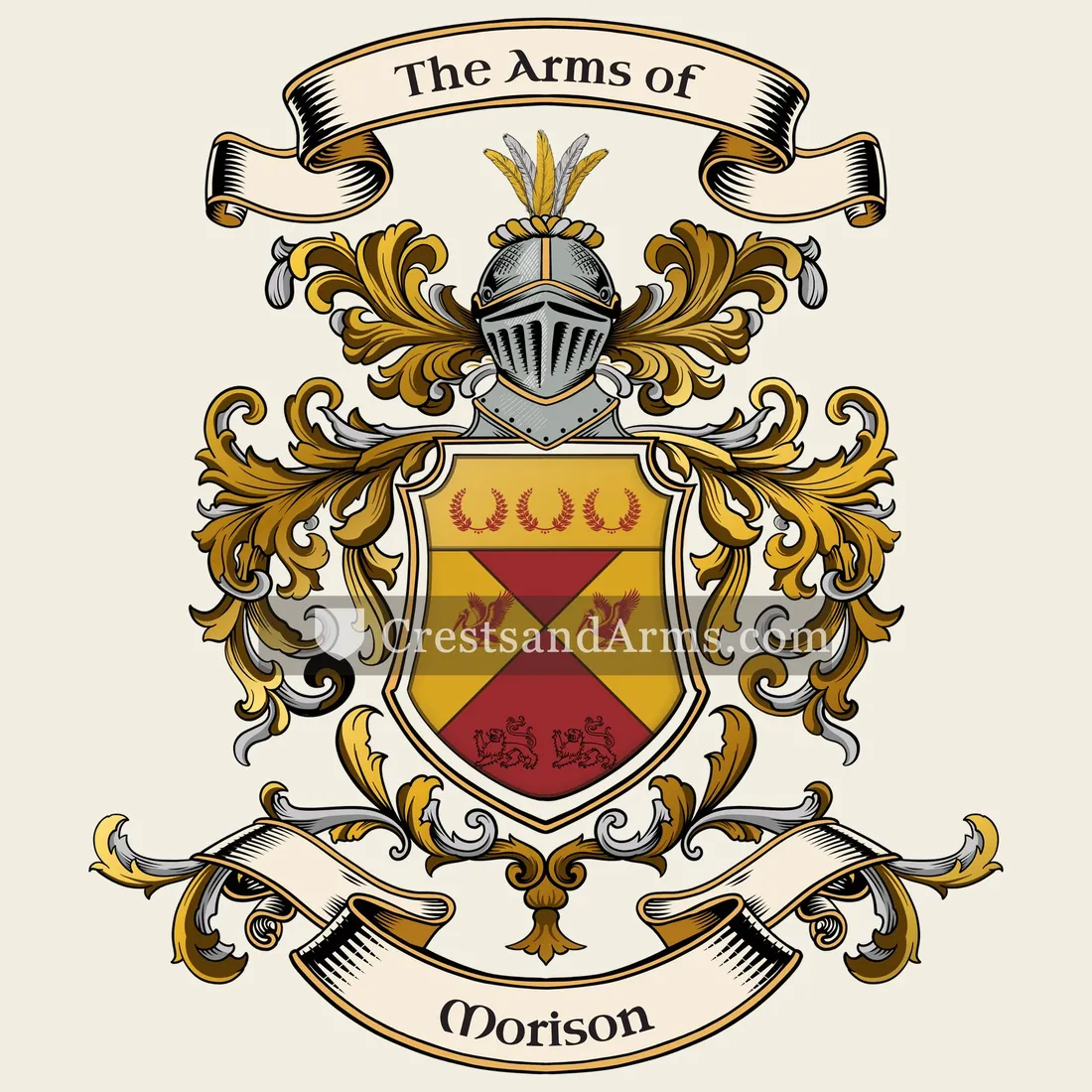
 chiefAuthority, wisdom and dominion
 pelicanSelf-sacrifice and devotion to one's children
 lionCourage, strength and royalty
 wreathHonour, and a victory crowned
 chiefAuthority, wisdom and dominion
 pelicanSelf-sacrifice and devotion to one's children
 lionCourage, strength and royalty
 wreathHonour, and a victory crowned


 saracens head affronty coupedA crusade fought, and an enemy met in the field