Map of Belgium showing where the Morocco arms are recorded
The Morocco arms were recorded in Hainaut, c. 1737.
Hainaut sat on the border between France and the Low Countries and was fought over for centuries. Families there held their land under arms and expected to defend it, so a shield was a working thing.
This is where the arms were entered in the register. Families often moved to other parts of the country, so the same name can turn up in more than one region.
The body that granted and recorded arms in Belgium in this period.
Charles VI, Holy Roman Emperor
Sovereign of the period
Charles VI, Holy Roman Emperor
1711–1740
Reigning in Belgium when the Morocco arms are first recorded.
How Arms Worked in Belgium
In Belgium, a coat of arms is considered personal property that is passed down through the male line to legitimate descendants. Families often use the same shield design across generations to show their shared heritage. If a branch of the family wants to change the design, they must apply for an official update to their specific version of the arms.
Granting authority
The Conseil héraldique is the official body that regulates and approves all coats of arms in Belgium.
How they got arms
Families obtain their coats of arms through formal royal grants or by confirming their historical right to use existing designs.
Where arms were recorded
All approved coats of arms are officially recorded in the public registers of the Conseil héraldique since 1844.
The family's standing
Recorded among the armigerous families of Hainaut.
Origin & History of the Morocco Family in Belgium
The surname Morocco carries a unique history that likely traces back to the movement of people across Europe during the eighteenth century. By 1737, records confirm that family members were established in the Hainaut region, which is a historic area currently located in modern-day Belgium. During this period, Hainaut was a crossroads for trade and migration, often attracting individuals from diverse backgrounds. The name itself suggests a connection to the Mediterranean region, possibly indicating that an ancestor traveled north to settle in the Low Countries. Families in this era often adopted names based on their geographic origins or the distant lands they had visited. As these individuals integrated into the local community in Hainaut, they contributed to the rich social fabric of the region while maintaining a name that hinted at a broader, international heritage.
Morocco Meaning & Related Branches
Root word
Marrakesh
Derived from the Berber phrase meaning land of God.
This name
MoroccoA toponymic surname referring to individuals originating from the country of Morocco.
also spelled
Morcoue
Morcoux
Morcouh
Morkoo
Documented Sources
J. B. Rietstap, Armorial Général, Gouda: G. B. van Goor Zonen, 1884–87
Archives de l'État à Mons, État civil et registres paroissiaux du Hainaut, 1737
Dion, R., Histoire des frontières de la France, 1947
Genicot, L., Histoire de la Wallonie, 1973
Digital archive packCoat of arms PNG, gold border print PDF, vector SVG and the certificate of authenticity. Sent to your email in minutes.


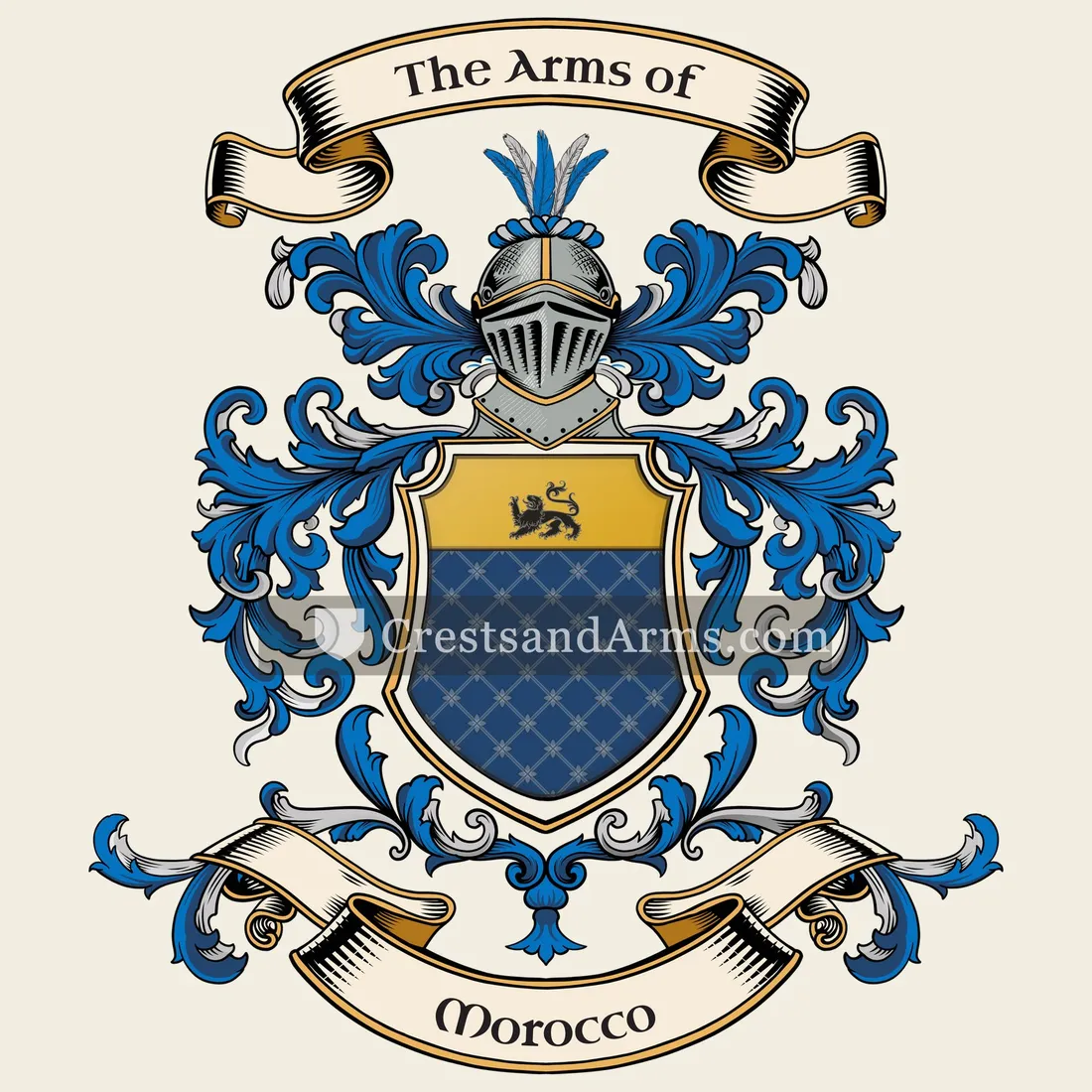
 chiefAuthority, wisdom and dominion
 lionCourage, strength and royalty
 chiefAuthority, wisdom and dominion
 lionCourage, strength and royalty