Map of Spain showing where the Morran arms are recorded
The Morran arms were recorded in Asturies, c. 1722.
This is where the arms were entered in the register. Families often moved to other parts of the country, so the same name can turn up in more than one region.
The body that granted and recorded arms in Spain in this period.
Philip V of Spain
Sovereign of the period
Philip V of Spain
1714–1724
Reigning in Spain when the Morran arms are first recorded.
How Arms Worked in Spain
In Spain, a coat of arms was considered a form of property that belonged to the entire family line. These arms were passed down from a father to all his children equally. Younger branches of the family usually kept the original design without needing to add any special marks to distinguish their specific line.
Granting authority
The Cronista Rey de Armas was the official body that regulated and granted coats of arms throughout Spain.
How they got arms
Families often obtained their arms through royal grants or by proving their noble status to the official heraldic authority.
Where arms were recorded
Coats of arms were officially recorded in the registers of the Cronista Rey de Armas starting in 1496.
The family's standing
Recorded among the armigerous families of Spain.
Origin & History of the Morran Family in Spain
The family name Morran carries a rich history rooted in the rugged landscapes of northern Spain. By the year 1722, records confirm that members of the family were firmly established in the region of Asturias. This area was historically significant because of its mountainous terrain and its role as a stronghold during the Middle Ages. Families living in Asturias during the early 18th century often worked in agriculture or local trade, contributing to the distinct cultural identity of the region. The name likely evolved as a way to identify specific households or individuals within these tight-knit mountain communities. Over time, the family became part of the social fabric of the area, leaving behind traces in local parish registers and administrative documents that highlight their presence in the province long before modern migration patterns began.
Morran Meaning & Related Branches
Root word
Moro
Derived from the Latin word maurus meaning dark or swarthy.
This name
MorranA topographic or habitational name referring to someone who lived near a moor or a dark-skinned person.
also spelled
Morran
Morane
Morann
Morren
Morin
Documented Sources
J. B. Rietstap, Armorial Général, Gouda: G. B. van Goor Zonen, 1884–87
Archivo Histórico Diocesano de Oviedo, Libros Sacramentales de la Parroquia de San Juan de Amandi, 1722
Fernández Conde, Francisco Javier, La Iglesia en Asturias durante la Edad Media, 1972
García de Cortázar, José Ángel, La sociedad rural en la España medieval, 1988
Digital archive packCoat of arms PNG, gold border print PDF, vector SVG and the certificate of authenticity. Sent to your email in minutes.


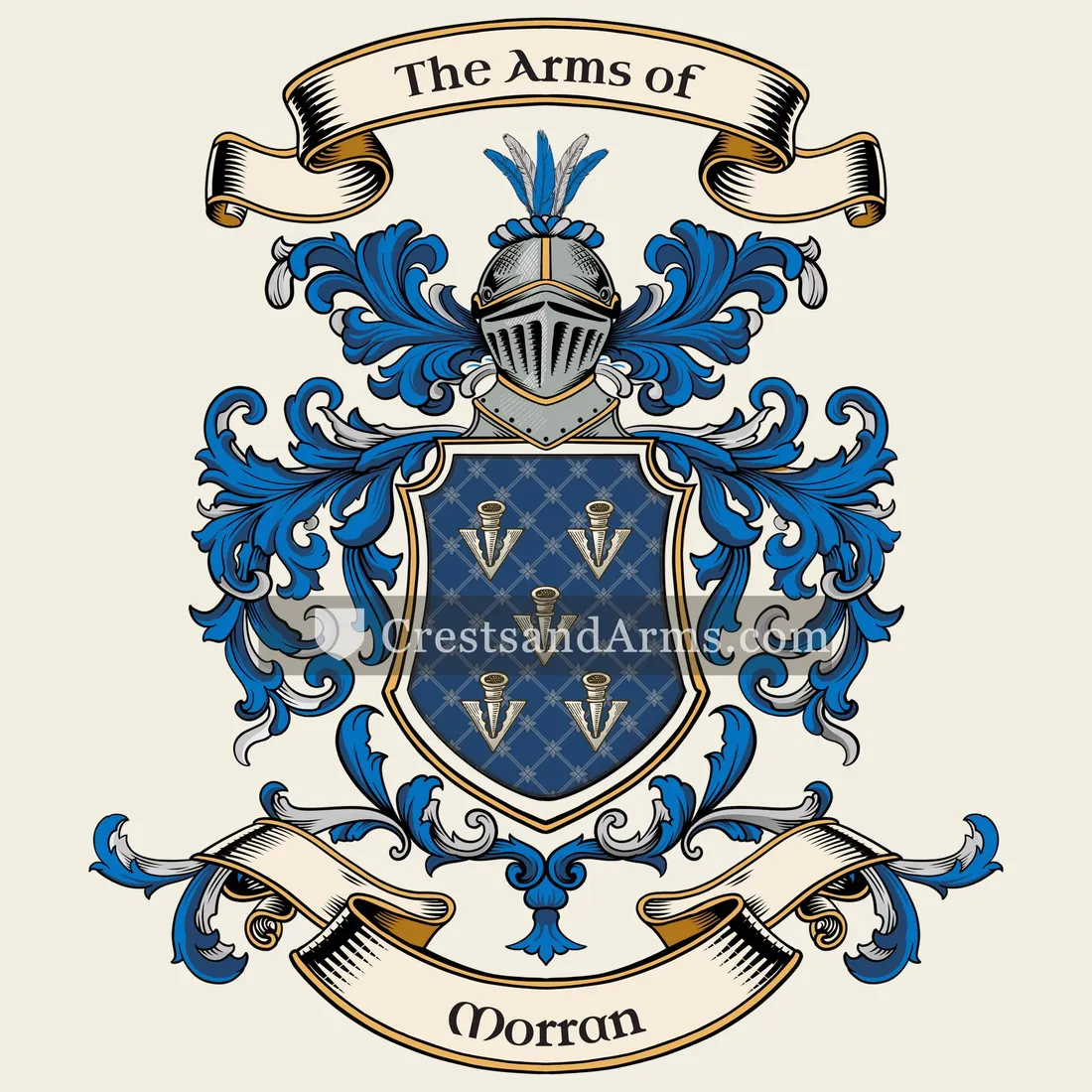
 arms pheon arrowheadReadiness for battle, and the broad arrow of the sovereign
 arms pheon arrowheadReadiness for battle, and the broad arrow of the sovereign