Map of Wales showing where the Morrish arms are recorded
The Morrish arms were recorded in Glamorgan, c. 1647.
Glamorgan was the richest part of Wales, with good coastal farmland and Norman castles along it. The families who held those castles kept their land for centuries, and long holding brought recorded arms.
This is where the arms were entered in the register. Families often moved to other parts of the country, so the same name can turn up in more than one region.
The body that granted and recorded arms in Wales in this period.
Charles I of England
Sovereign of the period
Charles I of England
1625–1649
Reigning in Wales when the Morrish arms are first recorded.
How Arms Worked in Wales
English heraldry allowed arms to be shared by all legitimate descendants of the original owner. These symbols were treated as personal property that moved through the generations to all children. While the eldest son kept the original design, other family members could use the same shield without needing to change it or register their own unique versions.
Granting authority
The College of Arms in London has regulated the use of coats of arms throughout England and Wales since 1484.
How they got arms
Families typically obtained their coats of arms through a formal grant from the Crown or by proving their ancient right to them.
Where arms were recorded
All official coats of arms are recorded in the registers kept at the College of Arms, which date back to the fifteenth century.
The family's standing
Recorded among the armigerous families of Glamorgan.
Origin & History of the Morrish Family in Wales
The surname Morrish has deep roots in the coastal region of Glamorgan, where records confirm the family was well-established by 1647. During this period, the name was closely tied to the social and economic landscape of South Wales, a time when many families were transitioning from traditional agrarian lifestyles to more structured community roles. The name itself is often linked to the personal name Maurice, which gained popularity across Britain following the Norman influence. In the context of Glamorgan, families like the Morrishes were often involved in the local parish systems, which served as the primary method for tracking births, marriages, and deaths in the seventeenth century. By settling in this area, early members of the family became part of the distinct cultural identity of the Welsh coast, contributing to the local workforce and the evolving history of the region during a century marked by significant political and social change.
Meaning of the Morrish family crest colors & symbols
Symbols on this shield
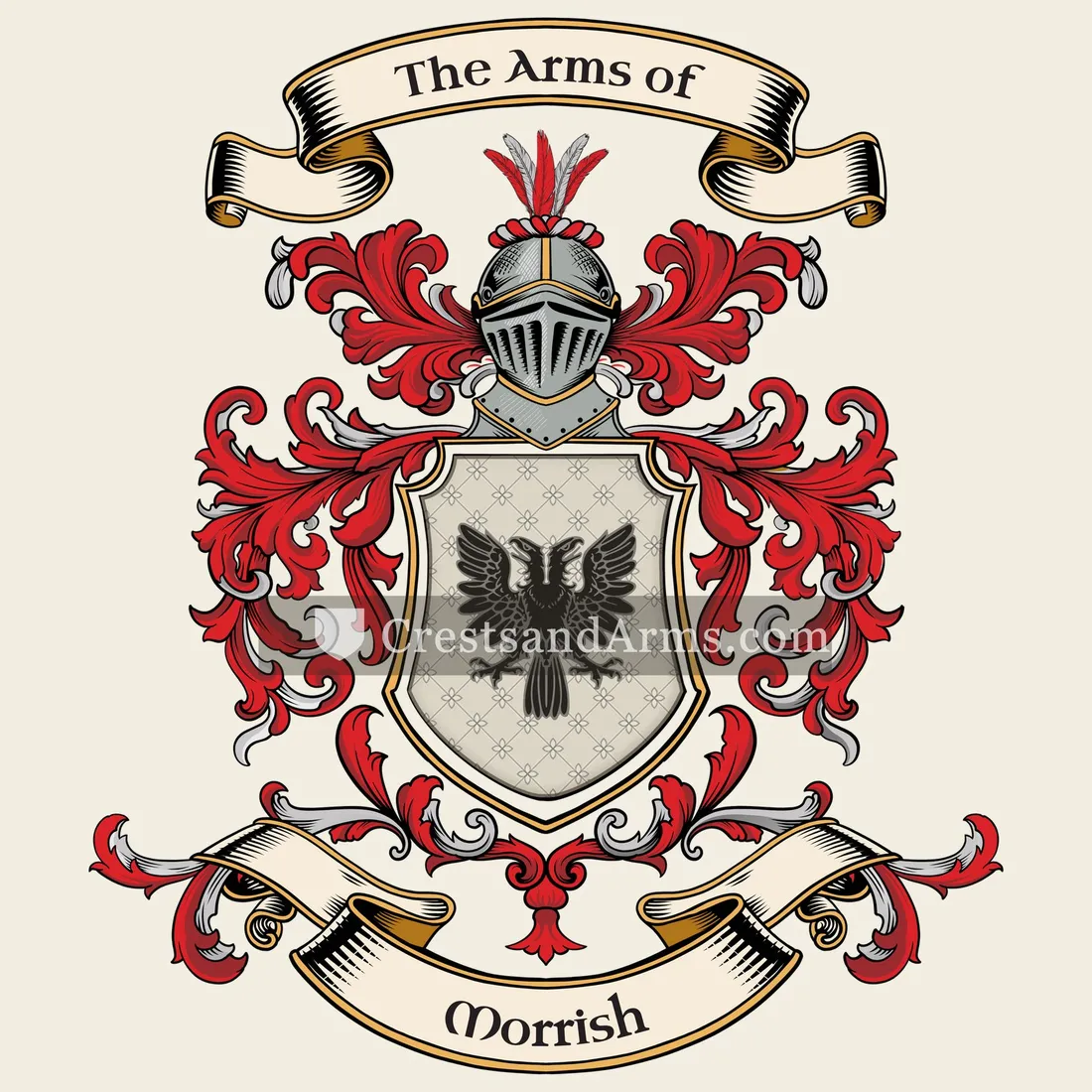
eagleNobility, strength and a keen mind
Colours
Silver (Argent)Means: Peace and sincerity
Black (Sable)Means: Constancy
Historical info
Source
Sir Bernard Burke, The General Armory of England, Scotland, Ireland and Wales, London: Harrison & Sons, 1884
Blazon (the actual original written record)
“Ar. an eagle displ. sa. beaked and legged or”
Englandc. 1619
Digital archive packCoat of arms PNG, gold border print PDF, vector SVG and the certificate of authenticity. Sent to your email in minutes.
Map of England showing where the Morrish arms are recorded
The Morrish arms were recorded in England, c. 1619.
Arms such as these were typically recorded in York.
Yorkshire is the largest of the English counties, and it held more gentry families than any other. Land there was split among a great many households rather than a few, so a great many of them carried arms.
This is where the arms were entered in the register. Families often moved to other parts of the country, so the same name can turn up in more than one region.
The body that granted and recorded arms in England in this period.
James VI and I
Sovereign of the period
James VI and I
1603–1625
Reigning in Wales when the Morrish arms are first recorded.
How Arms Worked in England
English heraldry allowed arms to be shared by all legitimate descendants of the original owner. These symbols were treated as personal property that moved through the generations to all children. While the eldest son kept the original design, other family members could use the same shield without needing to change it or register their own unique versions.
Granting authority
The College of Arms in London has regulated the use of coats of arms throughout England and Wales since 1484.
How they got arms
Families typically obtained their coats of arms through a formal grant from the Crown or by proving their ancient right to them.
Where arms were recorded
All official coats of arms are recorded in the registers kept at the College of Arms, which date back to the fifteenth century.
The family's standing
Recorded among the armigerous families of England.
Origin & History of the Morrish Family in England
The surname Morrish is a variant of the name Maurice, which traces its linguistic roots back to the Latin name Mauritius, meaning dark-skinned or moorish. In England, the name became established as a common personal name following the Norman Conquest, eventually evolving into a hereditary surname as populations grew and record-keeping became more formal. By the early seventeenth century, the family had firmly planted roots in the northern city of York. Records from 1619 confirm the presence of the Morrish family in this region, where they lived as part of the local community during the late Elizabethan and early Stuart eras. At this time, families often lived in the same parish for generations, working in local trades or agriculture. This stability allowed the name to persist in the historical record of northern England, marking the transition of the Morrish family from a group defined by a personal name to a distinct lineage with a recognized place in English society.
Meaning of the Morrish family crest colors & symbols
Symbols on this shield
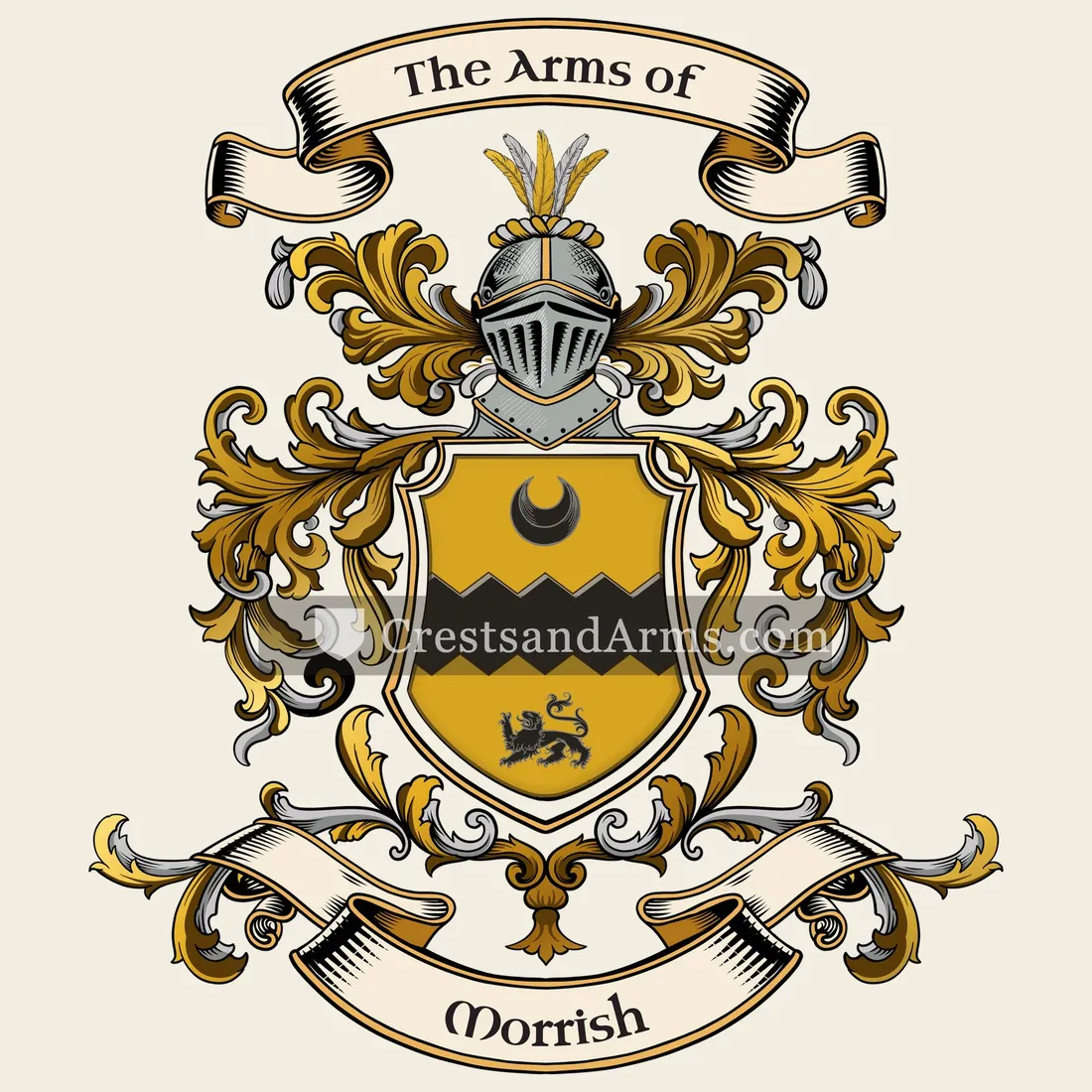
fessThe military belt, and readiness to serve
crescentHonour by the sovereign, and the second son
lionCourage, strength and royalty
Colours
Gold (Or)Means: Generosity
Black (Sable)Means: Constancy
Historical info
Source
Sir Bernard Burke, The General Armory of England, Scotland, Ireland and Wales, London: Harrison & Sons, 1884
Blazon (the actual original written record)
“Or, a fesse dancetté betw. in chief a crescent and in base a lion ramp. sa”
TipperaryTemplemore · Tipperary, c. 1629
Digital archive packCoat of arms PNG, gold border print PDF, vector SVG and the certificate of authenticity. Sent to your email in minutes.
Map of Ireland showing where the Morrish arms are recorded
The Morrish arms were recorded in Tipperary, c. 1629.
Tipperary was the best grazing land in Ireland, held by a small number of powerful families. Land of that value stayed in the same hands, and unbroken holding is what puts a name in the records.
This is where the arms were entered in the register. Families often moved to other parts of the country, so the same name can turn up in more than one region.
The body that granted and recorded arms in Ireland in this period.
Charles I of England
Sovereign of the period
Charles I of England
1625–1649
Reigning in Wales when the Morrish arms are first recorded.
How Arms Worked in Ireland
The Ulster King of Arms granted coats of arms to individuals who proved their social standing and good character. These symbols were typically inherited by all legitimate descendants of the original holder. If a family branch wanted a unique look, they could apply for a specific change to their design through the office to ensure their identity remained distinct.
Granting authority
The Ulster King of Arms acted as the official body that regulated and issued all coats of arms throughout Ireland.
How they got arms
Families obtained their arms through formal grants issued by the office after proving their eligibility and paying the required fees.
Where arms were recorded
All official grants were recorded in the registers held by the Ulster King of Arms starting from the year 1552.
The family's standing
Recorded among the armigerous families of Tipperary.
Origin & History of the Morrish Family in Ireland
The Morrish family name has deep roots in the Irish landscape, with documented evidence placing members of the family in County Tipperary as early as 1629. During this period, the name was often associated with the shifting social and land-holding structures of the seventeenth century. Families like the Morrishes frequently navigated the complex political environment of the time, often living as tenant farmers or local tradespeople within the rural communities of Munster. While the name likely arrived in Ireland through migration from Britain, those who settled in Tipperary quickly integrated into the local culture and economy. Over the generations, the family became a part of the regional history of the area, contributing to the development of the parishes where they resided. Their presence in official records from the early 1600s highlights the long-standing connection the family has maintained with the Irish countryside.
Morrish Meaning & Related Branches
Root word
Mauritius
Derived from the Latin word for a person from Mauretania or dark-skinned.
This name
MorrishA patronymic surname meaning son of Maurice, originating from the Latin name for a Moor.
also spelled
Morrice
Morries
Morres
Morys
Documented Sources
Sir Bernard Burke, The General Armory of England, Scotland, Ireland and Wales, London: Harrison & Sons, 1884
The National Archives, Prerogative Court of Canterbury and related Probate Jurisdictions: Will Registers, 1647
Glamorgan Archives, Parish Registers of the Diocese of Llandaff, 1647
Morgan, Prys, A History of Welsh Surnames, 1988
Rowlands, John and Sheila, The Surnames of Wales, 1996
Digital archive packCoat of arms PNG, gold border print PDF, vector SVG and the certificate of authenticity. Sent to your email in minutes.


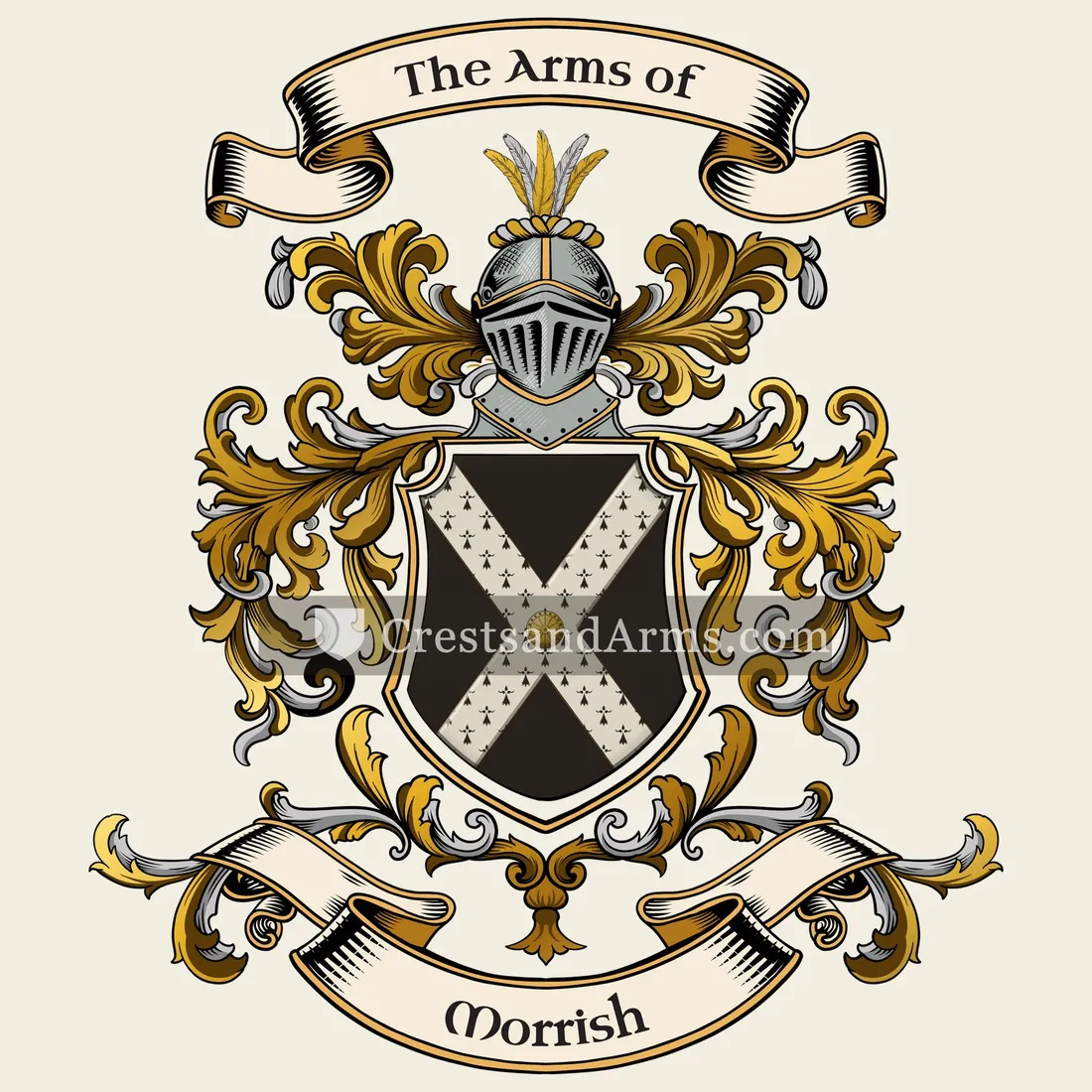
 saltireResolution, and St Andrew's cross
 roundelA coin, and one who has been to the crusades
 saltireResolution, and St Andrew's cross
 roundelA coin, and one who has been to the crusades


 eagleNobility, strength and a keen mind

 fessThe military belt, and readiness to serve
 crescentHonour by the sovereign, and the second son
 lionCourage, strength and royalty