Map of Italy showing where the Morro arms are recorded
The Morro arms were recorded in Venice, c. 1775.
Venice ran on trade, and its great families were merchants before they were anything else. The city kept a formal list of its noble houses, and a name on that list carried arms as a matter of record.
This is where the arms were entered in the register. Families often moved to other parts of the country, so the same name can turn up in more than one region.
The body that granted and recorded arms in Italy in this period.
Alvise Giovanni Mocenigo
Sovereign of the period
Alvise Giovanni Mocenigo
1763–1778
Reigning in Italy when the Morro arms are first recorded.
How Arms Worked in Italy
In the Italian states, coats of arms were often used by noble families to show their status and history. These symbols were passed down through the generations to all legitimate male descendants. Younger branches of a family usually kept the original design but sometimes added small changes to distinguish their specific line from the main branch.
Granting authority
Various local rulers and city governments controlled the use of coats of arms across the different Italian states.
How they got arms
Families often assumed their own arms or received them as official grants from local lords, popes, or city councils.
Where arms were recorded
Arms were recorded in local city archives or private family books rather than in one single national register.
The family's standing
Recorded among the armigerous families of Venice.
Origin & History of the Morro Family in Italy
The history of the Morro family in Italy is deeply tied to the maritime and commercial traditions of the Venetian Republic. By the late 18th century, the family had established a presence in Venice, a city that served as a vital bridge between Western Europe and the trade routes of the Mediterranean. The name Morro likely stems from geographical or descriptive roots, often associated with dark features or specific land formations found in the coastal regions of the Italian peninsula. During the 1770s, Venice was a hub for merchant families who navigated the complex political landscape of the Adriatic. Members of the Morro family living in this era were part of a society that valued trade, craftsmanship, and civic participation. As the Republic faced shifting power dynamics in Europe, families like the Morros contributed to the enduring cultural and economic fabric of the city. Their presence in 1775 places them within a period of transition for Venice, just before the city underwent significant changes at the turn of the century.
Meaning of the Morro family crest colors & symbols
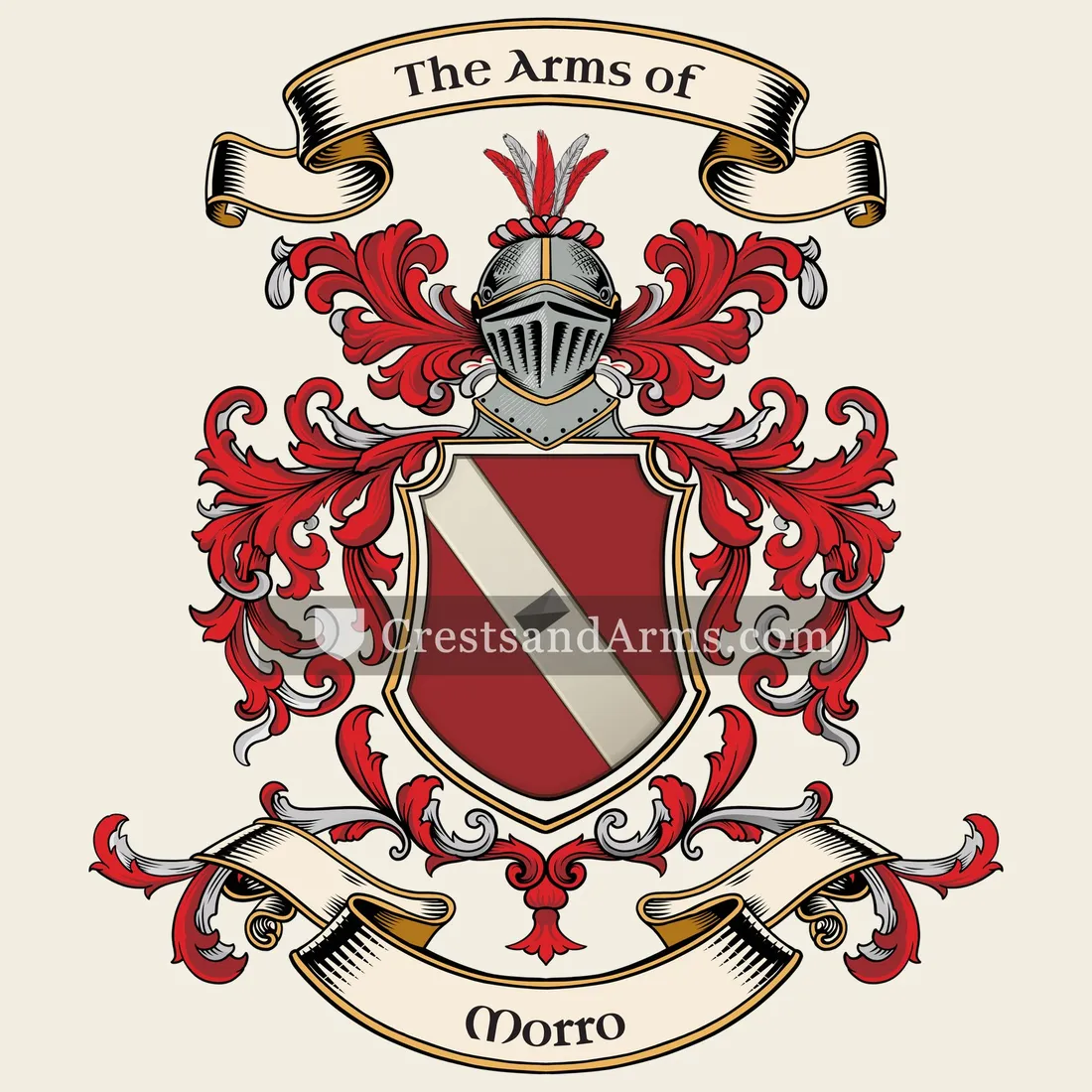
Symbols on this shield
bendDefence, and the scarf of a commander
billetThe sealed letter, and a message delivered
Colours
Red (Gules)Means: Military strength
Silver (Argent)Means: Peace and sincerity
Black (Sable)Means: Constancy
Historical info
Source
Sir Bernard Burke, The General Armory of England, Scotland, Ireland and Wales, London: Harrison & Sons, 1884
Blazon (the actual original written record)
“Gu. a bend ar. billettée sa”
Scotlandc. 1748
Digital archive packCoat of arms PNG, gold border print PDF, vector SVG and the certificate of authenticity. Sent to your email in minutes.
Map of Scotland showing where the Morro arms are recorded
The Morro arms were recorded in Scotland, c. 1748.
Arms such as these were typically recorded in Edinburgh.
Edinburgh was the seat of Scotland's government, its courts and its heralds. Families with business there settled nearby, and being close to where arms were recorded is exactly why so many of them appear.
This is where the arms were entered in the register. Families often moved to other parts of the country, so the same name can turn up in more than one region.
The body that granted and recorded arms in Scotland in this period.
George II of Great Britain
Sovereign of the period
George II of Great Britain
1727–1760
Reigning in Italy when the Morro arms are first recorded.
How Arms Worked in Scotland
Scottish heraldry is unique because it treats a coat of arms as a piece of personal property protected by law. Only one person can own a specific design at any given time. When a family grows, the head keeps the original shield while other relatives must apply for their own distinct version with slight changes to prove their specific identity.
Granting authority
The Court of the Lord Lyon acts as the official body that regulates and controls all heraldic matters throughout Scotland.
How they got arms
Individuals obtain a legal right to their arms through a formal petition process that confirms their identity and family connection.
Where arms were recorded
All valid coats of arms are officially entered into the Public Register of All Arms and Bearings starting from 1672.
The family's standing
Recorded among the armigerous families of Scotland.
Origin & History of the Morro Family in Scotland
The history of the Morro family in Scotland is deeply tied to the urban development of Edinburgh during the mid-eighteenth century. While the name likely has roots in older linguistic traditions, its documented presence in the city by 1748 places the family in a period of significant social and economic transition. At this time, Edinburgh was beginning to expand beyond its medieval walls, and families like the Morros were part of a growing class of residents contributing to the city’s trade and civic life. Living in the capital during the aftermath of the Jacobite risings, these early family members navigated a society that was rapidly modernizing. By establishing themselves in Edinburgh during this era, the Morro family became part of the long-term demographic shift that defined the city as a center of commerce and culture in Scotland.
Morro Meaning & Related Branches
Root word
Maurus
Derived from the Latin term for a dark-skinned person or Moor.
This name
MorroRefers to a person with a dark complexion or someone originating from North Africa.
also spelled
Morro
Morou
Moroh
Documented Sources
J. B. Rietstap, Armorial Général, Gouda: G. B. van Goor Zonen, 1884–87
Lane, Frederic C., Venice, A Maritime Republic, 1973
Archivio di Stato di Venezia, Anagrafi di cittadini e forestieri, 1775
Norwich, John Julius, A History of Venice, 1982
Digital archive packCoat of arms PNG, gold border print PDF, vector SVG and the certificate of authenticity. Sent to your email in minutes.


 chiefAuthority, wisdom and dominion
 applePeace, plenty and long-standing settlement
 chiefAuthority, wisdom and dominion
 applePeace, plenty and long-standing settlement
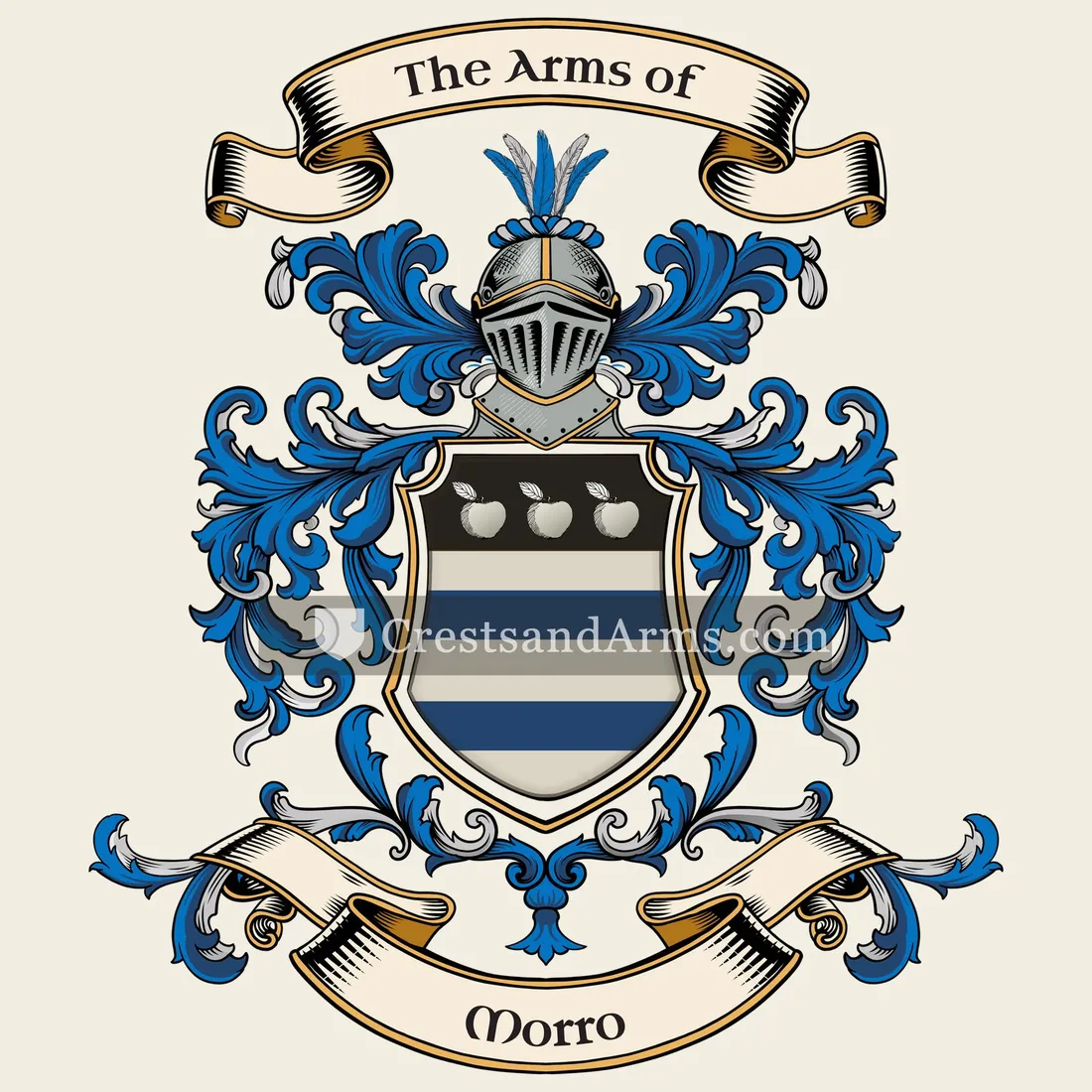


 bendDefence, and the scarf of a commander
 billetThe sealed letter, and a message delivered