A record of documented arms, meaning and origin, researched for the Mortimore family lines. Documented in 3 countries.
Reg. 7430 · Britain, M–O
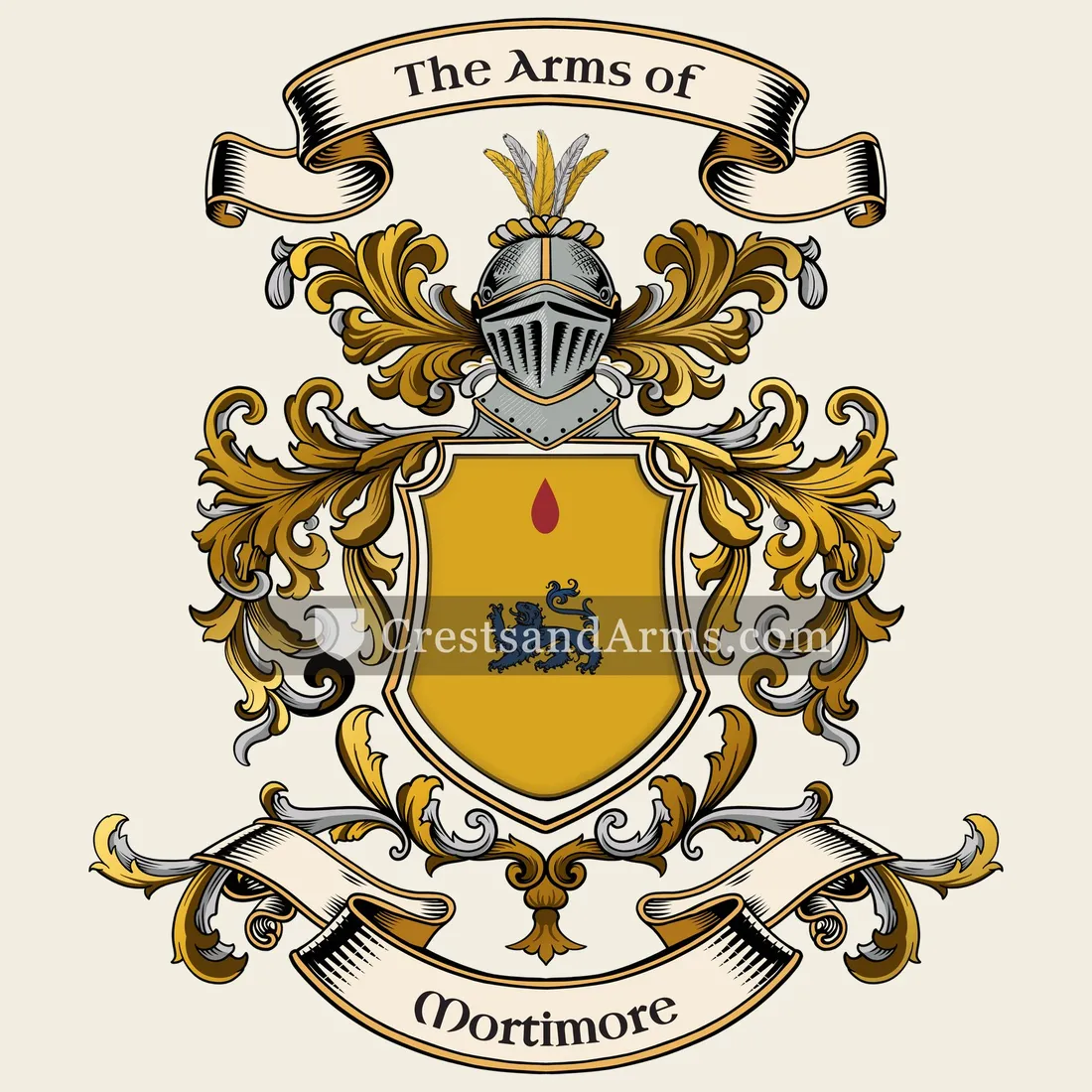
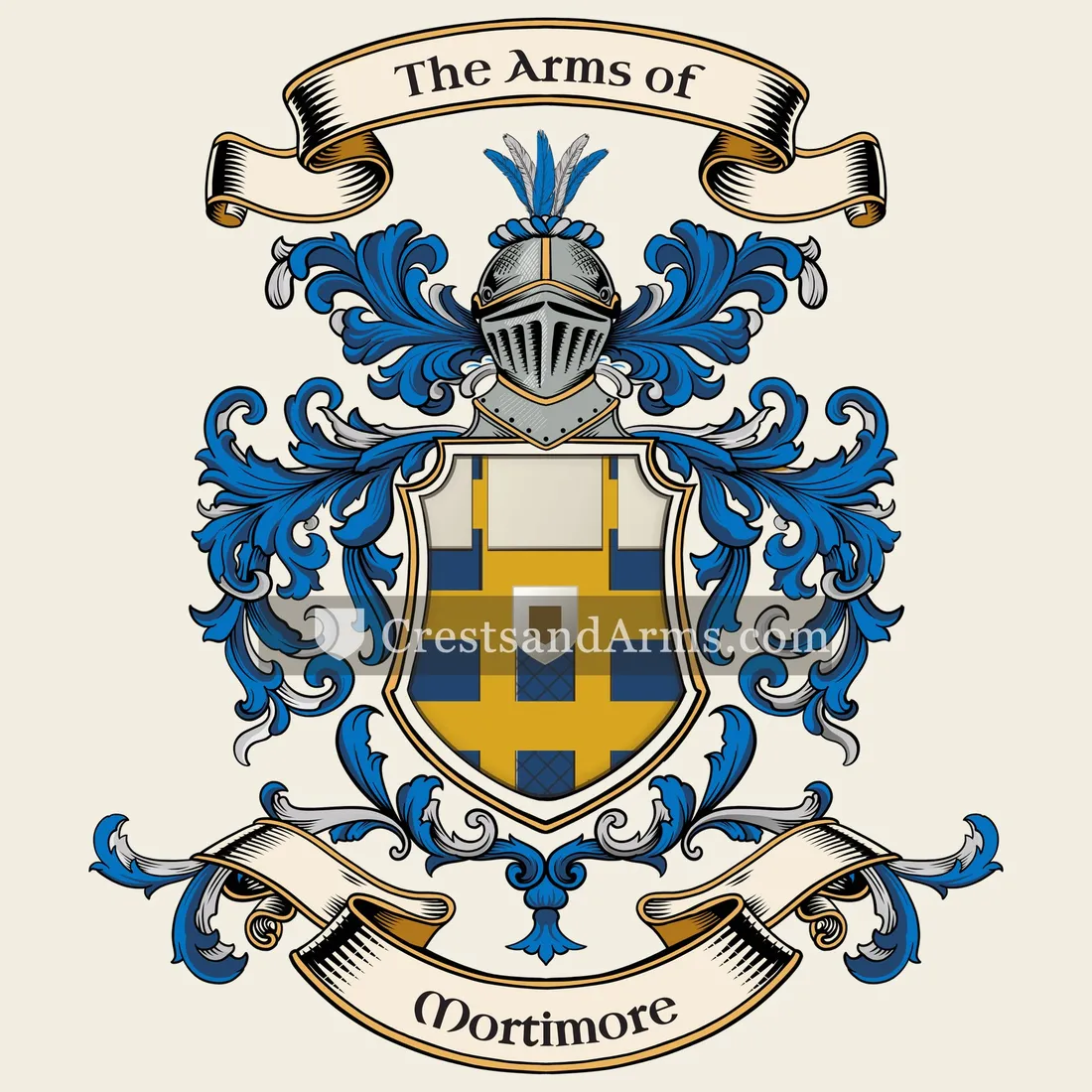
Meaning of the Mortimore family crest colors & symbols
Symbols on this shield
fessThe military belt, and readiness to serve
chiefAuthority, wisdom and dominion
paleMilitary strength, and a fortified defence
escutcheonA shield within a shield, and a claim inherited
Colours
Blue (Azure)Means: Loyalty and truth
Gold (Or)Means: Generosity
Silver (Argent)Means: Peace and sincerity
Historical info
Source
J. B. Rietstap, Armorial Général, Gouda: G. B. van Goor Zonen, 1884–87
Blazon (the actual original written record)
“D'azur à trois fasces d'or; au chef tiercé en pal: a. tranché d'azur sur or; b. d'or au pal d'azur; c. taillé d'azur sur or. A un écusson d'arg., br. sur la première fasce. C.: un panache de plumes [V. Garnault, Marans et Pressigny.]”
Britainc. 1424
Digital archive packCoat of arms PNG, gold border print PDF, vector SVG and the certificate of authenticity. Sent to your email in minutes.
Map of Britain showing where the Mortimore arms are recorded
The Mortimore arms were recorded in Britain, c. 1424.
Arms such as these were typically recorded in Kent.
Kent sits between London and the short crossing to Europe, and the trade passing through made it wealthy. Merchant families bought land with that money, and it was landowners who took coats of arms.
This is where the arms were entered in the register. Families often moved to other parts of the country, so the same name can turn up in more than one region.
The body that granted and recorded arms in Britain in this period.
Henry VI of England
Sovereign of the period
Henry VI of England
1422–1461
Reigning in Britain when the Mortimore arms are first recorded.
How Arms Worked in Britain
English heraldry allowed arms to be shared by all legitimate descendants of the original owner. These symbols were treated as personal property that moved through the generations to all children. While the eldest son kept the original design, other family members could use the same shield without needing to change it or register their own unique versions.
Granting authority
The College of Arms in London has regulated the use of coats of arms throughout England and Wales since 1484.
How they got arms
Families typically obtained their coats of arms through a formal grant from the Crown or by proving their ancient right to them.
Where arms were recorded
All official coats of arms are recorded in the registers kept at the College of Arms, which date back to the fifteenth century.
The family's standing
Recorded among the armigerous families of Britain.
Origin & History of the Mortimore Family in Britain
The family name Mortimore has deep roots in the English landscape, with historical evidence placing members of the family in the county of Kent as early as 1424. During this period, the name was often associated with families living near still or stagnant bodies of water, as the name itself is derived from the Old French words for dead sea or still water. In the fifteenth century, families like the Mortimores were typically part of the emerging middle class of landowners and tenant farmers who helped shape the local economy of southeastern England. As the name spread from Kent into other regions, it evolved through various spellings in local parish registers and tax documents. These early ancestors were likely involved in the agricultural life of the medieval countryside, contributing to the growth of rural communities long before the name became widely recognized across Britain.
Meaning of the Mortimore family crest colors & symbols
Symbols on this shield
lionCourage, strength and royalty
dropletsTears, and grief borne with patience
Colours
Gold (Or)Means: Generosity
Blue (Azure)Means: Loyalty and truth
Red (Gules)Means: Military strength
Historical info
Source
Sir Bernard Burke, The General Armory of England, Scotland, Ireland and Wales, London: Harrison & Sons, 1884
Blazon (the actual original written record)
“Or, guttée de sang a lion ramp. az”
EnglandLondon, c. 1620
Digital archive packCoat of arms PNG, gold border print PDF, vector SVG and the certificate of authenticity. Sent to your email in minutes.
Map of England showing where the Mortimore arms are recorded
The Mortimore arms were recorded in London, c. 1620.
This is where the arms were entered in the register. Families often moved to other parts of the country, so the same name can turn up in more than one region.
The body that granted and recorded arms in England in this period.
James VI and I
Sovereign of the period
James VI and I
1603–1625
Reigning in Britain when the Mortimore arms are first recorded.
How Arms Worked in England
English heraldry allowed arms to be shared by all legitimate descendants of the original owner. These symbols were treated as personal property that moved through the generations to all children. While the eldest son kept the original design, other family members could use the same shield without needing to change it or register their own unique versions.
Granting authority
The College of Arms in London has regulated the use of coats of arms throughout England and Wales since 1484.
How they got arms
Families typically obtained their coats of arms through a formal grant from the Crown or by proving their ancient right to them.
Where arms were recorded
All official coats of arms are recorded in the registers kept at the College of Arms, which date back to the fifteenth century.
The family's standing
Recorded among the armigerous families of England.
Origin & History of the Mortimore Family in England
The surname Mortimore is a variation of the name Mortimer, which first arrived in England following the Norman Conquest of 1066. The name originates from the French words "mort" and "mer," which translate to "dead sea." This likely referred to a specific location in Normandy where the family lived before moving across the channel. By the early 17th century, the family had established a firm presence in London. Records from 1620 show that members of the Mortimore family were living and working in the city during a time of great social change. As London grew into a global center for trade and politics, these early residents were part of the bustling urban population that helped shape the capital. Their presence in the city during this era suggests they were integrated into the local economy and the daily life of the English people long before the modern era.
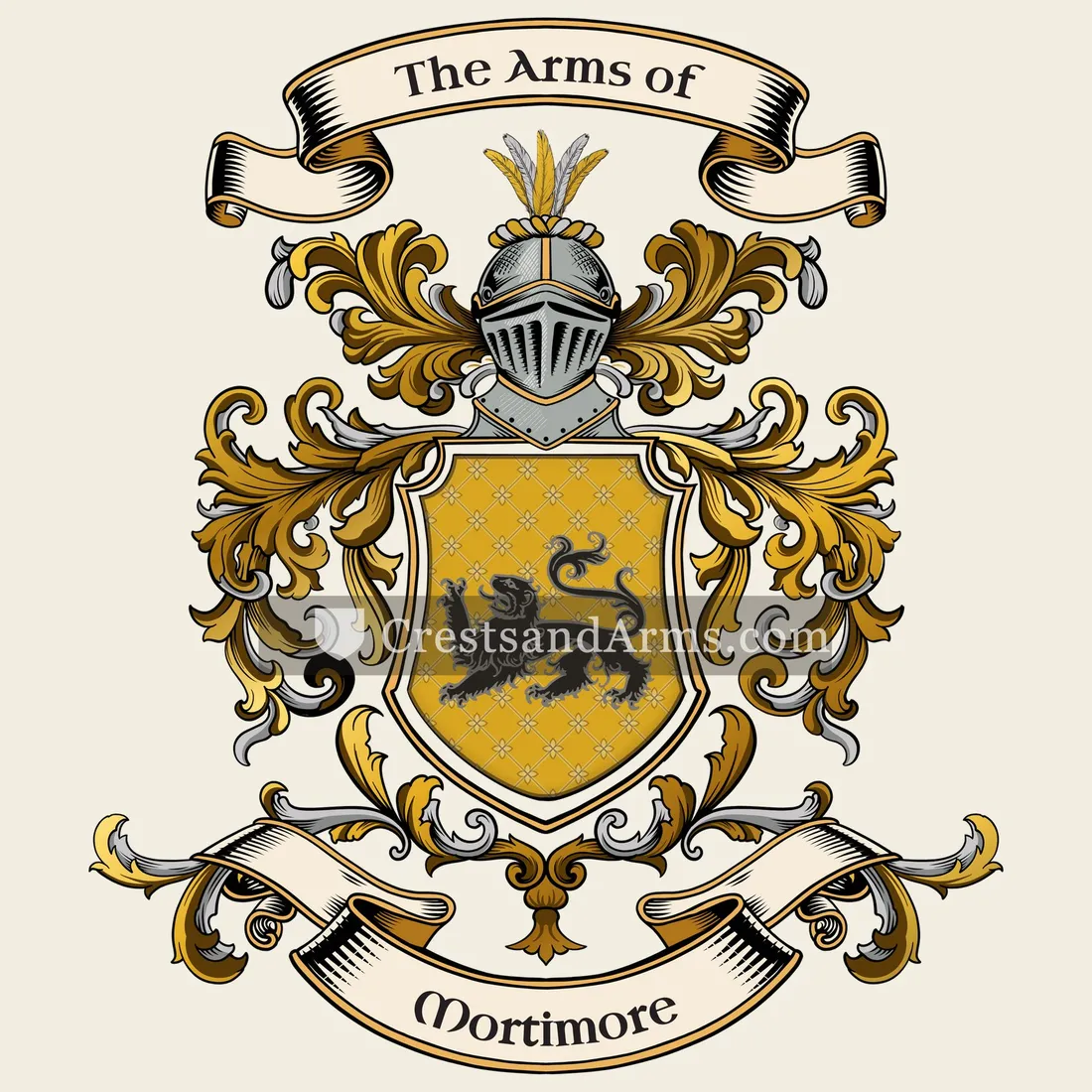
Meaning of the Mortimore family crest colors & symbols
Symbols on this shield
lionCourage, strength and royalty
Colours
Gold (Or)Means: Generosity
Black (Sable)Means: Constancy
Historical info
Source
Sir Bernard Burke, The General Armory of England, Scotland, Ireland and Wales, London: Harrison & Sons, 1884
Blazon (the actual original written record)
“Or, a lion ramp. sa. guttée d'or”
AberdeenCraigievar · Aberdeen, c. 1748
Digital archive packCoat of arms PNG, gold border print PDF, vector SVG and the certificate of authenticity. Sent to your email in minutes.
Map of Scotland showing where the Mortimore arms are recorded
The Mortimore arms were recorded in Aberdeen, c. 1748.
Aberdeen was a granite trading town on the north-east coast with farming country behind it. Merchants who prospered bought estates inland, and buying an estate was what brought a family its arms.
This is where the arms were entered in the register. Families often moved to other parts of the country, so the same name can turn up in more than one region.
The body that granted and recorded arms in Scotland in this period.
George II of Great Britain
Sovereign of the period
George II of Great Britain
1727–1760
Reigning in Britain when the Mortimore arms are first recorded.
How Arms Worked in Scotland
Scottish heraldry is unique because it treats a coat of arms as a piece of personal property protected by law. Only one person can own a specific design at any given time. When a family grows, the head keeps the original shield while other relatives must apply for their own distinct version with slight changes to prove their specific identity.
Granting authority
The Court of the Lord Lyon acts as the official body that regulates and controls all heraldic matters throughout Scotland.
How they got arms
Individuals obtain a legal right to their arms through a formal petition process that confirms their identity and family connection.
Where arms were recorded
All valid coats of arms are officially entered into the Public Register of All Arms and Bearings starting from 1672.
The family's standing
Recorded among the armigerous families of Aberdeen.
Origin & History of the Mortimore Family in Scotland
The Mortimore family name has deep roots in the coastal landscape of Northeast Scotland, particularly within the city of Aberdeen. While the surname is often associated with Norman origins elsewhere in Britain, the presence of the family in Aberdeen by 1748 suggests they were well-established members of the local merchant and trade classes during the mid-eighteenth century. During this period, Aberdeen was a bustling center for maritime commerce and education, and families like the Mortimores likely played a role in the city’s growing economic life. Historical records from the era indicate that individuals bearing the name were integrated into the social fabric of the region, participating in the daily affairs of a city defined by its stone architecture and North Sea trade routes. By settling in this specific part of Scotland, the family became part of a unique cultural history that blended local traditions with the broader developments of the Scottish Enlightenment.
Mortimore Meaning & Related Branches
Root word
Mortemer
Derived from the Old French words for dead sea or stagnant water.
This name
MortimoreA locational surname referring to individuals originating from the village of Mortemer in Normandy.
also spelled
Mortymer
Mortemar
Mortemer
Documented Sources
J. B. Rietstap, Armorial Général, Gouda: G. B. van Goor Zonen, 1884–87
Reaney, P.H. and Wilson, R.M., A Dictionary of English Surnames, 1997
Kent Archives, Canterbury Cathedral Archives: Records of the Dean and Chapter, 1424
Cottle, Basil, The Penguin Dictionary of Surnames, 1967
Digital archive packCoat of arms PNG, gold border print PDF, vector SVG and the certificate of authenticity. Sent to your email in minutes.


 fessThe military belt, and readiness to serve
 chiefAuthority, wisdom and dominion
 paleMilitary strength, and a fortified defence
 escutcheonA shield within a shield, and a claim inherited
 fessThe military belt, and readiness to serve
 chiefAuthority, wisdom and dominion
 paleMilitary strength, and a fortified defence
 escutcheonA shield within a shield, and a claim inherited


 lionCourage, strength and royalty
 dropletsTears, and grief borne with patience