Map of England showing where the Morton arms are recorded
The Morton arms were recorded in Kent, c. 1486.
Kent sits between London and the short crossing to Europe, and the trade passing through made it wealthy. Merchant families bought land with that money, and it was landowners who took coats of arms.
This is where the arms were entered in the register. Families often moved to other parts of the country, so the same name can turn up in more than one region.
The body that granted and recorded arms in England in this period.
Henry VII of England
Sovereign of the period
Henry VII of England
1485–1509
Reigning in England when the Morton arms are first recorded.
How Arms Worked in England
English heraldry allowed arms to be shared by all legitimate descendants of the original owner. These symbols were treated as personal property that moved through the generations to all children. While the eldest son kept the original design, other family members could use the same shield without needing to change it or register their own unique versions.
Granting authority
The College of Arms in London has regulated the use of coats of arms throughout England and Wales since 1484.
How they got arms
Families typically obtained their coats of arms through a formal grant from the Crown or by proving their ancient right to them.
Where arms were recorded
All official coats of arms are recorded in the registers kept at the College of Arms, which date back to the fifteenth century.
The family's standing
Recorded among the armigerous families of Kent.
Origin & History of the Morton Family in England
The surname Morton is a locative name, meaning it was originally taken from a specific place rather than a trade or a personal characteristic. In Old English, the name combines the words "mor," meaning moor or marsh, and "tun," meaning a settlement or enclosure. This suggests that the earliest ancestors to carry the name lived near a swampy or uncultivated tract of land. By the late 15th century, the family had established a notable presence in the county of Kent. Records confirm their residence there by 1486, a time when the family was becoming increasingly involved in the social and political life of the region. As the name spread across England, it became associated with various landholders who maintained these rural estates, helping the family name transition from a simple description of a home to a recognized identity passed down through generations.
Coat of Arms & Family Crest Details
Symbols on this shield
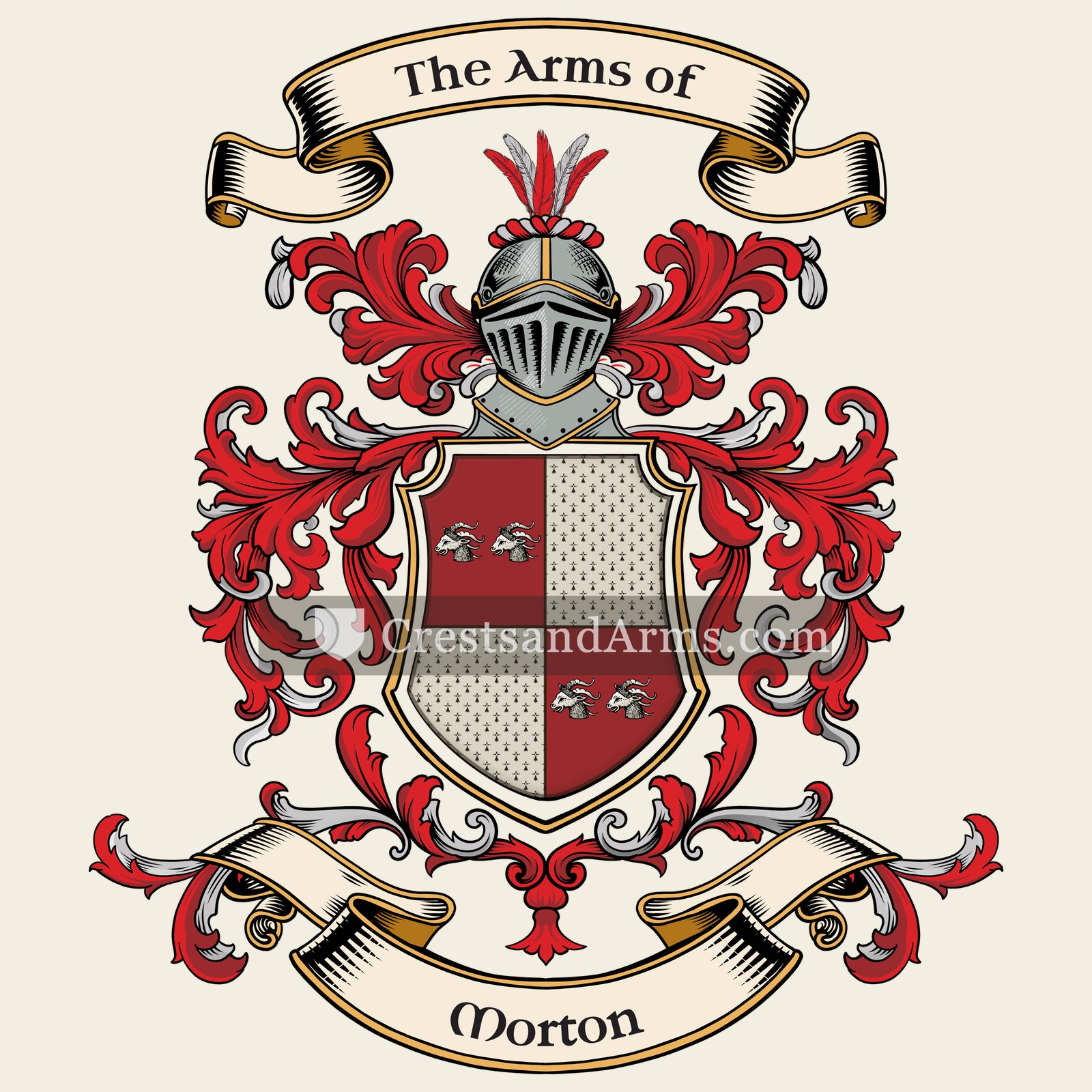
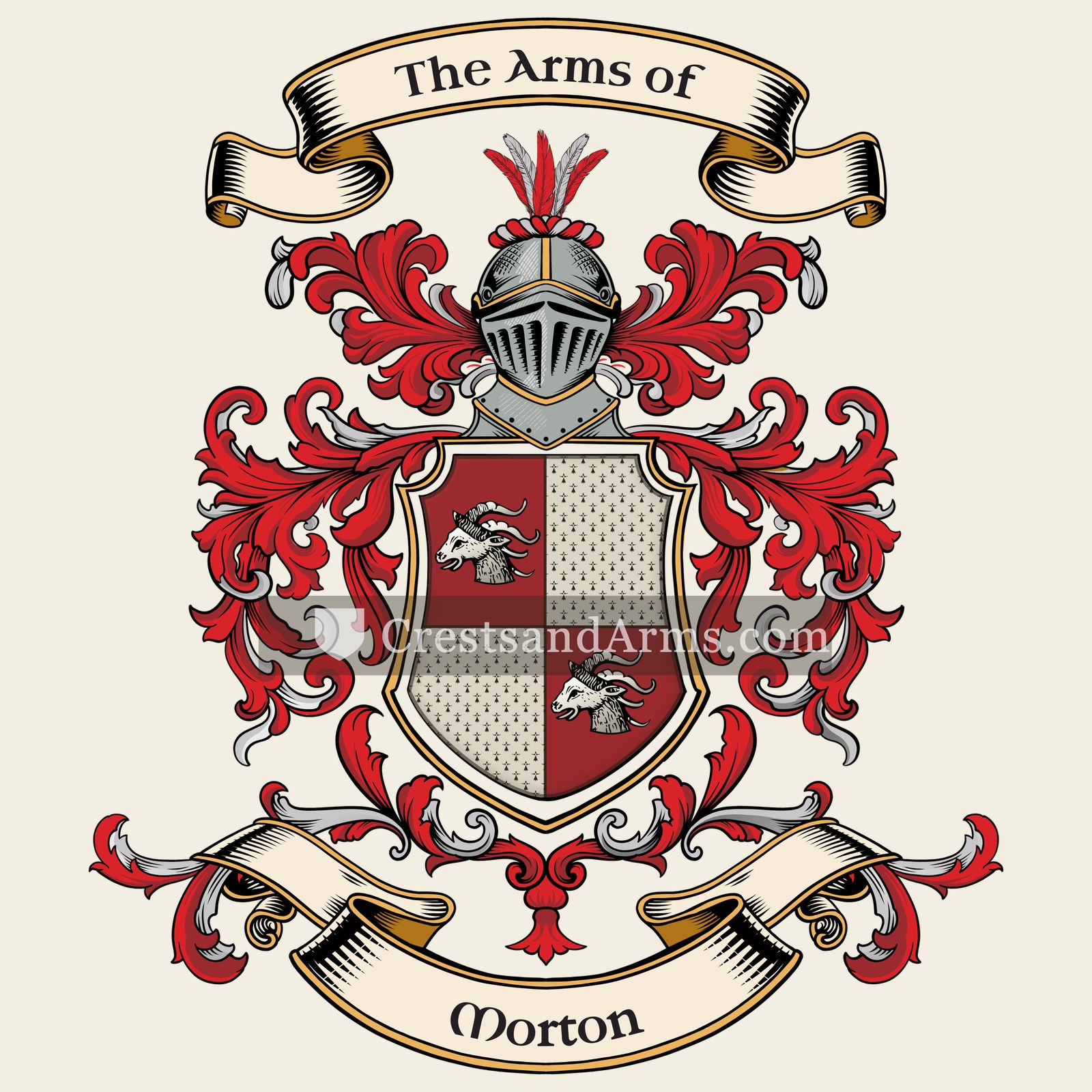
goats headWisdom, and one who wins by policy rather than force
Colours
Red (Gules)Means: Military strength
ErmineMeans: Dignity
Silver (Argent)Means: Peace and sincerity
Historical info
Source
Sir Bernard Burke, The General Armory of England, Scotland, Ireland and Wales, London: Harrison & Sons, 1884
Blazon (the actual original written record)
“Quarterly, gu. and erm. in the 1st and 4th quarters a goat's head erased ar”
Irelandc. 1655
Digital archive packCoat of arms PNG, gold border print PDF, vector SVG and the certificate of authenticity. Sent to your email in minutes.
Map of Ireland showing where the Morton arms are recorded
The Morton arms were recorded in Ireland, c. 1655.
Arms such as these were typically recorded in Dublin.
Dublin was the seat of government in Ireland and the place where grants were sought and recorded. Families with business at the castle or the courts settled nearby, and settling there put their arms on record.
This is where the arms were entered in the register. Families often moved to other parts of the country, so the same name can turn up in more than one region.
The body that granted and recorded arms in Ireland in this period.
How Arms Worked in Ireland
The Ulster King of Arms granted coats of arms to individuals who proved their social standing and good character. These symbols were typically inherited by all legitimate descendants of the original holder. If a family branch wanted a unique look, they could apply for a specific change to their design through the office to ensure their identity remained distinct.
Granting authority
The Ulster King of Arms acted as the official body that regulated and issued all coats of arms throughout Ireland.
How they got arms
Families obtained their arms through formal grants issued by the office after proving their eligibility and paying the required fees.
Where arms were recorded
All official grants were recorded in the registers held by the Ulster King of Arms starting from the year 1552.
The family's standing
Recorded among the armigerous families of Ireland.
Origin & History of the Morton Family in Ireland
The Morton family name in Ireland is deeply connected to the political and social shifts of the seventeenth century. While the name itself has roots in Old English, meaning a settlement near a moor or marsh, its presence in Ireland became firmly established during the mid-1600s. Records confirm that members of the Morton family were living in Dublin by 1655, a period defined by the aftermath of the Cromwellian conquest. During this time, many families from England and Scotland relocated to Irish urban centers to participate in the administration and trade of the city. These early settlers often integrated into the growing merchant and professional classes of Dublin. As the family established their lives in the capital, they became part of the complex social fabric of a changing Ireland. Their presence in the city during this era reflects the broader patterns of migration and settlement that shaped the demographic landscape of Dublin for generations to come.
Coat of Arms & Family Crest Details
Symbols on this shield
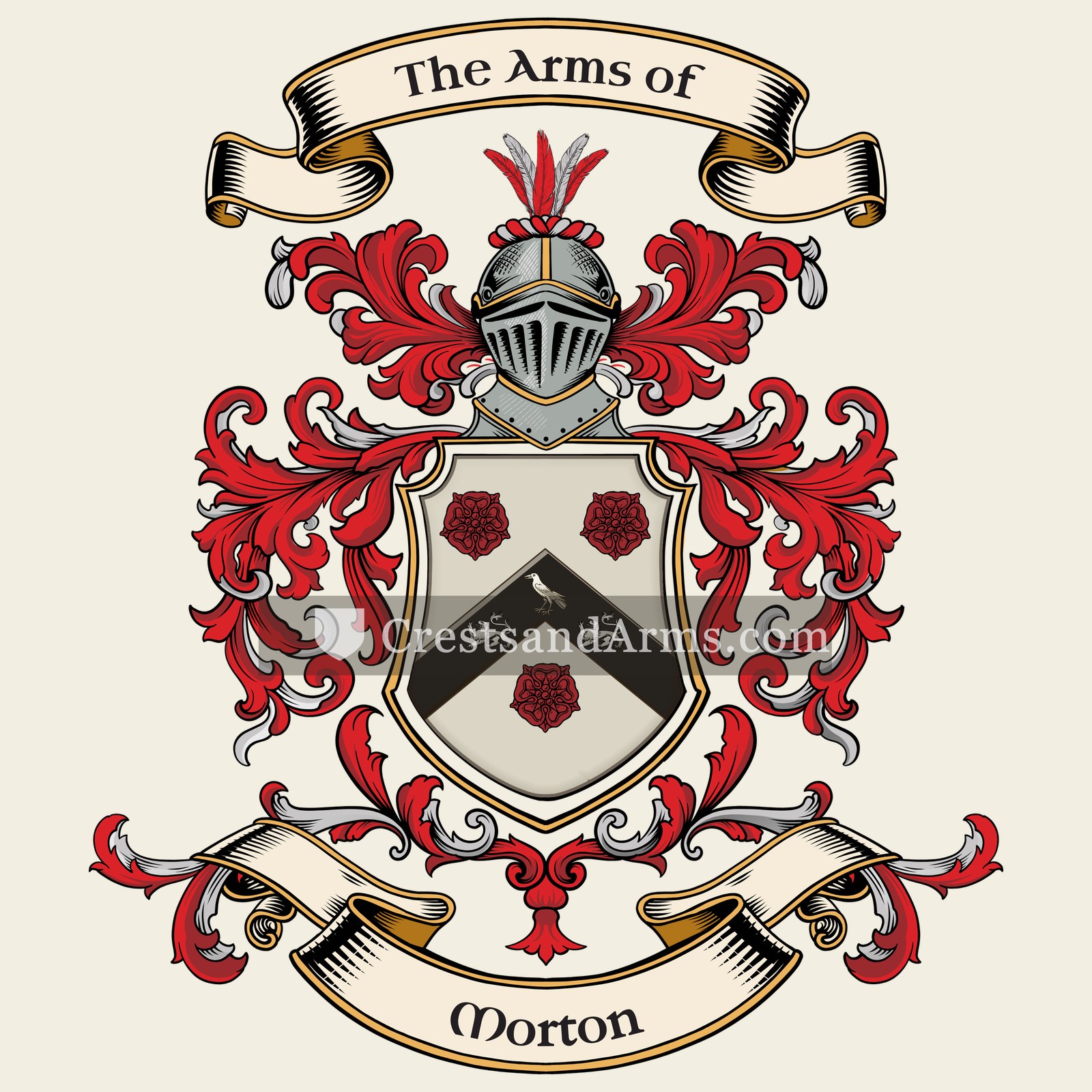
chevronProtection, and faithful service completed
ravenConstancy and divine providence
roseThe seventh son, and beauty with grace
lionCourage, strength and royalty
Colours
Silver (Argent)Means: Peace and sincerity
Black (Sable)Means: Constancy
Red (Gules)Means: Military strength
Historical info
Source
Sir Bernard Burke, The General Armory of England, Scotland, Ireland and Wales, London: Harrison & Sons, 1884
Blazon (the actual original written record)
“Ar. on a chev. sa. betw. three roses in chief gu. barbed vert, and in base two writing pens in saltire of the third, a raven ar. betw. two lions' heads erased of the first”
ScotlandBelmont, c. 1863
Digital archive packCoat of arms PNG, gold border print PDF, vector SVG and the certificate of authenticity. Sent to your email in minutes.
Map of Scotland showing where the Morton arms are recorded
The Morton arms were recorded in Belmont, c. 1863.
Arms such as these were typically recorded in Edinburgh.
Edinburgh was the seat of Scotland's government, its courts and its heralds. Families with business there settled nearby, and being close to where arms were recorded is exactly why so many of them appear.
This is where the arms were entered in the register. Families often moved to other parts of the country, so the same name can turn up in more than one region.
The body that granted and recorded arms in Scotland in this period.
Victoria
Sovereign of the period
Victoria
1837–1901
Reigning in England when the Morton arms are first recorded.
How Arms Worked in Scotland
Scottish heraldry is unique because it treats a coat of arms as a piece of personal property protected by law. Only one person can own a specific design at any given time. When a family grows, the head keeps the original shield while other relatives must apply for their own distinct version with slight changes to prove their specific identity.
Granting authority
The Court of the Lord Lyon acts as the official body that regulates and controls all heraldic matters throughout Scotland.
How they got arms
Individuals obtain a legal right to their arms through a formal petition process that confirms their identity and family connection.
Where arms were recorded
All valid coats of arms are officially entered into the Public Register of All Arms and Bearings starting from 1672.
The family's standing
Recorded among the armigerous families of Scotland.
Origin & History of the Morton Family in Scotland
The surname Morton is a locational name that originated from Old English words meaning a settlement near a moor or a marsh. While the name has deep roots across Britain, its presence in Scotland became firmly established through families who settled in the Lowlands and eventually moved into urban centers like Edinburgh. By the mid-nineteenth century, the Morton family was well-integrated into the social and economic life of the Scottish capital. During the 1860s, Edinburgh was a hub of industrial growth and professional development, providing a stable environment for families to establish their roots. The presence of the Morton name in city records from 1863 reflects this period of urban expansion, as families moved into the city to participate in the thriving trade and administrative sectors that defined Victorian Scotland.
Morton Meaning & Related Branches
Root word
Mor-tun
Old English elements meaning moor or marsh and an enclosed settlement.
This name
MortonA habitational name for someone who lived near a moorland farm or settlement.
also spelled
Mortoun
Mortun
Related arms
Moncktonsame arms
Moorton, or Moretonsimilar arms
Moretonsimilar arms
Dayrecorded with Morton, same area
Documented Sources
Sir Bernard Burke, The General Armory of England, Scotland, Ireland and Wales, London: Harrison & Sons, 1884
Reaney, P.H. and Wilson, R.M., A Dictionary of English Surnames, 1991
The National Archives, Early Chancery Proceedings, C 1/73/45 (Records regarding land disputes in Kent involving the Morton family, 1486)
Digital archive packCoat of arms PNG, gold border print PDF, vector SVG and the certificate of authenticity. Sent to your email in minutes.


 goats headWisdom, and one who wins by policy rather than force
 goats headWisdom, and one who wins by policy rather than force



 chevronProtection, and faithful service completed
 ravenConstancy and divine providence
 roseThe seventh son, and beauty with grace
 lionCourage, strength and royalty