A record of documented arms, meaning and origin, researched for the Mosier family lines. Documented in 3 countries.
Reg. 5565 · German, M–O
Coat of Arms & Family Crest Details
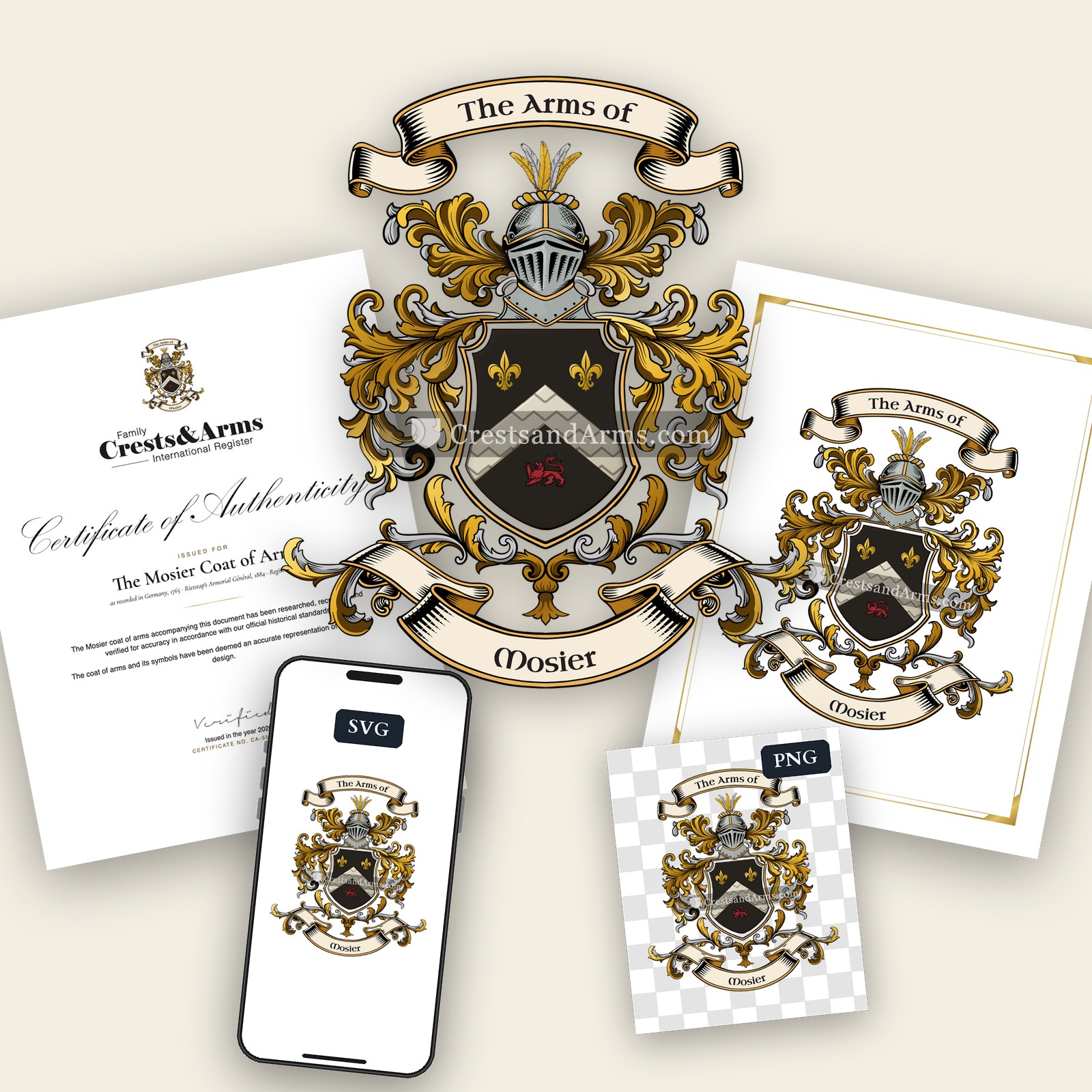
Symbols on this shield
chevronProtection, and faithful service completed
fleur de lisPurity, light, and the sixth son
lionCourage, strength and royalty
Colours
Black (Sable)Means: Constancy
Silver (Argent)Means: Peace and sincerity
Gold (Or)Means: Generosity
Red (Gules)Means: Military strength
Historical info
Source
J. B. Rietstap, Armorial Général, Gouda: G. B. van Goor Zonen, 1884–87
Blazon (the actual original written record)
“De sa. au chev. ployé d'arg., acc. en chef de deux fleurs-de-lis d'or et en p. d'un lion de gu. C.: un buste de femme, les cheveux épars, hab. d'un parti de sa. et d'arg.; entre deux prob., coupées d'arg. sur sa. L.: à dextre d'arg. et de sa., à sen. d'or et de sa.”
GermanySchwäbisch-Hall Wurt, c. 1765
Digital archive packCoat of arms PNG, gold border print PDF, vector SVG and the certificate of authenticity. Sent to your email in minutes.
Map of Germany showing where the Mosier arms are recorded
The Mosier arms were recorded in Schwäbisch-Hall Wurt, c. 1765.
This is where the arms were entered in the register. Families often moved to other parts of the country, so the same name can turn up in more than one region.
The body that granted and recorded arms in Germany in this period.
Francis I, Holy Roman Emperor
Sovereign of the period
Francis I, Holy Roman Emperor
1745–1765
Reigning in Germany when the Mosier arms are first recorded.
How Arms Worked in Germany
In the Holy Roman Empire, coats of arms were often granted to individuals by the Emperor or his representatives. These arms were then passed down through the generations to all legitimate descendants of the original holder. Younger branches of a family usually kept the same shield design without needing to change it, as the arms belonged to the entire lineage.
Granting authority
The Holy Roman Emperor held the sole power to grant new coats of arms throughout his vast imperial territories.
How they got arms
Families typically obtained their coats of arms through a formal imperial grant or by proving their noble status to the authorities.
Where arms were recorded
These grants were officially recorded in the Imperial Chancery registers, which began keeping formal records of such honors during the Middle Ages.
The family's standing
Recorded among the armigerous families of Germany.
Origin & History of the Mosier Family in Germany
The family name Mosier, often appearing in German records as Moser, finds its roots in the professional life of the Middle Ages. The name is an occupational surname derived from the Middle High German word *mos*, which referred to a marsh or a peat bog. It was originally used to identify someone who lived near such a landscape or worked as a harvester of peat. By the time the family was documented in the imperial city of Schwäbisch Hall in 1765, the name had become a well-established identifier for families living in the southwestern regions of Germany. During the eighteenth century, Schwäbisch Hall was a thriving center for salt production and trade, and families like the Mosers were often integrated into the local guild systems or agricultural communities that defined the Swabian region. This geographic history suggests that early ancestors were likely rooted in the rural or semi-urban life of the Holy Roman Empire, where their name served as a direct link to their ancestral connection with the local terrain.
Coat of Arms & Family Crest Details
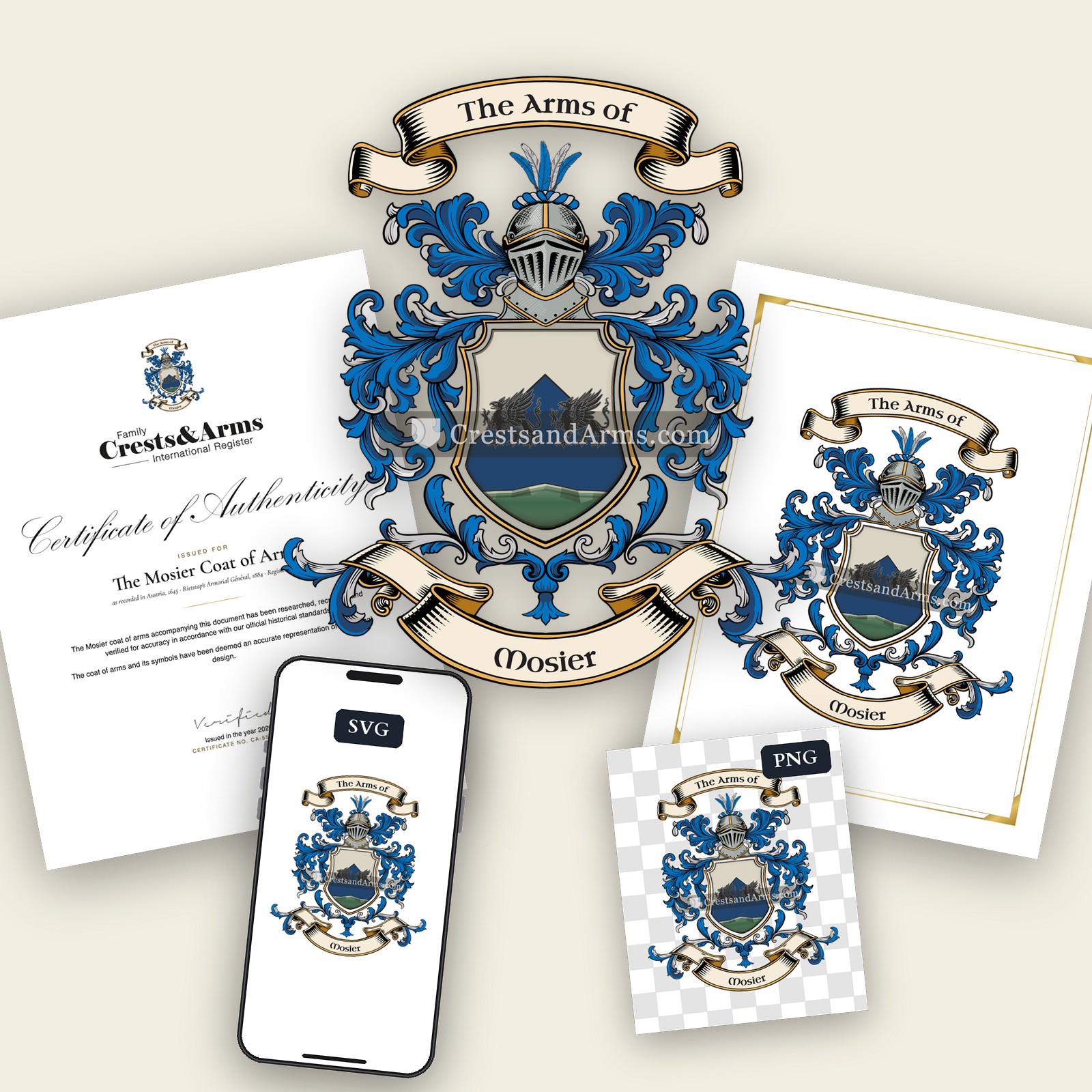
Symbols on this shield
mountThe ground held, and steadfastness upon it
griffinValour and vigilance, guarding great treasure
Colours
Silver (Argent)Means: Peace and sincerity
Blue (Azure)Means: Loyalty and truth
Green (Vert)Means: Hope
Historical info
Source
J. B. Rietstap, Armorial Général, Gouda: G. B. van Goor Zonen, 1884–87
Blazon (the actual original written record)
“D'arg. à une fleur tigée et feuillée, posée sur un tertre de sin.; le champ chapé-ployé d'azur, à deux griffons affr. de [?] C.: un griffon, tenant de sa patte dextre la fleur.”
CarinthiaCarinthia, c. 1645
Digital archive packCoat of arms PNG, gold border print PDF, vector SVG and the certificate of authenticity. Sent to your email in minutes.
Map of Austria showing where the Mosier arms are recorded
The Mosier arms were recorded in Carinthia, c. 1645.
Carinthia was Alpine country in southern Austria with iron and lead in its mountains. Mining and landholding both made money, and families who held either kind of property took arms.
This is where the arms were entered in the register. Families often moved to other parts of the country, so the same name can turn up in more than one region.
Region
Carinthia
First recorded
1645
Granting Authority for the Mosier Arms
Imperial and Royal chancery
Sodacan · CC BY-SA 3.0
The body that granted and recorded arms in Austria in this period.
Ferdinand III, Holy Roman Emperor
Sovereign of the period
Ferdinand III, Holy Roman Emperor
1637–1657
Reigning in Germany when the Mosier arms are first recorded.
How Arms Worked in Austria
Austrian coats of arms were often linked directly to noble titles granted by the Emperor. These symbols belonged to the entire family line rather than just one individual. When a family grew, new branches kept the original design without needing to change it. This system allowed all members of a noble house to share the same identity across many generations.
Granting authority
The Imperial and Royal chancery managed all heraldic matters and controlled the official granting of arms throughout the Austrian lands.
How they got arms
Families typically received their arms through a formal imperial decree that often accompanied the elevation of a person to noble status.
Where arms were recorded
Official records of these grants were kept in the Imperial Register of Nobility which began its formal documentation process in 1453.
The family's standing
Recorded among the armigerous families of Carinthia.
Origin & History of the Mosier Family in Austria
The family name Mosier traces its deep roots to the mountainous region of Carinthia, Austria, where records confirm the presence of family members as early as 1645. During the seventeenth century, this area was a rugged landscape defined by alpine agriculture and the influence of the Holy Roman Empire. The name likely developed as a topographical descriptor, identifying individuals who lived near a mossy area or a specific wetland terrain known in the local dialect as a *Moos*. As the family established itself in these high-altitude valleys, they were part of a resilient community that navigated the complex social and religious shifts of the post-Reformation era. Over generations, these early ancestors adapted to the harsh climate and the feudal structures of the Austrian provinces, gradually cementing their identity within the local parish records and regional land registries.
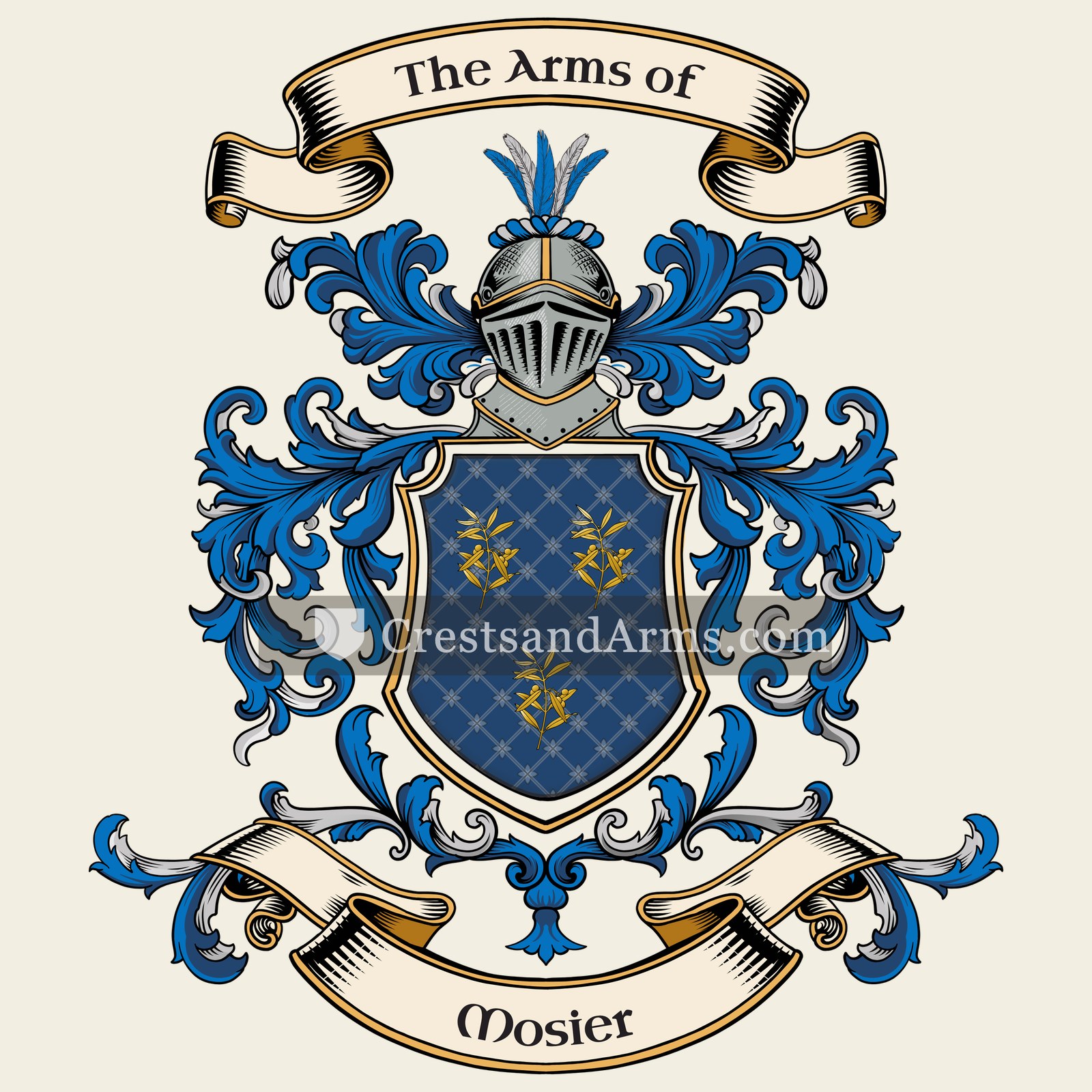
Coat of Arms & Family Crest Details
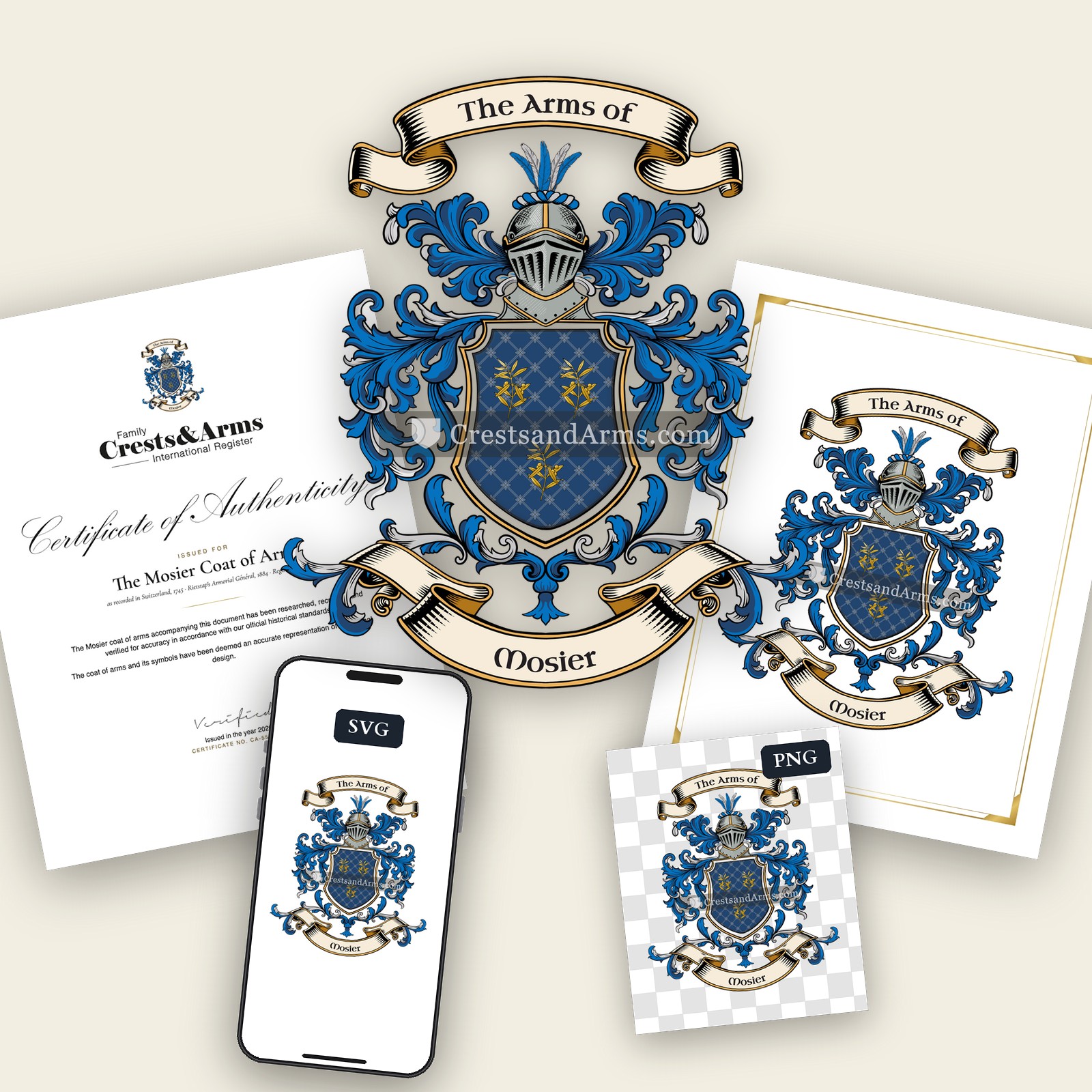
Symbols on this shield
branchPeace, and new growth
Colours
Blue (Azure)Means: Loyalty and truth
Gold (Or)Means: Generosity
Historical info
Source
J. B. Rietstap, Armorial Général, Gouda: G. B. van Goor Zonen, 1884–87
Blazon (the actual original written record)
“D'azur à trois roseaux”
SwitzerlandBaden Argovie, c. 1745
Digital archive packCoat of arms PNG, gold border print PDF, vector SVG and the certificate of authenticity. Sent to your email in minutes.
Map of Switzerland showing where the Mosier arms are recorded
The Mosier arms were recorded in Baden Argovie, c. 1745.
This is where the arms were entered in the register. Families often moved to other parts of the country, so the same name can turn up in more than one region.
The body that granted and recorded arms in Switzerland in this period.
How Arms Worked in Switzerland
In Switzerland, coats of arms were not restricted to the nobility and were often adopted by common citizens and families. These symbols were passed down through generations to show family identity. When branches of a family grew, they often changed small details of the design to distinguish their own line from the original group.
Granting authority
Cantonal and civic authorities managed the use of coats of arms within their specific regions and local jurisdictions.
How they got arms
Families typically assumed their own coats of arms based on local custom rather than receiving them from a central monarch.
Where arms were recorded
Arms were recorded in various cantonal and civic registers starting from the fourteenth century throughout the Swiss region.
The family's standing
Recorded among the armigerous families of Switzerland.
Origin & History of the Mosier Family in Switzerland
The family name Mosier, often appearing in historical records as Moser, finds its deep roots in the mountainous regions of Switzerland. The name is occupational in origin, derived from the Middle High German word *mos*, which referred to a peat bog or a marshy area. Early ancestors were likely people who lived near these wetlands or worked in the harvesting of peat for fuel. By the mid-18th century, members of the family had moved from their ancestral Swiss lands into the region of Baden, Germany. Records confirm that family members were firmly established in Baden by 1745, likely as part of the broader migration patterns of Swiss families seeking new agricultural opportunities during that era. These early generations were typically farmers or tradespeople who integrated into the local village life, leaving behind a legacy of resilience and steady movement across the borders of Central Europe.
Mosier Meaning & Related Branches
Root word
Moser
A person who lives near a swamp or marshland.
This name
MosierAn occupational surname for someone who worked or resided near a peat bog or marsh.
also spelled
Mosser
Mozer
Documented Sources
J. B. Rietstap, Armorial Général, Gouda: G. B. van Goor Zonen, 1884–87
Bahlow, Hans, Deutsches Namenlexikon: Familien- und Vornamen nach Ursprung und Sinn erklärt, 1967
Heintze, Albert, Die deutschen Familiennamen: geschichtlich, geographisch, sprachlich, 1903
Stadtarchiv Schwäbisch Hall, Bürgerbücher der Reichsstadt Schwäbisch Hall
Digital archive packCoat of arms PNG, gold border print PDF, vector SVG and the certificate of authenticity. Sent to your email in minutes.


 chevronProtection, and faithful service completed
 fleur de lisPurity, light, and the sixth son
 lionCourage, strength and royalty
 chevronProtection, and faithful service completed
 fleur de lisPurity, light, and the sixth son
 lionCourage, strength and royalty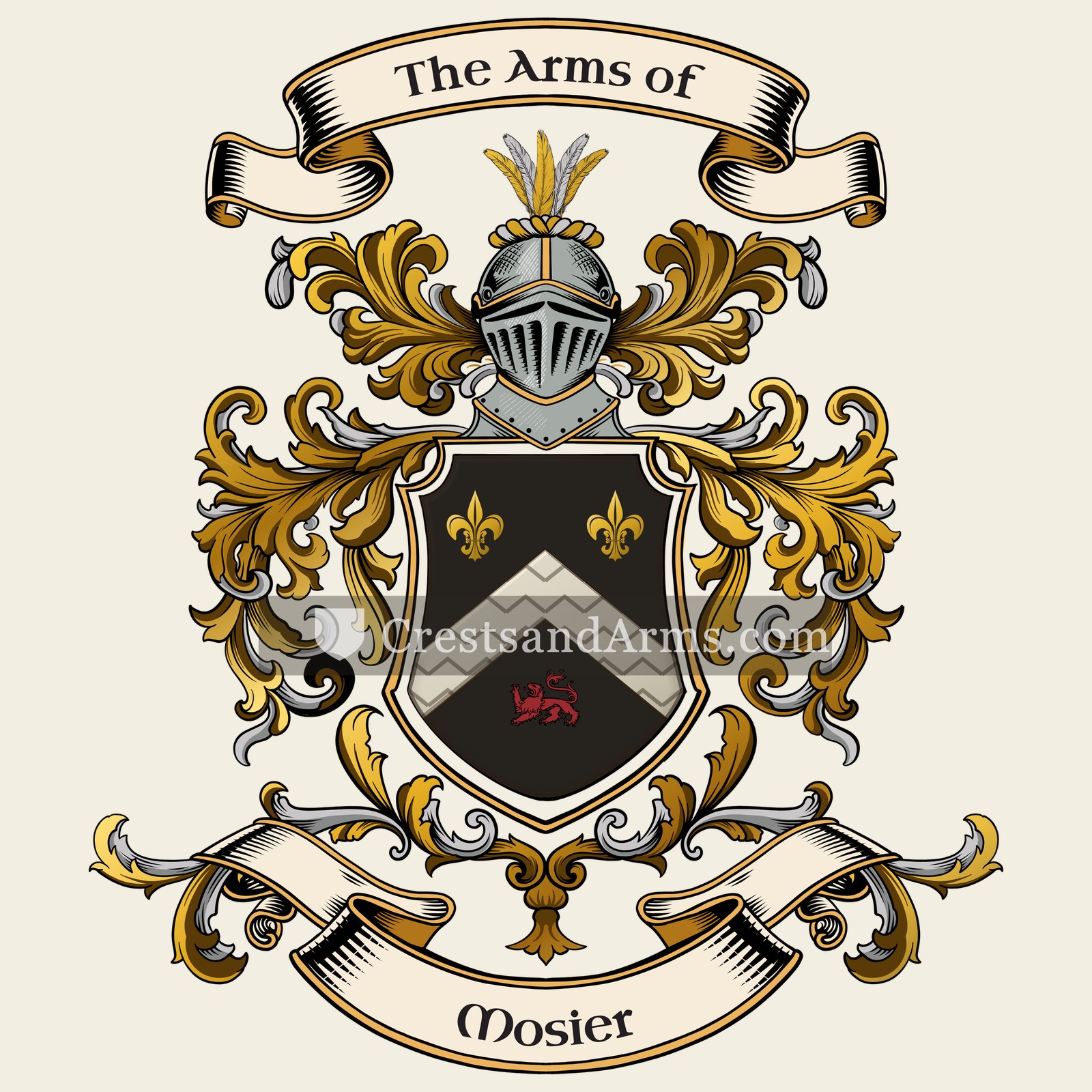


 mountThe ground held, and steadfastness upon it
 griffinValour and vigilance, guarding great treasure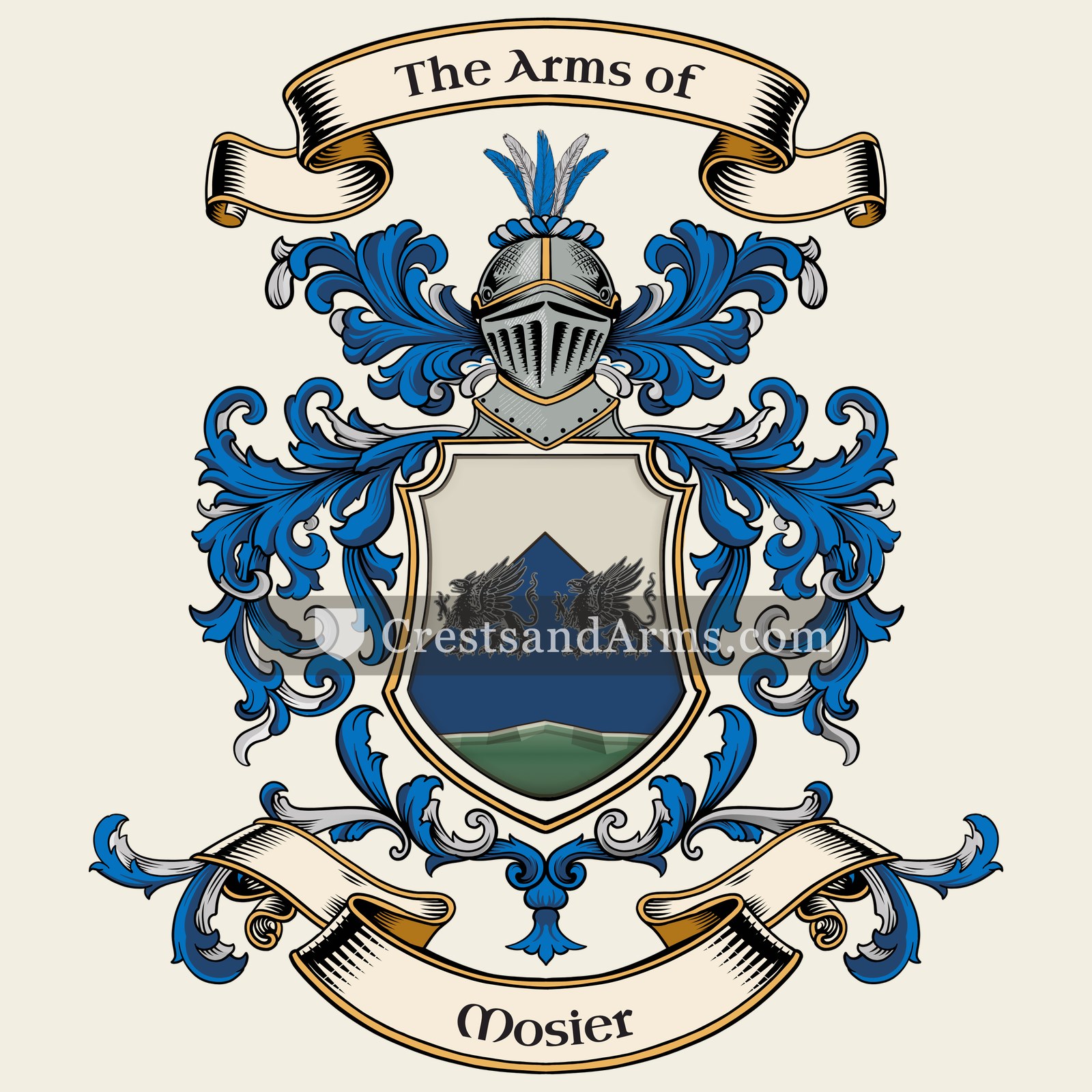


 branchPeace, and new growth