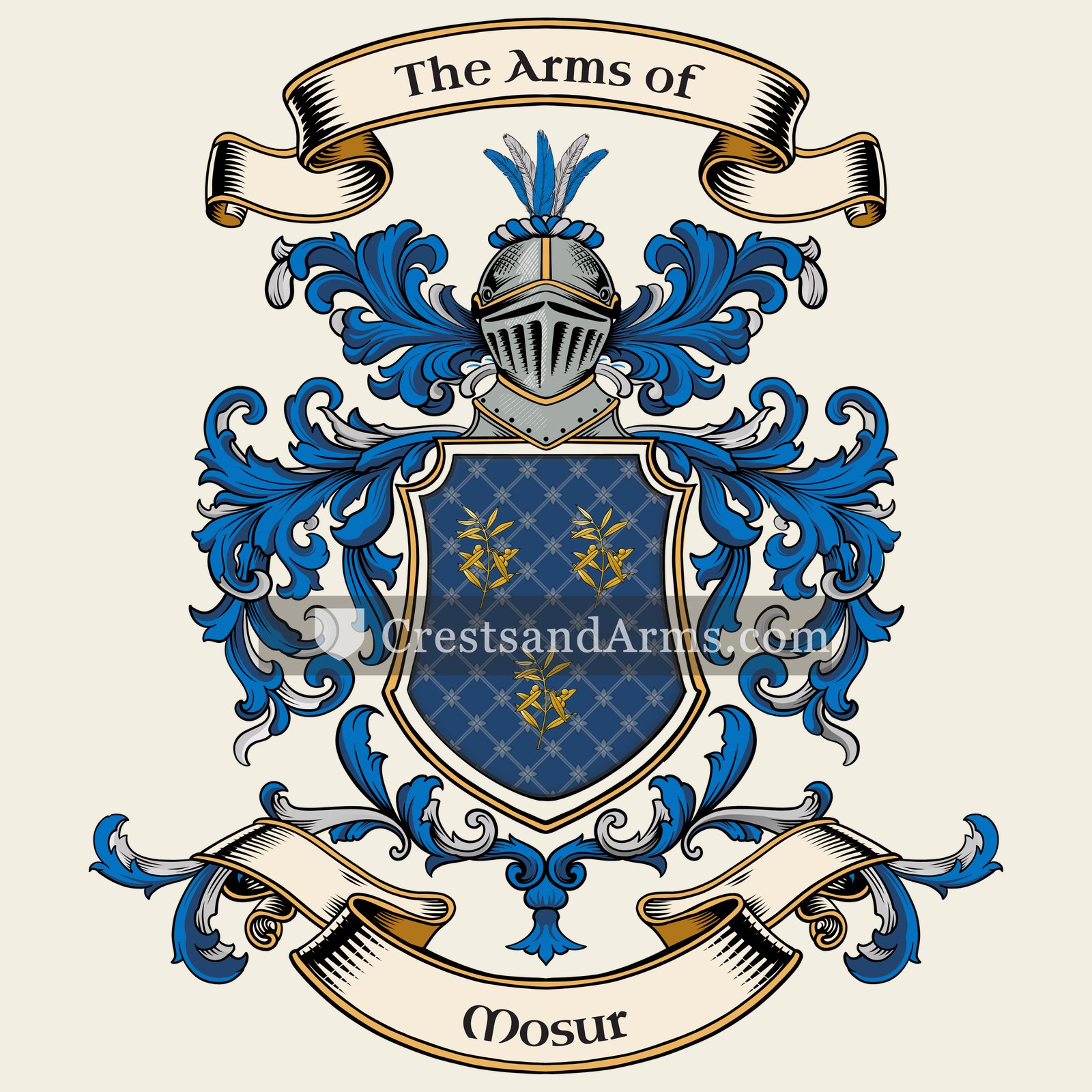
A record of documented arms, meaning and origin, researched for the Mosur family lines. Documented in 3 countries.
Reg. 2732 · German, M–O
Coat of Arms & Family Crest Details
Symbols on this shield
chevronProtection, and faithful service completed
fleur de lisPurity, light, and the sixth son
lionCourage, strength and royalty
Colours
Black (Sable)Means: Constancy
Silver (Argent)Means: Peace and sincerity
Gold (Or)Means: Generosity
Red (Gules)Means: Military strength
Historical info
Source
J. B. Rietstap, Armorial Général, Gouda: G. B. van Goor Zonen, 1884–87
Blazon (the actual original written record)
“De sa. au chev. ployé d'arg., acc. en chef de deux fleurs-de-lis d'or et en p. d'un lion de gu. C.: un buste de femme, les cheveux épars, hab. d'un parti de sa. et d'arg.; entre deux prob., coupées d'arg. sur sa. L.: à dextre d'arg. et de sa., à sen. d'or et de sa.”
GermanySchwäbisch-Hall Wurt, c. 1765
Digital archive packCoat of arms PNG, gold border print PDF, vector SVG and the certificate of authenticity. Sent to your email in minutes.
Map of Germany showing where the Mosur arms are recorded
The Mosur arms were recorded in Schwäbisch-Hall Wurt, c. 1765.
This is where the arms were entered in the register. Families often moved to other parts of the country, so the same name can turn up in more than one region.
The body that granted and recorded arms in Germany in this period.
Francis I, Holy Roman Emperor
Sovereign of the period
Francis I, Holy Roman Emperor
1745–1765
Reigning in Germany when the Mosur arms are first recorded.
How Arms Worked in Germany
In the Holy Roman Empire, coats of arms were often granted to individuals by the Emperor or his representatives. These arms were then passed down through the generations to all legitimate descendants of the original holder. Younger branches of a family usually kept the same shield design without needing to change it, as the arms belonged to the entire lineage.
Granting authority
The Holy Roman Emperor held the sole power to grant new coats of arms throughout his vast imperial territories.
How they got arms
Families typically obtained their coats of arms through a formal imperial grant or by proving their noble status to the authorities.
Where arms were recorded
These grants were officially recorded in the Imperial Chancery registers, which began keeping formal records of such honors during the Middle Ages.
The family's standing
Recorded among the armigerous families of Germany.
Origin & History of the Mosur Family in Germany
The history of the Mosur family in Germany is deeply rooted in the historic salt-producing city of Schwäbisch Hall. By the year 1765, members of the family were already established residents within this influential town, which was then a Free Imperial City of the Holy Roman Empire. During the eighteenth century, Schwäbisch Hall was a center of trade and craftsmanship, and families living there were often connected to the guilds or the local administration that managed the salt works. The name Mosur likely evolved as a regional variation, reflecting the way surnames were often shaped by local dialects and the specific linguistic patterns of the Swabian region. As the family navigated life in this bustling urban center, they participated in the social and economic rhythms of a society defined by its strict civic organization and long-standing traditions. Their presence in the city records during this period suggests they were part of the stable middle class that helped maintain the prosperity of the region before the major political shifts of the nineteenth century.
Coat of Arms & Family Crest Details
Symbols on this shield
mountThe ground held, and steadfastness upon it
griffinValour and vigilance, guarding great treasure
Colours
Silver (Argent)Means: Peace and sincerity
Blue (Azure)Means: Loyalty and truth
Green (Vert)Means: Hope
Historical info
Source
J. B. Rietstap, Armorial Général, Gouda: G. B. van Goor Zonen, 1884–87
Blazon (the actual original written record)
“D'arg. à une fleur tigée et feuillée, posée sur un tertre de sin.; le champ chapé-ployé d'azur, à deux griffons affr. de [?] C.: un griffon, tenant de sa patte dextre la fleur.”
CarinthiaCarinthia, c. 1645
Digital archive packCoat of arms PNG, gold border print PDF, vector SVG and the certificate of authenticity. Sent to your email in minutes.
Map of Austria showing where the Mosur arms are recorded
The Mosur arms were recorded in Carinthia, c. 1645.
Carinthia was Alpine country in southern Austria with iron and lead in its mountains. Mining and landholding both made money, and families who held either kind of property took arms.
This is where the arms were entered in the register. Families often moved to other parts of the country, so the same name can turn up in more than one region.
Region
Carinthia
First recorded
1645
Granting Authority for the Mosur Arms
Imperial and Royal chancery
Sodacan · CC BY-SA 3.0
The body that granted and recorded arms in Austria in this period.
Ferdinand III, Holy Roman Emperor
Sovereign of the period
Ferdinand III, Holy Roman Emperor
1637–1657
Reigning in Germany when the Mosur arms are first recorded.
How Arms Worked in Austria
Austrian coats of arms were often linked directly to noble titles granted by the Emperor. These symbols belonged to the entire family line rather than just one individual. When a family grew, new branches kept the original design without needing to change it. This system allowed all members of a noble house to share the same identity across many generations.
Granting authority
The Imperial and Royal chancery managed all heraldic matters and controlled the official granting of arms throughout the Austrian lands.
How they got arms
Families typically received their arms through a formal imperial decree that often accompanied the elevation of a person to noble status.
Where arms were recorded
Official records of these grants were kept in the Imperial Register of Nobility which began its formal documentation process in 1453.
The family's standing
Recorded among the armigerous families of Carinthia.
Origin & History of the Mosur Family in Austria
The history of the Mosur family in Austria is deeply rooted in the mountainous region of Carinthia, where records confirm their presence as early as 1645. During the seventeenth century, Carinthia was a landscape defined by strict social structures and the influence of the Holy Roman Empire. Families like the Mosurs often lived in rural or semi-rural communities where they were tied to the land through agricultural labor or local trade. Given the geography of the southern Austrian Alps, the name likely emerged as a way to identify individuals based on their specific village or the distinct terrain they occupied. Life in 1645 was shaped by the aftermath of the Thirty Years' War, which brought significant economic hardship and population shifts across the region. Despite these turbulent times, the Mosur family maintained a stable presence in Carinthia, suggesting they were well-integrated into the local parish systems that tracked births, marriages, and deaths. These early ancestors were part of the backbone of the region, contributing to the development of the local economy and the preservation of Carinthian traditions over several generations.
Coat of Arms & Family Crest Details
Symbols on this shield
branchPeace, and new growth
Colours
Blue (Azure)Means: Loyalty and truth
Gold (Or)Means: Generosity
Historical info
Source
J. B. Rietstap, Armorial Général, Gouda: G. B. van Goor Zonen, 1884–87
Blazon (the actual original written record)
“D'azur à trois roseaux”
SwitzerlandBaden Argovie, c. 1745
Digital archive packCoat of arms PNG, gold border print PDF, vector SVG and the certificate of authenticity. Sent to your email in minutes.
Map of Switzerland showing where the Mosur arms are recorded
The Mosur arms were recorded in Baden Argovie, c. 1745.
This is where the arms were entered in the register. Families often moved to other parts of the country, so the same name can turn up in more than one region.
The body that granted and recorded arms in Switzerland in this period.
How Arms Worked in Switzerland
In Switzerland, coats of arms were not restricted to the nobility and were often adopted by common citizens and families. These symbols were passed down through generations to show family identity. When branches of a family grew, they often changed small details of the design to distinguish their own line from the original group.
Granting authority
Cantonal and civic authorities managed the use of coats of arms within their specific regions and local jurisdictions.
How they got arms
Families typically assumed their own coats of arms based on local custom rather than receiving them from a central monarch.
Where arms were recorded
Arms were recorded in various cantonal and civic registers starting from the fourteenth century throughout the Swiss region.
The family's standing
Recorded among the armigerous families of Switzerland.
Origin & History of the Mosur Family in Switzerland
The history of the Mosur family in Switzerland is rooted in the rural landscapes of the Canton of Aargau, with documented evidence placing family members in the district of Baden by 1745. During the mid-eighteenth century, this region was a center of agricultural activity and small-scale trade, where families often identified themselves through their local parish and land holdings. The name likely evolved from regional dialects spoken in the Swiss Plateau, reflecting the way families were recorded by local clerks in church registers. Life in Baden during this period was shaped by the transition from traditional feudal structures to more settled village communities. As the family established themselves in the area, they became part of the social fabric that defined Swiss life before the industrial changes of the nineteenth century. By maintaining a consistent presence in the region, the Mosur family contributed to the long-standing demographic history of the Baden district.
Related Branches & Arms
Root word
Moser
A person who lives near a peat bog or marshland.
This name
MosurA topographic surname referring to someone residing in or near a swampy area.
also spelled
Mosser
Mozer
Documented Sources
J. B. Rietstap, Armorial Général, Gouda: G. B. van Goor Zonen, 1884–87
Haller, Max. Geschichte der Stadt Schwäbisch Hall. 1925
Krieger, Karl-Friedrich. Geschichte von Baden-Württemberg: Von den Anfängen bis zur Gegenwart. 2004
Stadtarchiv Schwäbisch Hall, Bürgerbücher und Einwohnerverzeichnisse
Digital archive packCoat of arms PNG, gold border print PDF, vector SVG and the certificate of authenticity. Sent to your email in minutes.


 chevronProtection, and faithful service completed
 fleur de lisPurity, light, and the sixth son
 lionCourage, strength and royalty
 chevronProtection, and faithful service completed
 fleur de lisPurity, light, and the sixth son
 lionCourage, strength and royalty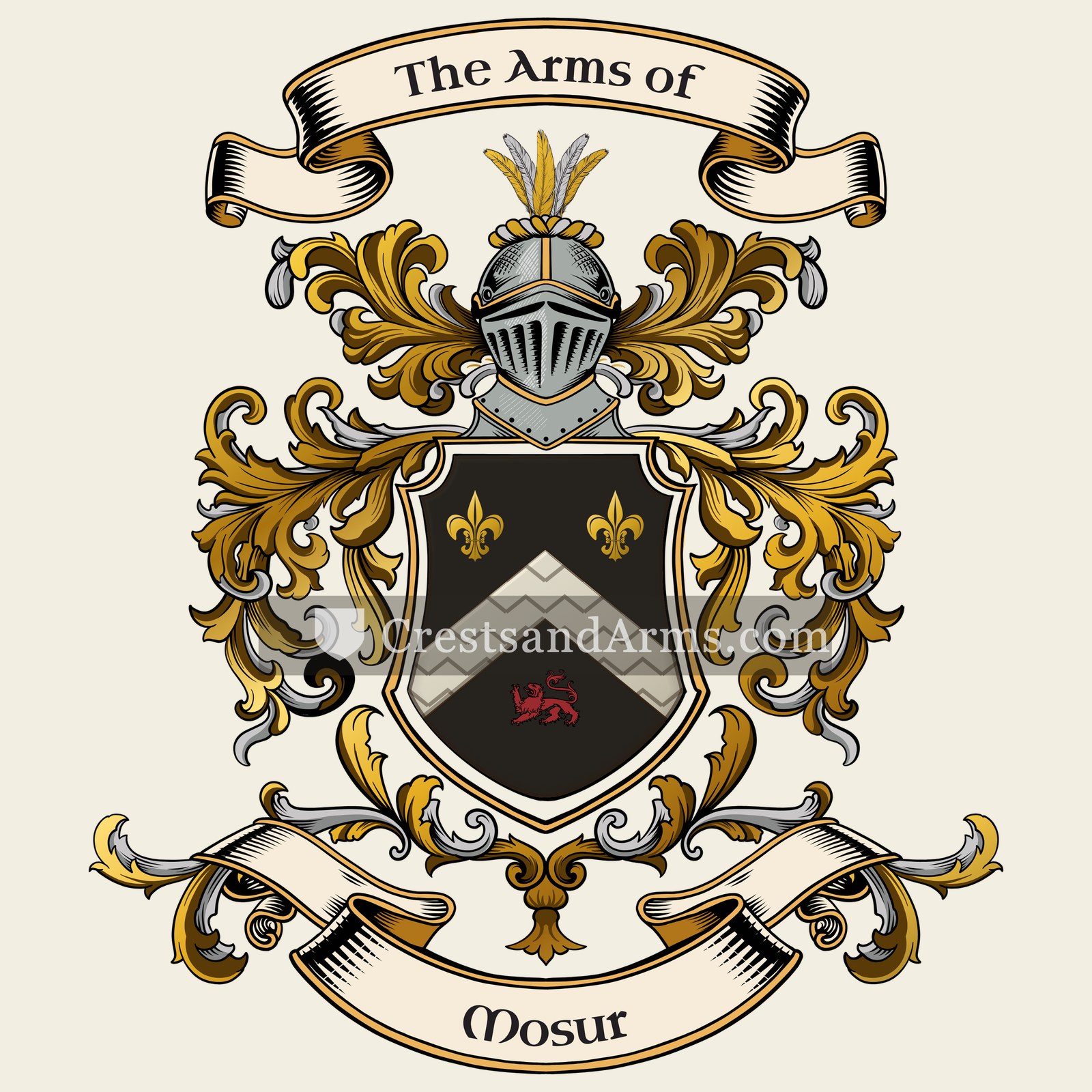


 mountThe ground held, and steadfastness upon it
 griffinValour and vigilance, guarding great treasure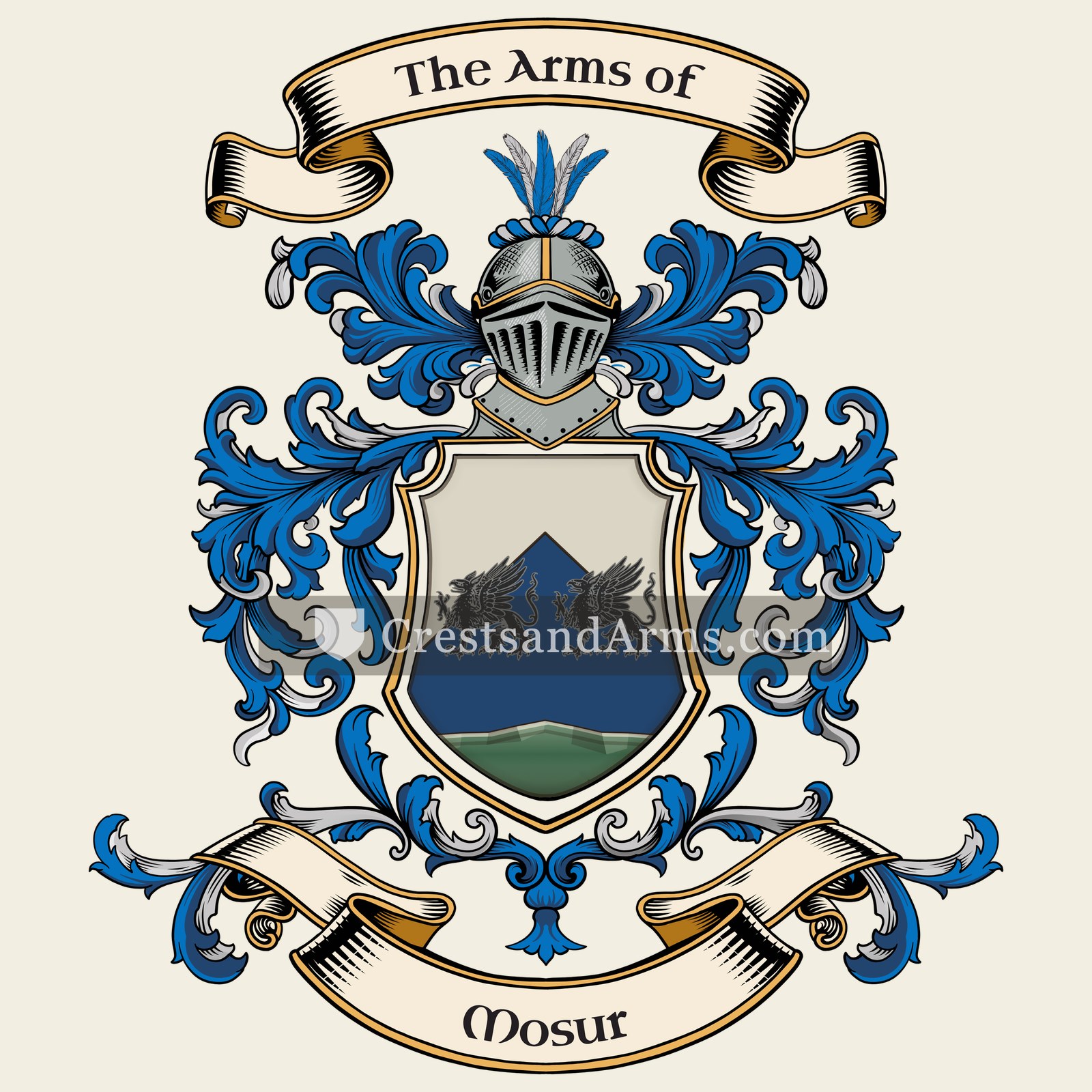


 branchPeace, and new growth