Map of Switzerland showing where the Moux arms are recorded
The Moux arms were recorded in Valais, c. 1745.
This is where the arms were entered in the register. Families often moved to other parts of the country, so the same name can turn up in more than one region.
The body that granted and recorded arms in Switzerland in this period.
How Arms Worked in Switzerland
In Switzerland, coats of arms were not restricted to the nobility and were often adopted by common citizens and families. These symbols were passed down through generations to show family identity. When branches of a family grew, they often changed small details of the design to distinguish their own line from the original group.
Granting authority
Cantonal and civic authorities managed the use of coats of arms within their specific regions and local jurisdictions.
How they got arms
Families typically assumed their own coats of arms based on local custom rather than receiving them from a central monarch.
Where arms were recorded
Arms were recorded in various cantonal and civic registers starting from the fourteenth century throughout the Swiss region.
The family's standing
Recorded among the armigerous families of Switzerland.
Origin & History of the Moux Family in Switzerland
The Moux family name has deep roots in the rugged landscape of the Valais region in Switzerland. By the year 1745, records confirm that members of the family were already established residents in this alpine area. During the eighteenth century, families in Valais often lived in small, tight-knit mountain communities where they relied on agriculture and livestock to survive. The name likely developed as a way to identify specific households or individuals based on their local surroundings or their family lineage within these isolated valleys. As the family grew, they became part of the long history of Swiss mountain dwellers who maintained strong ties to their local parishes and village traditions. This early presence in the region suggests that the Moux family was well-integrated into the social and economic life of the Valais during a period of significant regional development.
Moux Meaning & Related Branches
Root word
Moul
Derived from the Old French word for a mill or miller.
This name
MouxAn occupational surname referring to a person who operated or lived near a mill.
also spelled
Mouxie
Mouxi
Mooxy
Documented Sources
J. B. Rietstap, Armorial Général, Gouda: G. B. van Goor Zonen, 1884–87
Archives: Archives de l'État du Valais, Registres paroissiaux (Baptêmes, mariages et sépultures)
Book: Anton Riva, Dictionnaire historique et géographique du canton du Valais, 1904
Digital archive packCoat of arms PNG, gold border print PDF, vector SVG and the certificate of authenticity. Sent to your email in minutes.


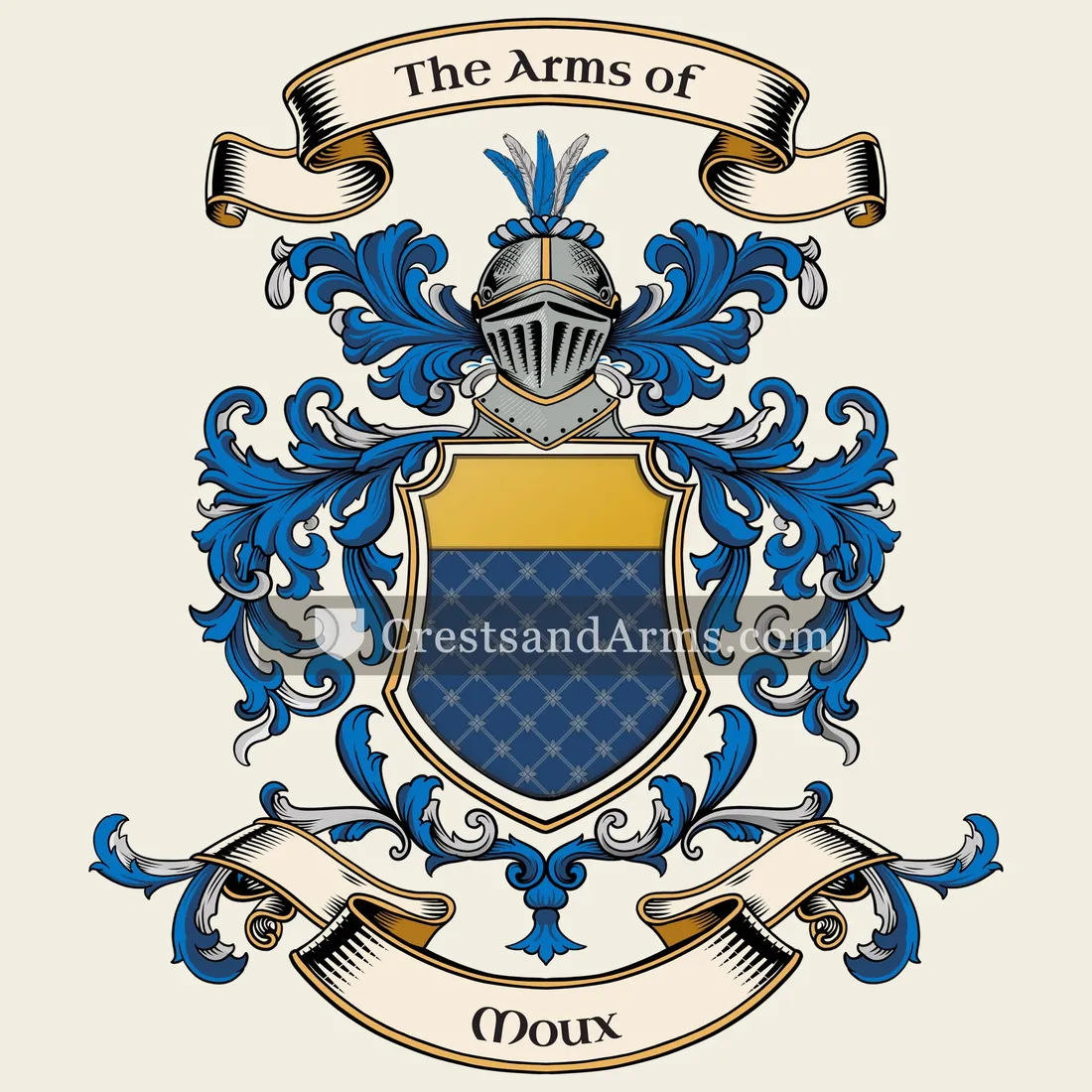
 chiefAuthority, wisdom and dominion
 chiefAuthority, wisdom and dominion