A record of documented arms, meaning and origin, researched for the Muench family lines. Documented in 3 countries.
Reg. 0781 · French, M–O
Meaning of the Muench family crest colors & symbols
Symbols on this shield
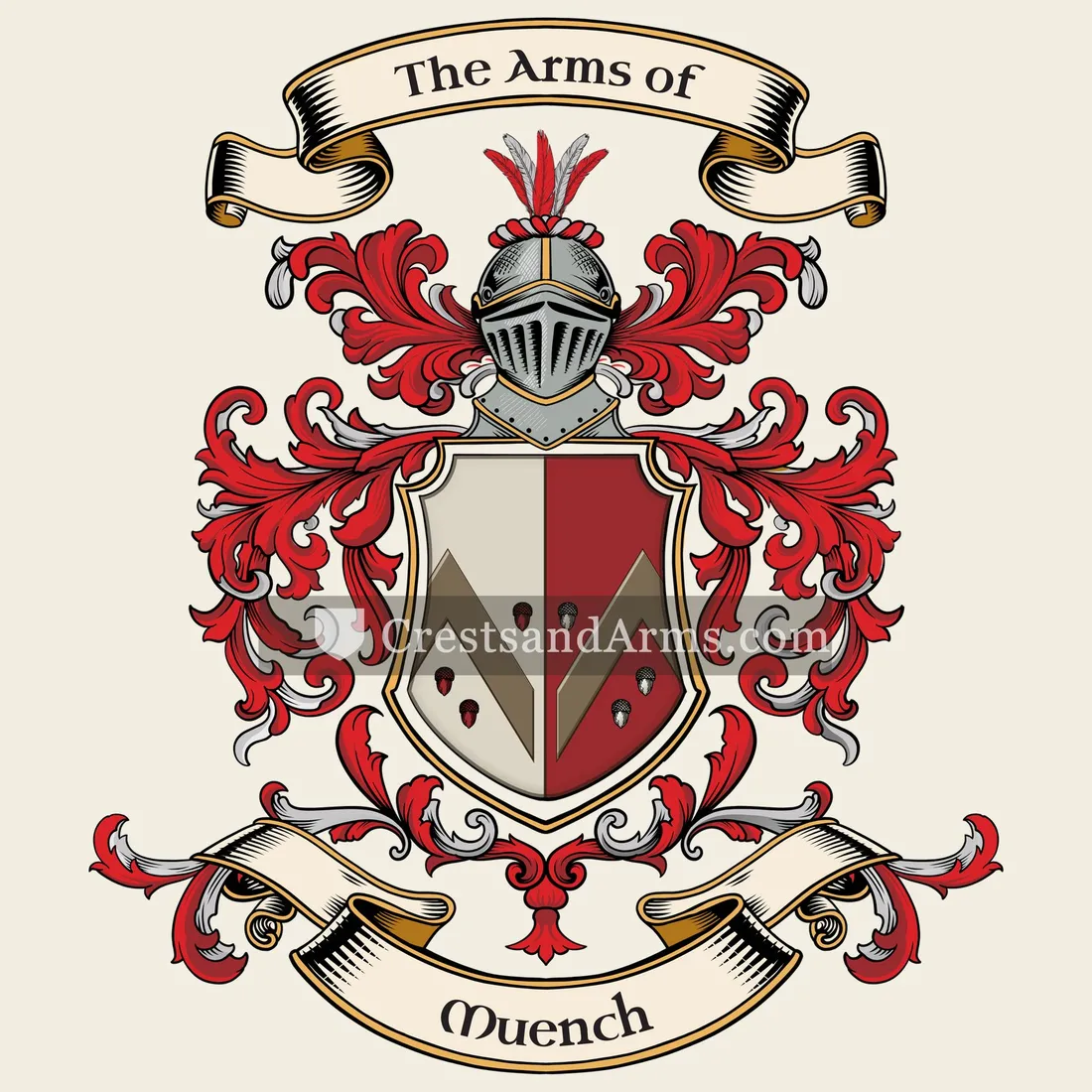
chevronProtection, and faithful service completed
acornAntiquity and strength from small beginnings
Colours
Silver (Argent)Means: Peace and sincerity
Red (Gules)Means: Military strength
Historical info
Source
J. B. Rietstap, Armorial Général, Gouda: G. B. van Goor Zonen, 1884–87
Blazon (the actual original written record)
“Parti d'arg. et de gu.; au chev. de l'un en l'autre, ch. de trois glands effeuillés au nat., les queues en bas. C.: un buste de vieillard, hab. de sa. à la croix ancrée d'arg., la tête bandée d'un tortil d'arg. et de gu.; le tout entre un vol, l'aile dextre de gu. ch. d'une barre d'arg. surch. de trois glands effeuillés au nat., les queues en bas, posés dans le sens de la barre; l'aile sen. d'arg. ch. une bande gu. surch. de trois glands effeuillés au nat., les queues en bas, posés dans le sens de la bande.”
Francec. 1580
Digital archive packCoat of arms PNG, gold border print PDF, vector SVG and the certificate of authenticity. Sent to your email in minutes.
Map of France showing where the Muench arms are recorded
The Muench arms were recorded in France, c. 1580.
Arms such as these were typically recorded in Bretagne.
More families held coats of arms in Bretagne than anywhere else in France. The land was divided into many small estates rather than a few large ones, so far more households counted as gentry, and each needed a shield of its own to be told apart.
This is where the arms were entered in the register. Families often moved to other parts of the country, so the same name can turn up in more than one region.
The body that granted and recorded arms in France in this period.
Henry III of France
Sovereign of the period
Henry III of France
1574–1589
Reigning in France when the Muench arms are first recorded.
How Arms Worked in France
In France, a coat of arms was a mark of honor that passed down through the male line to all legitimate descendants. Families often used the same shield without changes to show their shared heritage. If a branch wanted to stand out, they could add a small mark to their shield to show their specific place in the family tree.
Granting authority
The Juge d'armes de France acted as the official authority that regulated and verified coats of arms across the country.
How they got arms
Families typically inherited their arms from ancestors, though they could also receive them through royal grants or by proving their noble status.
Where arms were recorded
Coats of arms were officially recorded in the Armorial Général de France, which began its main collection in the year 1696.
The family's standing
Recorded among the armigerous families of France.
Origin & History of the Muench Family in France
The family name Muench has deep roots that connect to the complex cultural landscape of France, particularly within the region of Bretagne. By the year 1580, records confirm that members of the family were already established in this area, which was a time of significant transition for the French kingdom. While the name itself often carries linguistic ties to Germanic origins, its presence in western France suggests a history of migration and integration into local communities. Families like the Muenchs during this era were often involved in the agricultural or artisanal life of their provinces, helping to shape the social fabric of the towns where they settled. Their ability to maintain a distinct identity while living in the unique environment of Bretagne highlights the resilience and adaptability of the family line during the late Renaissance period.
Meaning of the Muench family crest colors & symbols
Symbols on this shield
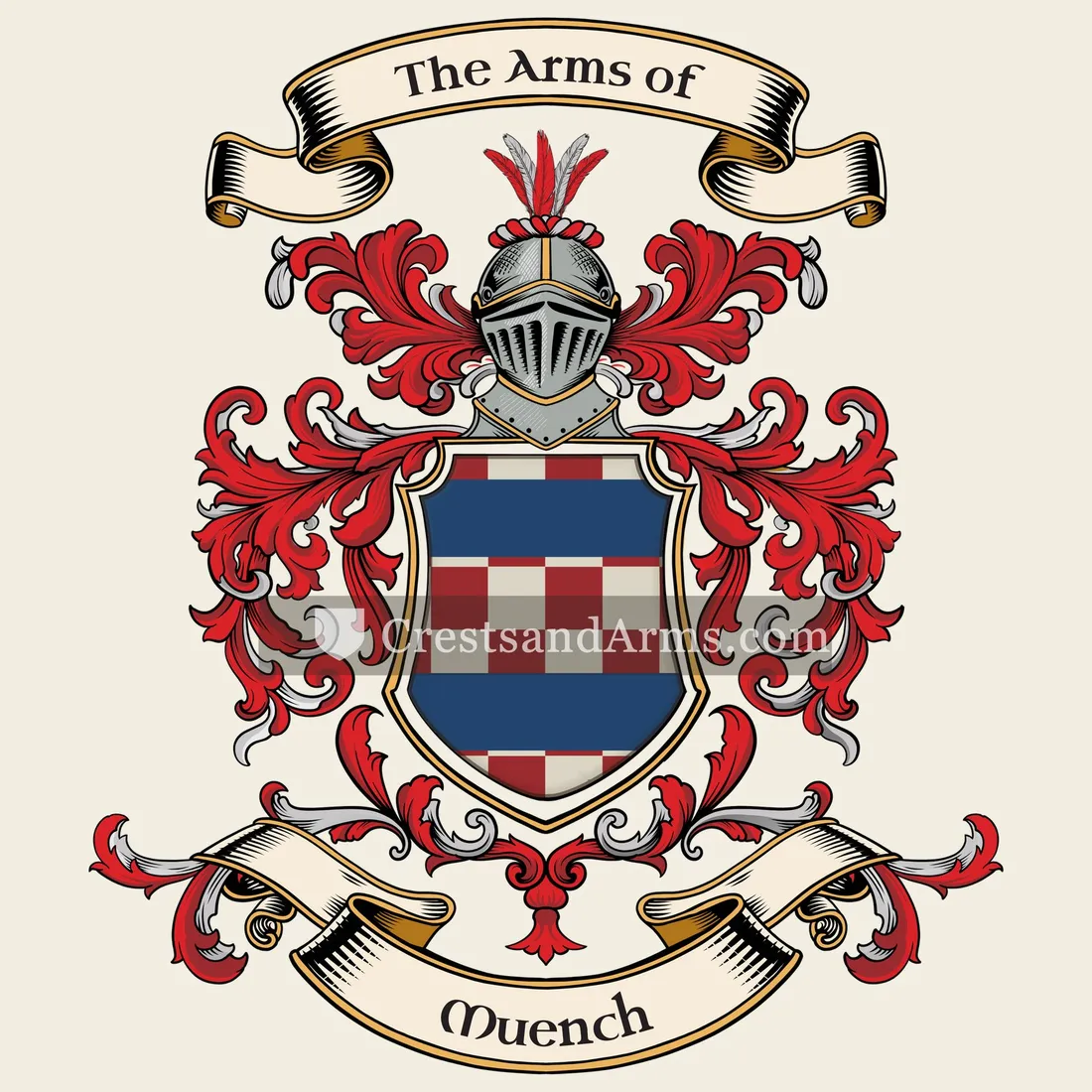
chequyConstancy, and the counting-board
fessThe military belt, and readiness to serve
Colours
Red (Gules)Means: Military strength
Blue (Azure)Means: Loyalty and truth
Silver (Argent)Means: Peace and sincerity
Historical info
Source
J. B. Rietstap, Armorial Général, Gouda: G. B. van Goor Zonen, 1884–87
Blazon (the actual original written record)
“Echiq. de gu. et d'arg.; à deux fasces d'azur, br. sur l'échiqueté. C.: deux cornes de buffle d'arg., ch. chacune d'une fasce échiq. de gu. et d'arg. de trois tires. L.: à dextre d'arg. et d'azur, à sen. d'arg. et de gu.”
SaxonySaxony, c. 1765
Digital archive packCoat of arms PNG, gold border print PDF, vector SVG and the certificate of authenticity. Sent to your email in minutes.
Map of Germany showing where the Muench arms are recorded
The Muench arms were recorded in Saxony, c. 1765.
Saxony had mines, trade and old landed families all at once. Silver made some fortunes and land held others, and both sorts of family kept arms, which is why Saxon names appear so often in the registers.
This is where the arms were entered in the register. Families often moved to other parts of the country, so the same name can turn up in more than one region.
The body that granted and recorded arms in Germany in this period.
Francis I, Holy Roman Emperor
Sovereign of the period
Francis I, Holy Roman Emperor
1745–1765
Reigning in France when the Muench arms are first recorded.
How Arms Worked in Germany
In the Holy Roman Empire, coats of arms were often granted to individuals by the Emperor or his representatives. These arms were then passed down through the generations to all legitimate descendants of the original holder. Younger branches of a family usually kept the same shield design without needing to change it, as the arms belonged to the entire lineage.
Granting authority
The Holy Roman Emperor held the sole power to grant new coats of arms throughout his vast imperial territories.
How they got arms
Families typically obtained their coats of arms through a formal imperial grant or by proving their noble status to the authorities.
Where arms were recorded
These grants were officially recorded in the Imperial Chancery registers, which began keeping formal records of such honors during the Middle Ages.
The family's standing
Recorded among the armigerous families of Saxony.
Origin & History of the Muench Family in Germany
The surname Muench originates from the Middle High German word "münch," which translates to monk. During the Middle Ages, this name was often given as a nickname to someone who lived near a monastery, worked for one, or perhaps displayed a personality or appearance similar to a monk. By the time the family was firmly established in the region of Saxony in 1765, the name had become a permanent hereditary surname passed down through generations. In the social structure of 18th-century Germany, families in Saxony were often tied to the land or specific local trades, and the name Muench likely identified these ancestors as members of a stable, settled community. As the family grew, they became part of the long history of German migration and local development, carrying a name that reflects the deep influence of religious institutions on everyday life in the medieval and early modern periods.
Meaning of the Muench family crest colors & symbols
Colours
Silver (Argent)Means: Peace and sincerity
Historical info
Source
J. B. Rietstap, Armorial Général, Gouda: G. B. van Goor Zonen, 1884–87
Blazon (the actual original written record)
“D'arg. à un moine, posé de profil, hab. au nat., la tête découverte, les mains jointes levées, chaussé de souliers de gu. C.: le moine, iss.”
SwitzerlandBâle, c. 1745
Digital archive packCoat of arms PNG, gold border print PDF, vector SVG and the certificate of authenticity. Sent to your email in minutes.
Map of Switzerland showing where the Muench arms are recorded
The Muench arms were recorded in Bâle, c. 1745.
This is where the arms were entered in the register. Families often moved to other parts of the country, so the same name can turn up in more than one region.
The body that granted and recorded arms in Switzerland in this period.
How Arms Worked in Switzerland
In Switzerland, coats of arms were not restricted to the nobility and were often adopted by common citizens and families. These symbols were passed down through generations to show family identity. When branches of a family grew, they often changed small details of the design to distinguish their own line from the original group.
Granting authority
Cantonal and civic authorities managed the use of coats of arms within their specific regions and local jurisdictions.
How they got arms
Families typically assumed their own coats of arms based on local custom rather than receiving them from a central monarch.
Where arms were recorded
Arms were recorded in various cantonal and civic registers starting from the fourteenth century throughout the Swiss region.
The family's standing
Recorded among the armigerous families of Switzerland.
Origin & History of the Muench Family in Switzerland
The surname Muench has deep roots in the German-speaking regions of Switzerland, where it functioned as a descriptive name for individuals who lived near or worked within a monastery. By the mid-eighteenth century, the family had established a notable presence in the city of Basel. Records confirm that members of the Muench family were active residents of this urban center by 1745. During this era, Basel was a thriving hub of trade and intellectual exchange, and families like the Muenchs often integrated into the local guilds or merchant networks that defined the city’s social structure. As the family settled into the region, they became part of the long-standing tradition of Swiss citizenship, which emphasized local community ties and professional contributions to the city state. Their presence in Basel during this period reflects the broader movement of families who sought stability and opportunity in the heart of the Swiss Confederation.
Muench Meaning & Related Branches
Root word
Monachus
A Latin term referring to a solitary person or monk.
This name
MuenchAn occupational surname for someone who lived near a monastery or served as a monk.
also spelled
Muench
Munk
Documented Sources
J. B. Rietstap, Armorial Général, Gouda: G. B. van Goor Zonen, 1884–87
Archives départementales d'Ille-et-Vilaine, Série B (Cours et juridictions)
Dupuy, Pascal, Histoire de la Bretagne, 2005
Le Moyne de La Borderie, Arthur, Histoire de Bretagne, 1896
Digital archive packCoat of arms PNG, gold border print PDF, vector SVG and the certificate of authenticity. Sent to your email in minutes.


 chevronProtection, and faithful service completed
 acornAntiquity and strength from small beginnings
 chevronProtection, and faithful service completed
 acornAntiquity and strength from small beginnings


 chequyConstancy, and the counting-board
 fessThe military belt, and readiness to serve