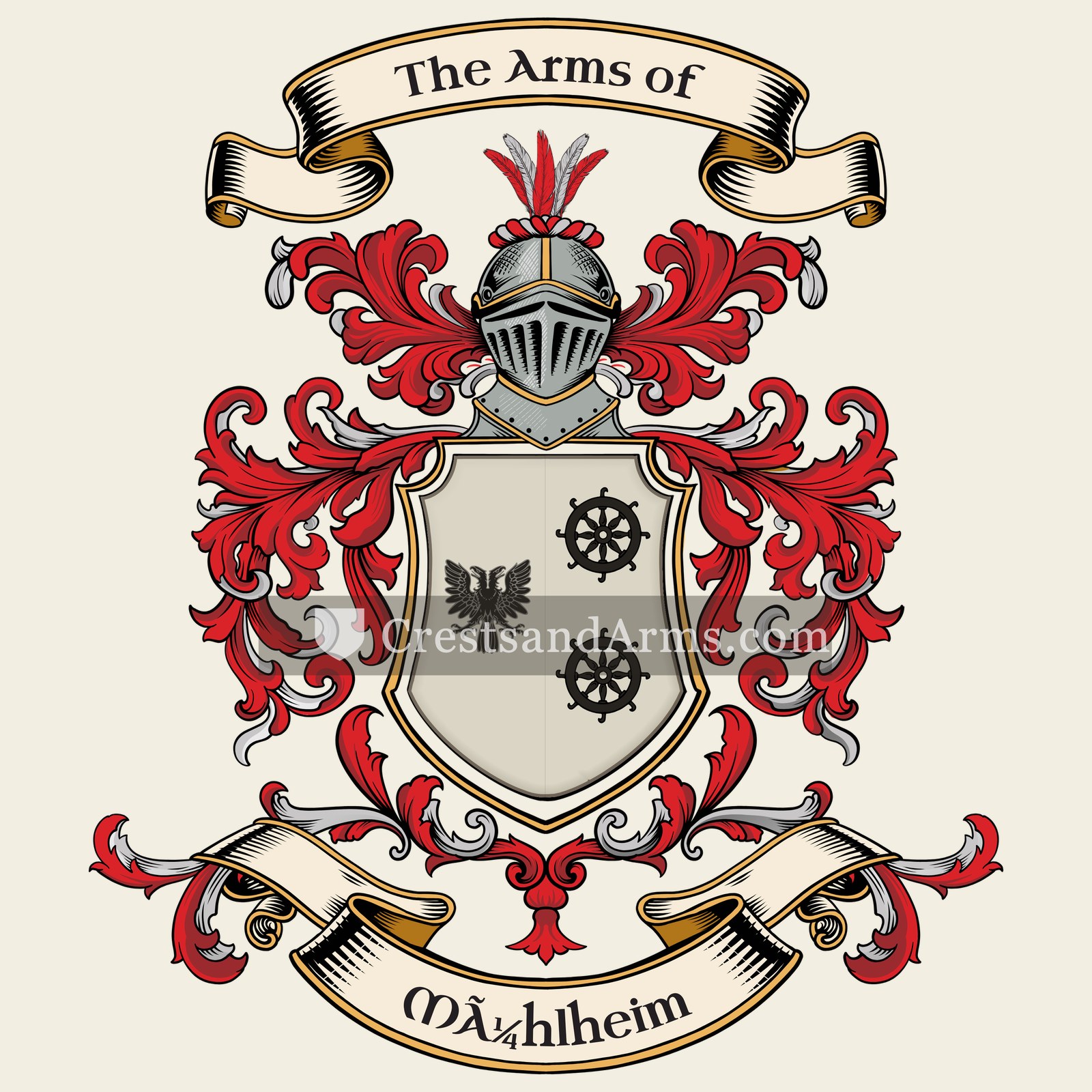
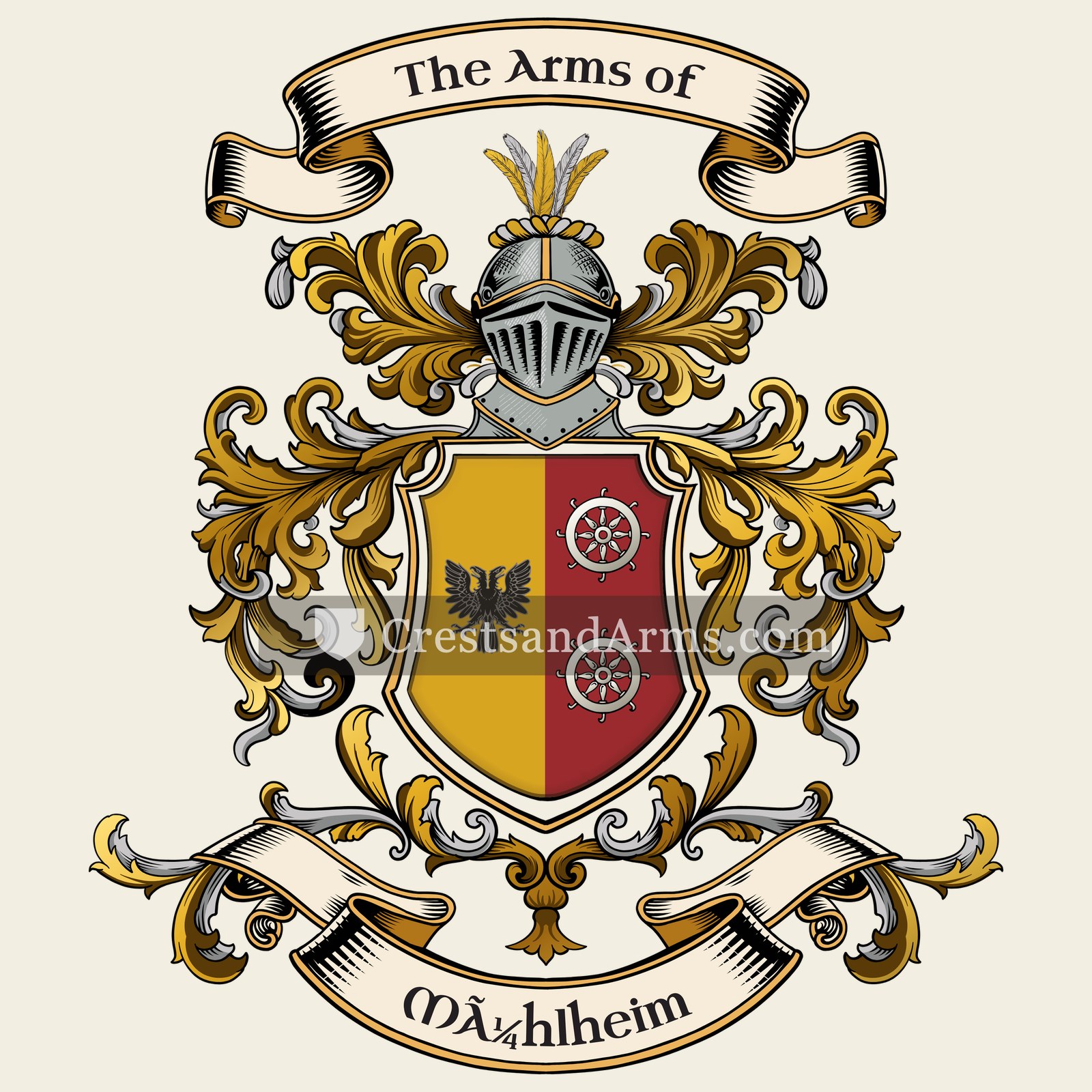
A record of documented arms, meaning and origin, researched for the Mühlheim family lines. Documented in 2 countries.
Reg. 2256 · Danish, M–O
Coat of Arms & Family Crest Details
Symbols on this shield
eagleNobility, strength and a keen mind
wheelFortune's turning, and the carter's trade
Colours
Silver (Argent)Means: Peace and sincerity
Black (Sable)Means: Constancy
Historical info
Source
J. B. Rietstap, Armorial Général, Gouda: G. B. van Goor Zonen, 1884–87
Blazon (the actual original written record)
“Parti: au 1 d'arg. à la demi-aigle de sa., bq. et m. d'or, mouv. du parti; au 2 d'arg. à deux roues de moulin de sa., l'une sur l'autre. C.: une roue de moulin de sa., sommée de cinq plumes de paon au nat.”
Denmarkc. 1722
Digital archive packCoat of arms PNG, gold border print PDF, vector SVG and the certificate of authenticity. Sent to your email in minutes.
Map of Denmark showing where the Mühlheim arms are recorded
The Mühlheim arms were recorded in Denmark, c. 1722.
Arms such as these were typically recorded in Sjaælland.
Zealand held the Danish court, the crown's offices and Copenhagen itself. Families who served the king kept estates within reach of it, and royal service was the ordinary route to a coat of arms.
This is where the arms were entered in the register. Families often moved to other parts of the country, so the same name can turn up in more than one region.
The body that granted and recorded arms in Denmark in this period.
Frederik IV of Denmark
Sovereign of the period
Frederik IV of Denmark
1699–1730
Reigning in Denmark when the Mühlheim arms are first recorded.
How Arms Worked in Denmark
Danish heraldry during this period was closely tied to noble status and royal favor rather than being open to all citizens. Arms were typically granted by the monarch to individuals, and these symbols were then shared by all members of the noble house. If a family line died out, the right to use those specific arms ended with them.
Granting authority
The Danish royal chancery held the power to issue and regulate official coats of arms for the kingdom.
How they got arms
Families usually received their arms through a formal royal grant that confirmed their noble status and rights.
Where arms were recorded
These grants were officially recorded in the Danish Royal Chancery records starting in the sixteenth century.
The family's standing
Recorded among the armigerous families of Denmark.
Origin & History of the Mühlheim Family in Denmark
The family name Mühlheim first appears in the historical records of Denmark during the early eighteenth century, specifically within the region of Sjælland in 1722. The name itself is of German origin, meaning "mill home," which suggests that the earliest ancestors were likely associated with the milling trade or lived near a prominent watermill. During this period, Denmark saw a steady influx of skilled workers and craftsmen from German-speaking lands who were often recruited to support the growing agricultural and industrial needs of the Danish crown. By settling in Sjælland, the Mühlheim family integrated into a society that was rapidly modernizing its local economy. These early settlers were part of a broader movement of families who moved across borders to seek new opportunities in the Danish countryside and urban centers. Their presence in the 1722 records marks the beginning of a multi-generational history that saw the family transition from newcomers to established members of the local community.
Coat of Arms & Family Crest Details
Symbols on this shield
eagleNobility, strength and a keen mind
wheelFortune's turning, and the carter's trade
Colours
Gold (Or)Means: Generosity
Red (Gules)Means: Military strength
Black (Sable)Means: Constancy
Silver (Argent)Means: Peace and sincerity
Historical info
Source
J. B. Rietstap, Armorial Général, Gouda: G. B. van Goor Zonen, 1884–87
Blazon (the actual original written record)
“Parti: au 1 d'or à la demi-aigle de sa., mouv. du parti; au 2 de gu. à deux roues de moulin d'arg., l'une sur l'autre. C.: une roue de moulin d'arg., les augettes ornées de plumes de coq de sa. (la branche d'Aut. portait en cimier un vol coupé, à dextre d'or sur sa., à sen. de gu. sur arg.) L.: à dextre d'or et de sa., à sen. d'arg. et de gu.”
SilesiaSilesia, c. 1765
Digital archive packCoat of arms PNG, gold border print PDF, vector SVG and the certificate of authenticity. Sent to your email in minutes.
Map of Germany showing where the Mühlheim arms are recorded
The Mühlheim arms were recorded in Silesia, c. 1765.
Silesia was farming country in the east of the German lands, held in large estates by families who stayed put for generations. Owning land was what entitled a family to arms, so the region fills a good deal of the register.
This is where the arms were entered in the register. Families often moved to other parts of the country, so the same name can turn up in more than one region.
The body that granted and recorded arms in Germany in this period.
Francis I, Holy Roman Emperor
Sovereign of the period
Francis I, Holy Roman Emperor
1745–1765
Reigning in Denmark when the Mühlheim arms are first recorded.
How Arms Worked in Germany
In the Holy Roman Empire, coats of arms were often granted to individuals by the Emperor or his representatives. These arms were then passed down through the generations to all legitimate descendants of the original holder. Younger branches of a family usually kept the same shield design without needing to change it, as the arms belonged to the entire lineage.
Granting authority
The Holy Roman Emperor held the sole power to grant new coats of arms throughout his vast imperial territories.
How they got arms
Families typically obtained their coats of arms through a formal imperial grant or by proving their noble status to the authorities.
Where arms were recorded
These grants were officially recorded in the Imperial Chancery registers, which began keeping formal records of such honors during the Middle Ages.
The family's standing
Recorded among the armigerous families of Silesia.
Origin & History of the Mühlheim Family in Germany
The surname Mühlheim is a topographical name, meaning it was originally derived from the physical landscape where a family lived. In German, the name combines the words *Mühle*, meaning mill, and *Heim*, meaning home or settlement. This suggests that the earliest ancestors to carry this name likely resided near a watermill or a windmill, which were vital centers of community life in medieval Germany. By 1765, records confirm that members of the family were well-established in the region of Silesia. During this period, Silesia was a diverse and shifting territory under the control of the Prussian crown. Families living there often moved between rural farming communities and growing trade towns, where the presence of a mill was essential for processing grain. Because the name describes a specific location, it likely emerged independently in several different German-speaking regions before becoming a permanent family identifier for those living in the Silesian provinces.
Mühlheim Meaning & Related Branches
Root word
Mühle and Heim
Mill and home or settlement.
This name
MühlheimA habitational name referring to a settlement located near a mill.
also spelled
Muhlheym
Muelhime
Meelhime
Mulheim
Documented Sources
J. B. Rietstap, Armorial Général, Gouda: G. B. van Goor Zonen, 1884–87
Rigsarkivet, Kirkebøger for Sjællands Stift (Parish registers for the Diocese of Sjælland)
Rigsarkivet, Folketællinger og lægdsruller (Census records and conscription rolls)
Jensen, J. V., De tyske indvandrere i Danmark (1988)
Nielsen, O., Kjøbenhavns historie og beskrivelse (1877)
Digital archive packCoat of arms PNG, gold border print PDF, vector SVG and the certificate of authenticity. Sent to your email in minutes.


 eagleNobility, strength and a keen mind
 wheelFortune's turning, and the carter's trade
 eagleNobility, strength and a keen mind
 wheelFortune's turning, and the carter's trade