Map of France showing where the Muncy arms are recorded
The Muncy arms were recorded in Alsace, c. 1773.
Alsace lay between France and the German lands and belonged to both at different times. Its families held small estates and served whichever side ruled, and men who served in arms carried arms of their own.
This is where the arms were entered in the register. Families often moved to other parts of the country, so the same name can turn up in more than one region.
The body that granted and recorded arms in France in this period.
Louis XV of France
Sovereign of the period
Louis XV of France
1715–1774
Reigning in France when the Muncy arms are first recorded.
How Arms Worked in France
In France, a coat of arms was a mark of honor that passed down through the male line to all legitimate descendants. Families often used the same shield without changes to show their shared heritage. If a branch wanted to stand out, they could add a small mark to their shield to show their specific place in the family tree.
Granting authority
The Juge d'armes de France acted as the official authority that regulated and verified coats of arms across the country.
How they got arms
Families typically inherited their arms from ancestors, though they could also receive them through royal grants or by proving their noble status.
Where arms were recorded
Coats of arms were officially recorded in the Armorial Général de France, which began its main collection in the year 1696.
The family's standing
Recorded among the armigerous families of Alsace.
Origin & History of the Muncy Family in France
The family name Muncy is deeply connected to the historical region of Alsace, a territory located in eastern France that has long served as a crossroads for European cultures. By 1773, family members were well-established in this area, living through a period when Alsace was transitioning between French and Germanic cultural influences. The name likely evolved from local place names or descriptive terms common to the Rhine Valley, reflecting the mobile nature of families living in this borderland. During the late 18th century, families in Alsace often navigated complex social changes as the region became more integrated into the French administrative system. These ancestors were part of a resilient community that maintained its traditions while adapting to the shifting political landscape of the era. Their presence in the region during this time highlights a history of endurance and adaptation in one of Europe’s most historically significant provinces.
Meaning of the Muncy family crest colors & symbols
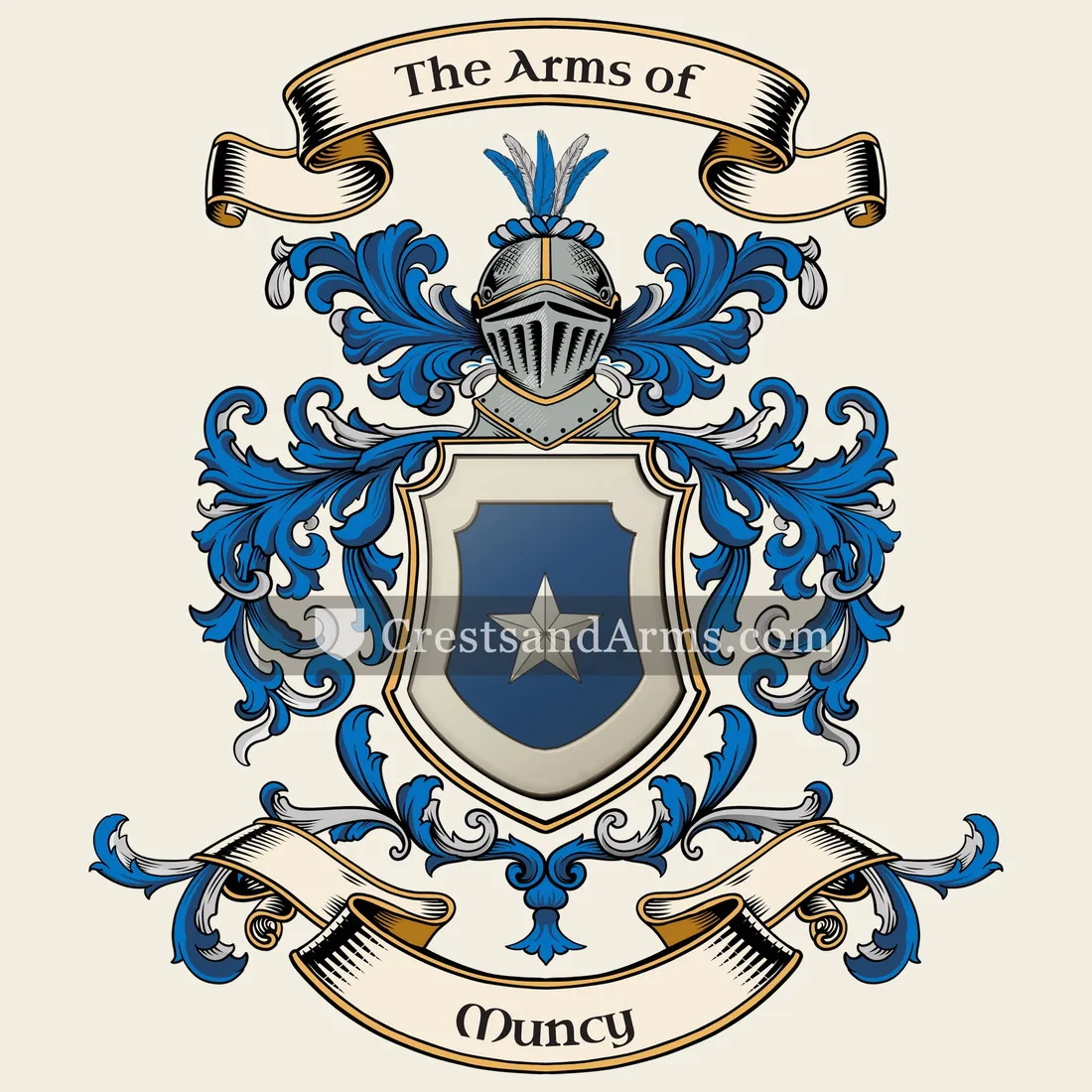
Symbols on this shield
mulletThe third son, and a divine quality from above
Colours
Blue (Azure)Means: Loyalty and truth
Silver (Argent)Means: Peace and sincerity
Historical info
Source
J. B. Rietstap, Armorial Général, Gouda: G. B. van Goor Zonen, 1884–87
Blazon (the actual original written record)
“D'azur à un moine iss., hab. de blanc, coiffé de son capuchon du même qui supporte une étoile d'arg.; l'écu bordé d'arg. Deux cq. cour. C.: 1° le chiffre III d'or, dans un G du même, sommé d'une couronne royale d'or; adextré d'un drapeau d'azur semé de couronnes à l'antique d'or, bordé d'arg., et senestré d'une bannière d'arg. ch. d'un écusson d'azur timbré d'une couronne royale d'or; 2° les meubles de l'écu.”
Swedenc. 1778
Digital archive packCoat of arms PNG, gold border print PDF, vector SVG and the certificate of authenticity. Sent to your email in minutes.
Map of Sweden showing where the Muncy arms are recorded
The Muncy arms were recorded in Sweden, c. 1778.
Arms such as these were typically recorded in Stockholm.
Stockholm held the Swedish court and the House of Nobility, where every noble family's arms were entered and kept. Families ennobled for service registered there, which is why so many are recorded around the city.
This is where the arms were entered in the register. Families often moved to other parts of the country, so the same name can turn up in more than one region.
The body that granted and recorded arms in Sweden in this period.
Gustav III of Sweden
Sovereign of the period
Gustav III of Sweden
1771–1792
Reigning in France when the Muncy arms are first recorded.
How Arms Worked in Sweden
In Sweden, a coat of arms belonged to a noble family as a whole rather than just one individual. These arms were passed down through the generations to all legitimate descendants. Younger branches of the family used the same shield without needing to change it. This system ensured that the entire lineage shared the same identity and status under the law.
Granting authority
The Riddarhuset, or House of Nobility, regulated all noble coats of arms in Sweden under royal authority.
How they got arms
Families received their coats of arms through royal grants of nobility which were then officially registered with the House.
Where arms were recorded
Coats of arms were officially recorded in the Swedish House of Nobility register starting in the year 1626.
The family's standing
Recorded among the armigerous families of Sweden.
Origin & History of the Muncy Family in Sweden
The history of the Muncy name in Sweden is deeply connected to the urban development of Stockholm during the late eighteenth century. By 1778, records indicate that members of the family were already established residents within the city, a time when Stockholm was evolving into a major center for trade and administration. During this period, families with names like Muncy often integrated into the growing professional classes, working as skilled craftsmen or merchants who helped support the city's expanding economy. Because Sweden maintained meticulous parish registers and census records during the 1700s, the presence of the family in the capital suggests they were part of the documented social fabric of the Swedish Enlightenment. Their residence in Stockholm at this time places them at the heart of a rapidly changing society that was beginning to modernize its legal and social structures.
Muncy Meaning & Related Branches
Root word
Monciacum
A Gallo-Roman estate belonging to a person named Moncius.
This name
MuncyA habitational surname derived from a specific French locality or village of the same name.
also spelled
Munk
Documented Sources
J. B. Rietstap, Armorial Général, Gouda: G. B. van Goor Zonen, 1884–87
Archives départementales du Bas-Rhin, État civil et registres paroissiaux
Livet, Georges, L'Alsace et les Alsaciens, 1982
Vogler, Bernard, Histoire de l'Alsace, 2009
Digital archive packCoat of arms PNG, gold border print PDF, vector SVG and the certificate of authenticity. Sent to your email in minutes.


 roseThe seventh son, and beauty with grace
 roseThe seventh son, and beauty with grace
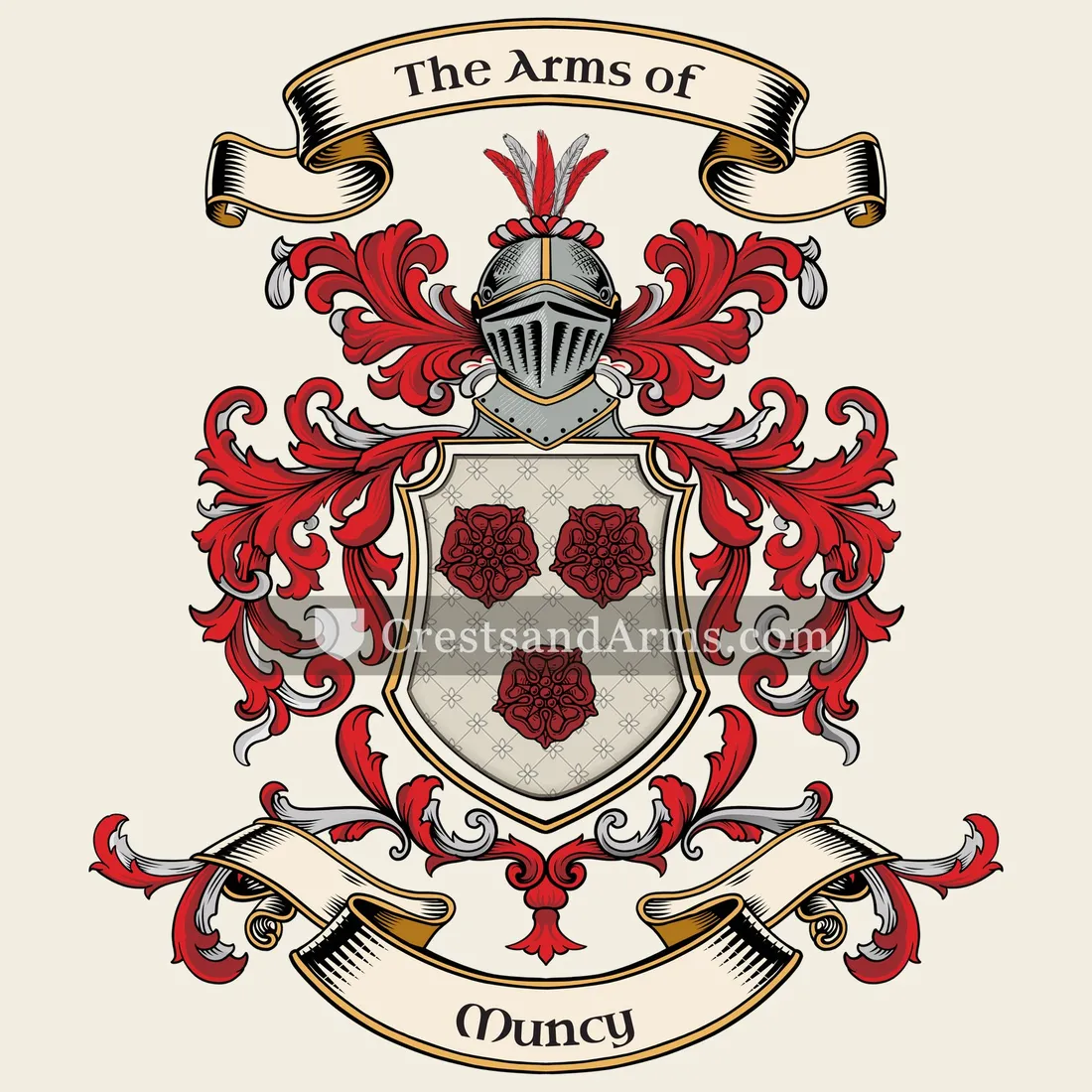


 mulletThe third son, and a divine quality from above