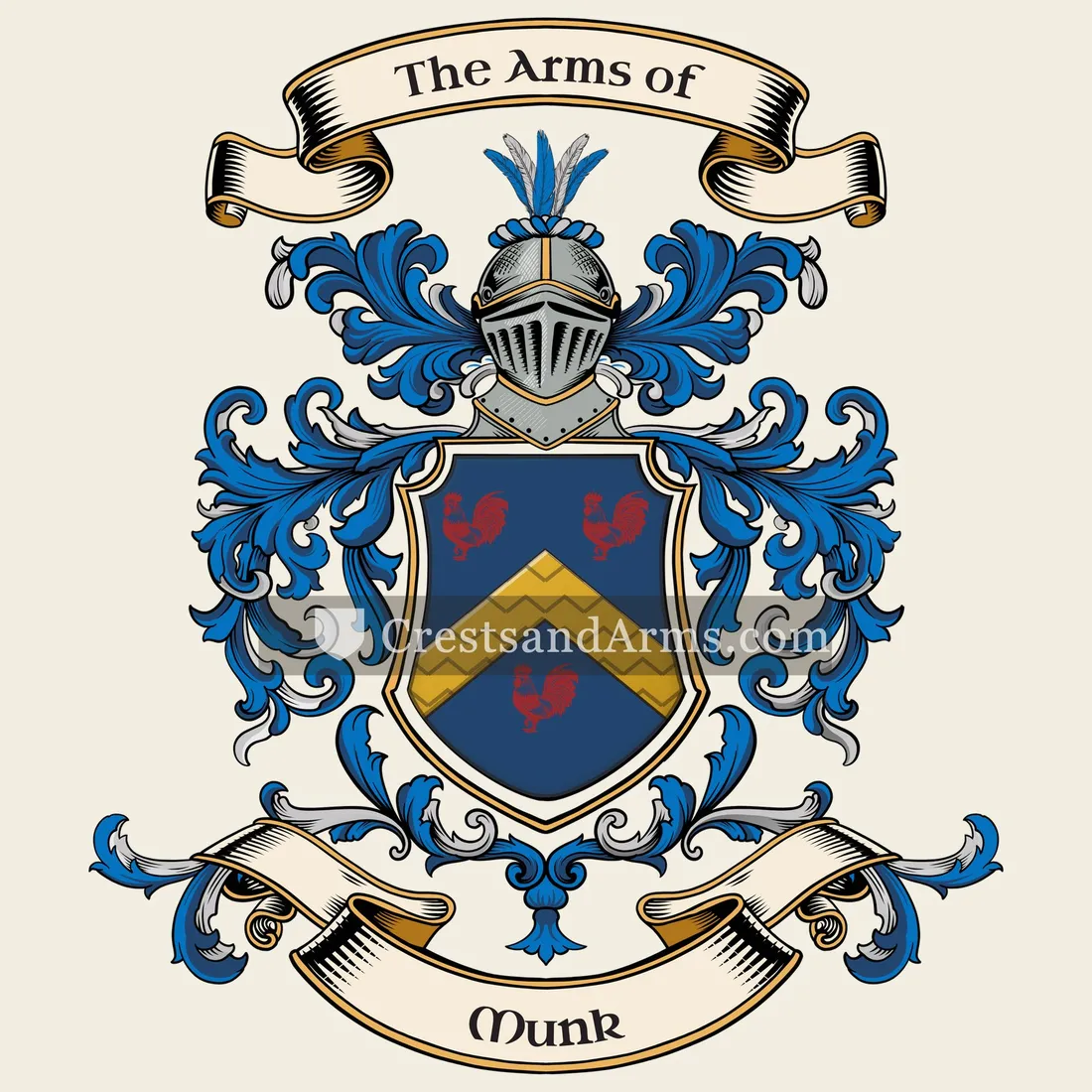
A record of documented arms, meaning and origin, researched for the Munk family of Denmark.
Reg. 5174 · Danish, M–O
Meaning of the Munk family crest colors & symbols
Symbols on this shield
chevronProtection, and faithful service completed
cockCourage, vigilance and readiness for battle
Colours
Blue (Azure)Means: Loyalty and truth
Gold (Or)Means: Generosity
Red (Gules)Means: Military strength
Historical info
Source
J. B. Rietstap, Armorial Général, Gouda: G. B. van Goor Zonen, 1884–87
Blazon (the actual original written record)
“D'azur au chev. d'or, acc. de trois coqs de gu., les deux du chef affr. et celui en p. cont. C.: un coq de gu.; entre deux prob., coupées alt. d'or et de gu.”
Denmarkc. 1581
Digital archive packCoat of arms PNG, gold border print PDF, vector SVG and the certificate of authenticity. Sent to your email in minutes.
Map of Denmark showing where the Munk arms are recorded
The Munk arms were recorded in Denmark, c. 1581.
Arms such as these were typically recorded in Sjaælland.
Zealand held the Danish court, the crown's offices and Copenhagen itself. Families who served the king kept estates within reach of it, and royal service was the ordinary route to a coat of arms.
This is where the arms were entered in the register. Families often moved to other parts of the country, so the same name can turn up in more than one region.
The body that granted and recorded arms in Denmark in this period.
Frederick II of Denmark
Sovereign of the period
Frederick II of Denmark
1559–1588
Reigning in Denmark when the Munk arms are first recorded.
How Arms Worked in Denmark
Danish heraldry during this period was closely tied to noble status and royal favor rather than being open to all citizens. Arms were typically granted by the monarch to individuals, and these symbols were then shared by all members of the noble house. If a family line died out, the right to use those specific arms ended with them.
Granting authority
The Danish royal chancery held the power to issue and regulate official coats of arms for the kingdom.
How they got arms
Families usually received their arms through a formal royal grant that confirmed their noble status and rights.
Where arms were recorded
These grants were officially recorded in the Danish Royal Chancery records starting in the sixteenth century.
The family's standing
Recorded among the armigerous families of Denmark.
Origin & History of the Munk Family in Denmark
The name Munk, which translates to "monk" in Danish, likely began as a descriptive nickname or an occupational title during the Middle Ages. In Denmark, such names were often given to individuals who lived near a monastery, worked for one, or perhaps displayed a personality or appearance reminiscent of a religious brother. By the late 16th century, the family was well-established in the region of Sjælland. Historical records confirm that members of the Munk family were active there as early as 1581. During this period, families in Denmark were beginning to adopt more permanent surnames, and the Munk name became a way to identify specific lineages within the local community. These early ancestors were part of the social fabric of rural and urban Sjælland, contributing to the agricultural and administrative life of the Danish landscape long before modern record-keeping systems were standardized.
Munk Meaning & Related Branches
Root word
Monachus
A Latin term referring to a person living in religious seclusion.
This name
MunkAn occupational surname for a monk or someone who lived like one.
also spelled
Munck
Related arms
Munckvariant spelling
Documented Sources
J. B. Rietstap, Armorial Général, Gouda: G. B. van Goor Zonen, 1884–87
Krarup, Alfred. Dansk Personalhistorisk Bibliografi. 1908
Larsen, Knud. Danske Slægtsnavne. 1968
Rigsarkivet (Danish National Archives), Danske Kancelli, Sjællandske Tegnelser
Rigsarkivet (Danish National Archives), Kirkebøger for Sjælland
Digital archive packCoat of arms PNG, gold border print PDF, vector SVG and the certificate of authenticity. Sent to your email in minutes.


 chevronProtection, and faithful service completed
 cockCourage, vigilance and readiness for battle
 chevronProtection, and faithful service completed
 cockCourage, vigilance and readiness for battle