A record of documented arms, meaning and origin, researched for the Munro family lines. Documented in 3 countries.
Reg. 3984 · Britain, M–O
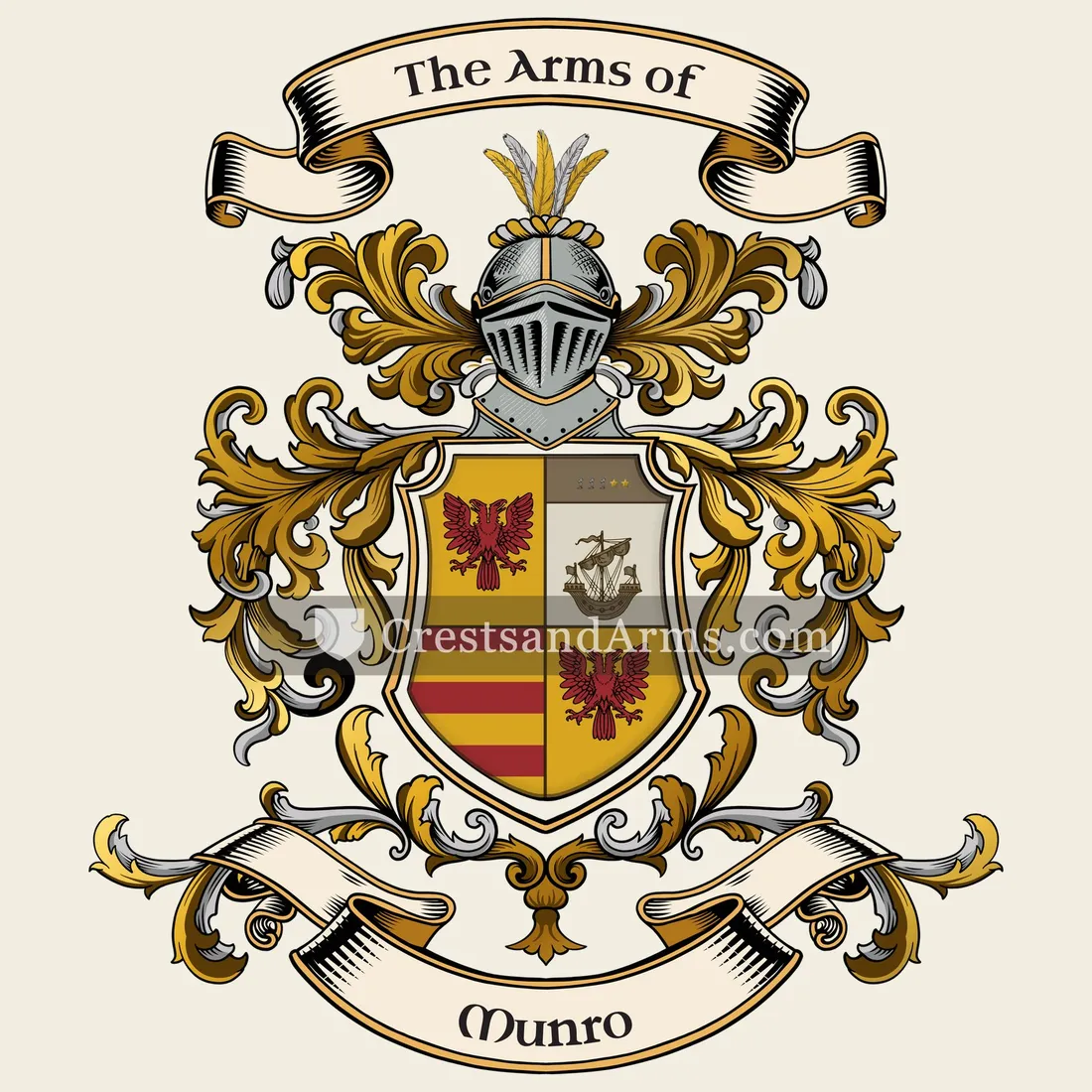
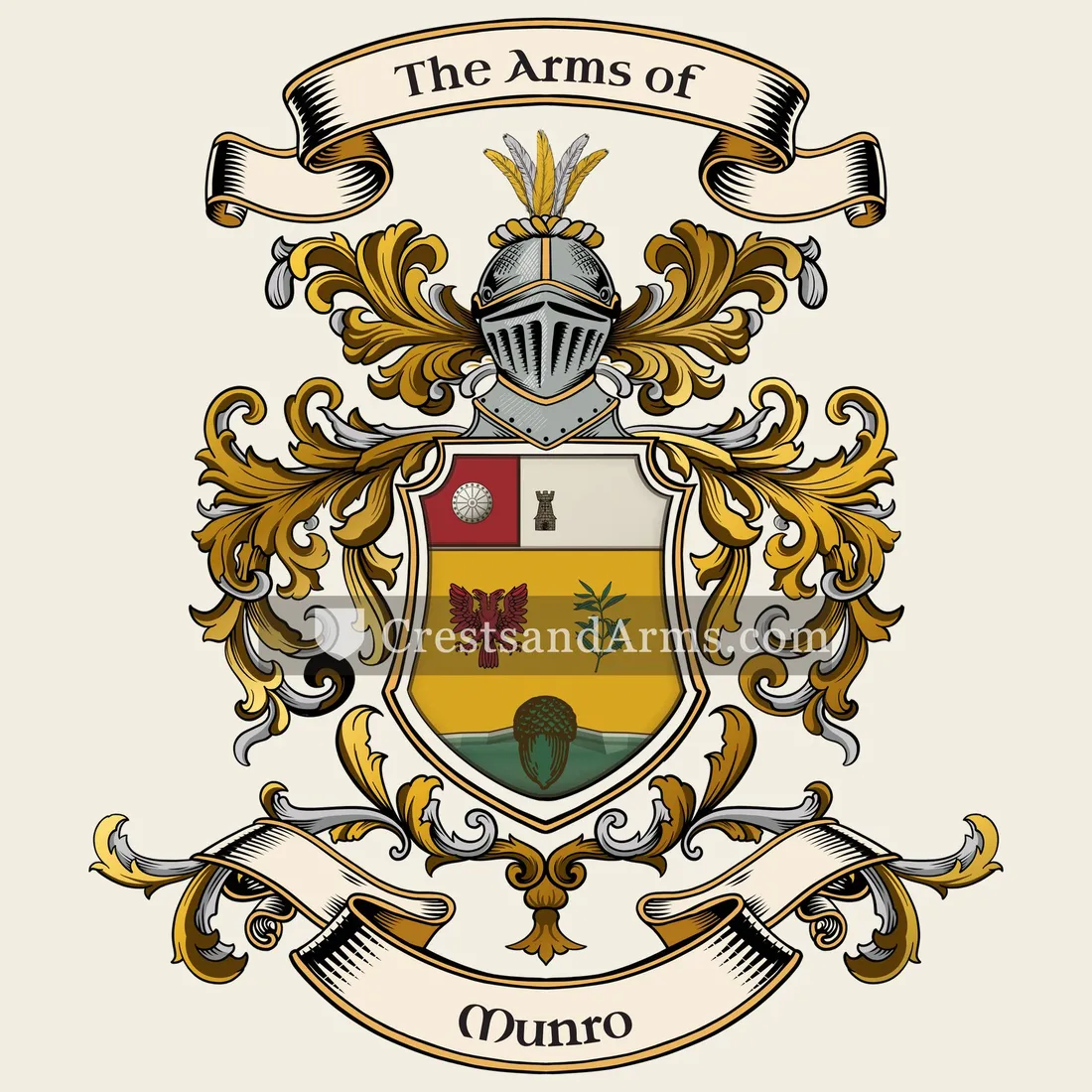
Meaning of the Munro family crest colors & symbols
Symbols on this shield
chiefAuthority, wisdom and dominion
mountThe ground held, and steadfastness upon it
cantonA mark of honour granted by the sovereign
eagleNobility, strength and a keen mind
branchPeace, and new growth
oakGreat age, strength and steadfastness
towerGrandeur and solidity, and a stronghold defended
roundelA coin, and one who has been to the crusades
Colours
Gold (Or)Means: Generosity
Silver (Argent)Means: Peace and sincerity
Red (Gules)Means: Military strength
Green (Vert)Means: Hope
Historical info
Source
J. B. Rietstap, Armorial Général, Gouda: G. B. van Goor Zonen, 1884–87
Blazon (the actual original written record)
“D'or à une tête d'aigle de gu., embrassée par une branche de laurier à dextre et une branche de chêne à sen., les pieds passés en saut.; au chef d'arg., ch. d'une forteresse indienne sur une colline au nat., la colline ch. du mot BADAMY en lettres d'or; au canton de gu., ch. d'une médaille d'arg., attachée à son ruban. C.: une aigle de profil au nat., tenant en son bec une branche de laurier, portant suspendue à son col la médaille d'arg. attachée à son ruban, et posant sa patte dextre sur un écusson de gu., ch. de la forteresse.”
Britainc. 1823
Digital archive packCoat of arms PNG, gold border print PDF, vector SVG and the certificate of authenticity. Sent to your email in minutes.
Map of Britain showing where the Munro arms are recorded
The Munro arms were recorded in Britain, c. 1823.
Arms such as these were typically recorded in Kent.
Kent sits between London and the short crossing to Europe, and the trade passing through made it wealthy. Merchant families bought land with that money, and it was landowners who took coats of arms.
This is where the arms were entered in the register. Families often moved to other parts of the country, so the same name can turn up in more than one region.
The body that granted and recorded arms in Britain in this period.
George IV of the United Kingdom
Sovereign of the period
George IV of the United Kingdom
1820–1830
Reigning in Britain when the Munro arms are first recorded.
How Arms Worked in Britain
English heraldry allowed arms to be shared by all legitimate descendants of the original owner. These symbols were treated as personal property that moved through the generations to all children. While the eldest son kept the original design, other family members could use the same shield without needing to change it or register their own unique versions.
Granting authority
The College of Arms in London has regulated the use of coats of arms throughout England and Wales since 1484.
How they got arms
Families typically obtained their coats of arms through a formal grant from the Crown or by proving their ancient right to them.
Where arms were recorded
All official coats of arms are recorded in the registers kept at the College of Arms, which date back to the fifteenth century.
The family's standing
Recorded among the armigerous families of Britain.
Origin & History of the Munro Family in Britain
The Munro family name has deep roots in the northern regions of Scotland, where it emerged as a prominent clan near the Cromarty Firth. Historically, the name is associated with the Gaelic phrase *Bun Rotha*, which translates to the mouth of the River Roe. Over many centuries, members of the family moved away from their ancestral lands in the Highlands to seek new opportunities across Britain. By the early 19th century, records confirm that the family had established a presence in Kent, England. This migration reflects the broader movement of families during the Industrial Revolution as people relocated to the south for work and trade. The family name evolved alongside these shifts in geography, maintaining its distinct identity while becoming part of the social fabric of southern England by 1823.
Meaning of the Munro family crest colors & symbols
Symbols on this shield
chiefAuthority, wisdom and dominion
eagleNobility, strength and a keen mind
shipEnterprise, and a great voyage undertaken
legStrength and swiftness
mulletThe third son, and a divine quality from above
Colours
Gold (Or)Means: Generosity
Silver (Argent)Means: Peace and sincerity
Red (Gules)Means: Military strength
Historical info
Source
Sir Bernard Burke, The General Armory of England, Scotland, Ireland and Wales, London: Harrison & Sons, 1884
Blazon (the actual original written record)
“Quarterly, 1st and 4th, or, an eagle's head erased gu. beaked and langued az., for MUNRO; 2nd, ar. a three-masted ship in the sea ppr. flagged gu. on a chief of the last three legs in armour conjoined at the thigh and flexed in triangle ppr. betw. two mullets or, for GUN; 3rd, barry of eight or and gu., for POYNTZ”
Scotlandc. 1748
Digital archive packCoat of arms PNG, gold border print PDF, vector SVG and the certificate of authenticity. Sent to your email in minutes.
Map of Scotland showing where the Munro arms are recorded
The Munro arms were recorded in Scotland, c. 1748.
Arms such as these were typically recorded in Edinburgh.
Edinburgh was the seat of Scotland's government, its courts and its heralds. Families with business there settled nearby, and being close to where arms were recorded is exactly why so many of them appear.
This is where the arms were entered in the register. Families often moved to other parts of the country, so the same name can turn up in more than one region.
The body that granted and recorded arms in Scotland in this period.
George II of Great Britain
Sovereign of the period
George II of Great Britain
1727–1760
Reigning in Britain when the Munro arms are first recorded.
How Arms Worked in Scotland
Scottish heraldry is unique because it treats a coat of arms as a piece of personal property protected by law. Only one person can own a specific design at any given time. When a family grows, the head keeps the original shield while other relatives must apply for their own distinct version with slight changes to prove their specific identity.
Granting authority
The Court of the Lord Lyon acts as the official body that regulates and controls all heraldic matters throughout Scotland.
How they got arms
Individuals obtain a legal right to their arms through a formal petition process that confirms their identity and family connection.
Where arms were recorded
All valid coats of arms are officially entered into the Public Register of All Arms and Bearings starting from 1672.
The family's standing
Recorded among the armigerous families of Scotland.
Origin & History of the Munro Family in Scotland
The Munro family name has deep roots in the rugged landscape of the Scottish Highlands, where the clan traditionally held lands in Ross-shire near the Cromarty Firth. Historians often link the origins of the name to the Gaelic phrase *Bun Rotha*, which translates to "the mouth of the River Roe," suggesting that the family’s earliest ancestors settled near this waterway. Over many centuries, the Munros became known as a loyal and influential group that played a significant role in regional politics and military service. By the mid-eighteenth century, the family had expanded its reach beyond the Highlands, with records confirming their presence in the bustling capital city of Edinburgh by 1748. During this era, members of the family were active participants in the social and professional life of the city, transitioning from their traditional Highland origins into the urban centers of the Scottish Enlightenment.
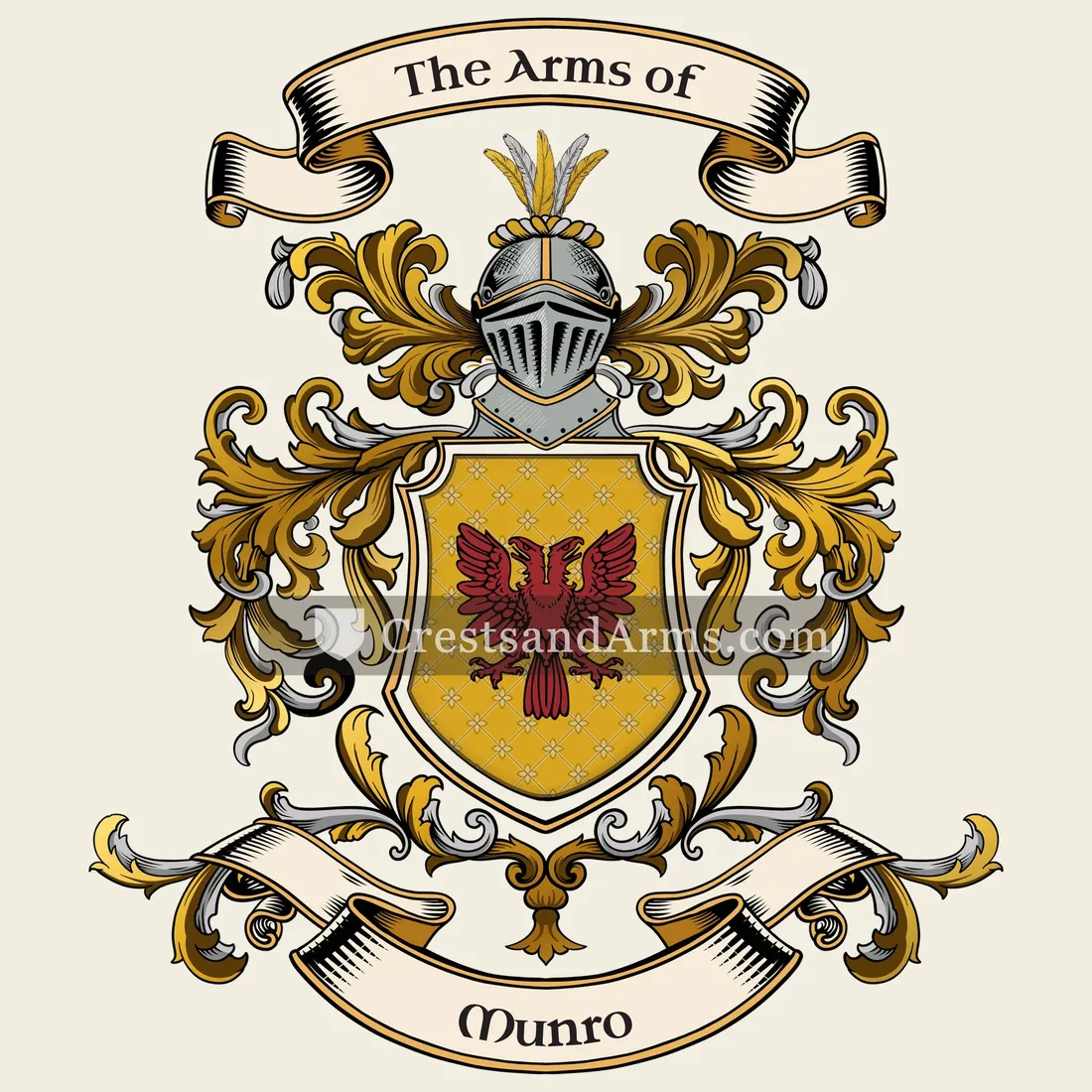
Meaning of the Munro family crest colors & symbols
Symbols on this shield
eagleNobility, strength and a keen mind
Colours
Gold (Or)Means: Generosity
Red (Gules)Means: Military strength
Historical info
Source
Sir Bernard Burke, The General Armory of England, Scotland, Ireland and Wales, London: Harrison & Sons, 1884
Blazon (the actual original written record)
“Or, an eagle's head erased gu”
Englandc. 1779
Digital archive packCoat of arms PNG, gold border print PDF, vector SVG and the certificate of authenticity. Sent to your email in minutes.
Map of England showing where the Munro arms are recorded
The Munro arms were recorded in England, c. 1779.
Arms such as these were typically recorded in York.
Yorkshire is the largest of the English counties, and it held more gentry families than any other. Land there was split among a great many households rather than a few, so a great many of them carried arms.
This is where the arms were entered in the register. Families often moved to other parts of the country, so the same name can turn up in more than one region.
The body that granted and recorded arms in England in this period.
George III of Great Britain
Sovereign of the period
George III of Great Britain
1760–1801
Reigning in Britain when the Munro arms are first recorded.
How Arms Worked in England
English heraldry allowed arms to be shared by all legitimate descendants of the original owner. These symbols were treated as personal property that moved through the generations to all children. While the eldest son kept the original design, other family members could use the same shield without needing to change it or register their own unique versions.
Granting authority
The College of Arms in London has regulated the use of coats of arms throughout England and Wales since 1484.
How they got arms
Families typically obtained their coats of arms through a formal grant from the Crown or by proving their ancient right to them.
Where arms were recorded
All official coats of arms are recorded in the registers kept at the College of Arms, which date back to the fifteenth century.
The family's standing
Recorded among the armigerous families of England.
Origin & History of the Munro Family in England
The history of the Munro name in England is often traced through the movement of individuals from the Scottish Highlands toward urban centers during the eighteenth century. While the family name has deep roots in the north of Scotland, records confirm that members of the Munro family were established in the city of York by 1779. During this period, York served as a vital hub for trade and administration, attracting families who sought new professional opportunities outside of their ancestral territories. These early settlers often integrated into the local economy as merchants or skilled tradespeople, gradually shifting the family identity from a clan-based structure to one defined by urban residency. By settling in northern English cities, these individuals helped transition the name from its regional Scottish origins into the broader social fabric of England.
Munro Meaning & Related Branches
Root word
Bun Rotha
Gaelic for mouth of the river
This name
MunroRefers to a person originating from the mouth of the River Roe
also spelled
Monro
Munroe
Munrow
Related arms
Gun-Monrovariant spelling
Monre, De La, or Monreyvariant spelling
Monrovariant spelling
Documented Sources
J. B. Rietstap, Armorial Général, Gouda: G. B. van Goor Zonen, 1884–87
MacKenzie, Alexander, History of the Munros of Foulis, 1898
The National Archives, Kew, Census Returns of England and Wales, 1841
Black, George Fraser, The Surnames of Scotland: Their Origin, Meaning, and History, 1946
Digital archive packCoat of arms PNG, gold border print PDF, vector SVG and the certificate of authenticity. Sent to your email in minutes.


 chiefAuthority, wisdom and dominion
 mountThe ground held, and steadfastness upon it
 cantonA mark of honour granted by the sovereign
 eagleNobility, strength and a keen mind
 branchPeace, and new growth
 oakGreat age, strength and steadfastness
 towerGrandeur and solidity, and a stronghold defended
 roundelA coin, and one who has been to the crusades


 shipEnterprise, and a great voyage undertaken
 legStrength and swiftness
 mulletThe third son, and a divine quality from above