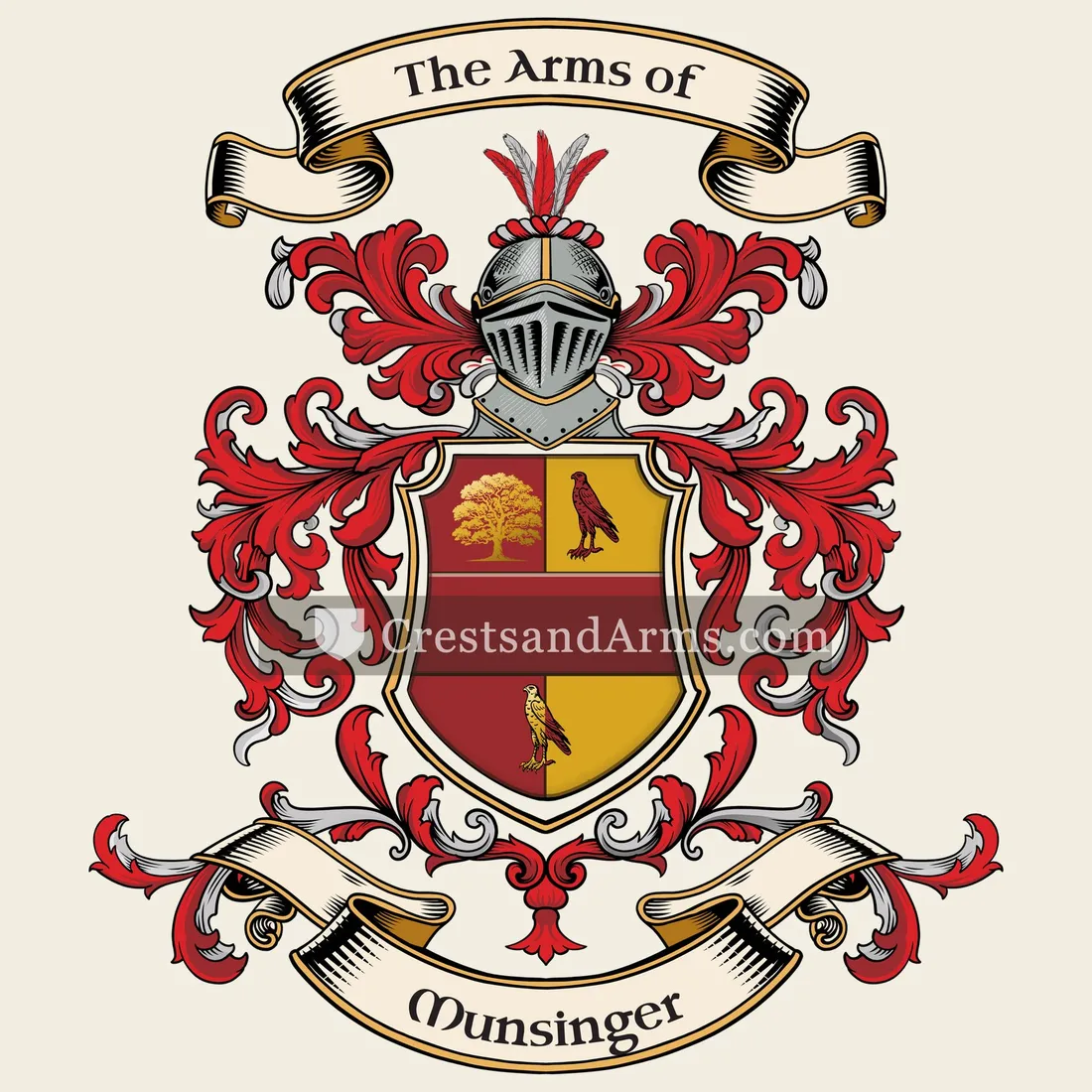
A record of documented arms, meaning and origin, researched for the Munsinger family of Switzerland.
Reg. 6495 · Swiss, M–O
Meaning of the Munsinger family crest colors & symbols
Symbols on this shield
treeLife, endurance and deep roots
falconOne eager and quick in pursuit
Colours
Red (Gules)Means: Military strength
Gold (Or)Means: Generosity
Historical info
Source
J. B. Rietstap, Armorial Général, Gouda: G. B. van Goor Zonen, 1884–87
Blazon (the actual original written record)
“Parti de gu. et d'or; à un tronc coupé, en fasce, de l'un en l'autre, supp. deux éperviers affr. au nat. C.: un épervier au nat., entre deux prob., d'or et de gu., ornées chacune dans son embouchure de trois plumes de paon au nat.”
Switzerlandc. 1745
Digital archive packCoat of arms PNG, gold border print PDF, vector SVG and the certificate of authenticity. Sent to your email in minutes.
Map of Switzerland showing where the Munsinger arms are recorded
The Munsinger arms were recorded in Switzerland, c. 1745.
Arms such as these were typically recorded in Bern.
Bern was the largest of the Swiss cantons and ran itself, with its own council and its own courts. Its governing families held office for generations, and office of that kind carried a shield with it.
This is where the arms were entered in the register. Families often moved to other parts of the country, so the same name can turn up in more than one region.
The body that granted and recorded arms in Switzerland in this period.
How Arms Worked in Switzerland
In Switzerland, coats of arms were not restricted to the nobility and were often adopted by common citizens and families. These symbols were passed down through generations to show family identity. When branches of a family grew, they often changed small details of the design to distinguish their own line from the original group.
Granting authority
Cantonal and civic authorities managed the use of coats of arms within their specific regions and local jurisdictions.
How they got arms
Families typically assumed their own coats of arms based on local custom rather than receiving them from a central monarch.
Where arms were recorded
Arms were recorded in various cantonal and civic registers starting from the fourteenth century throughout the Swiss region.
The family's standing
Recorded among the armigerous families of Switzerland.
Origin & History of the Munsinger Family in Switzerland
The Munsinger family name is deeply rooted in the historical landscape of the Swiss canton of Bern, where records confirm the family was well-established by 1745. The name likely originated as a topographic or habitational surname, which was a common practice in German-speaking regions during the Middle Ages. Such names were often derived from a specific location, such as a farm, a small settlement, or a particular geographic feature near where the ancestors lived. By the mid-18th century, the Munsinger family was part of the structured social fabric of Bern, likely participating in the agricultural or trade-based economy that defined the region at that time. As members of a settled community, these early ancestors would have been subject to the local laws and parish registrations that maintained the order of the Swiss cantons. Their presence in the historical record during this period reflects a long-standing connection to the land and the administrative traditions of the Swiss Confederation.
Munsinger Meaning & Related Branches
Root word
Munsingen
A place name referring to the settlement of the people of Muno.
This name
MunsingerA habitational surname denoting someone who originated from the town of Munsingen in Switzerland.
also spelled
Muensinger de Frundeck
Münsinger v. Frundeck
Munsinger
Documented Sources
J. B. Rietstap, Armorial Général, Gouda: G. B. van Goor Zonen, 1884–87
Historisches Lexikon der Schweiz, Historisches Lexikon der Schweiz, 2002
Staatsarchiv des Kantons Bern, Kirchenbücher des Kantons Bern, 1745
Digital archive packCoat of arms PNG, gold border print PDF, vector SVG and the certificate of authenticity. Sent to your email in minutes.


 treeLife, endurance and deep roots
 falconOne eager and quick in pursuit
 treeLife, endurance and deep roots
 falconOne eager and quick in pursuit