A record of documented arms, meaning and origin, researched for the Murray family lines. Documented in 3 countries.
Reg. 6055 · Dutch, M–O
Meaning of the Murray family crest colors & symbols
Symbols on this shield
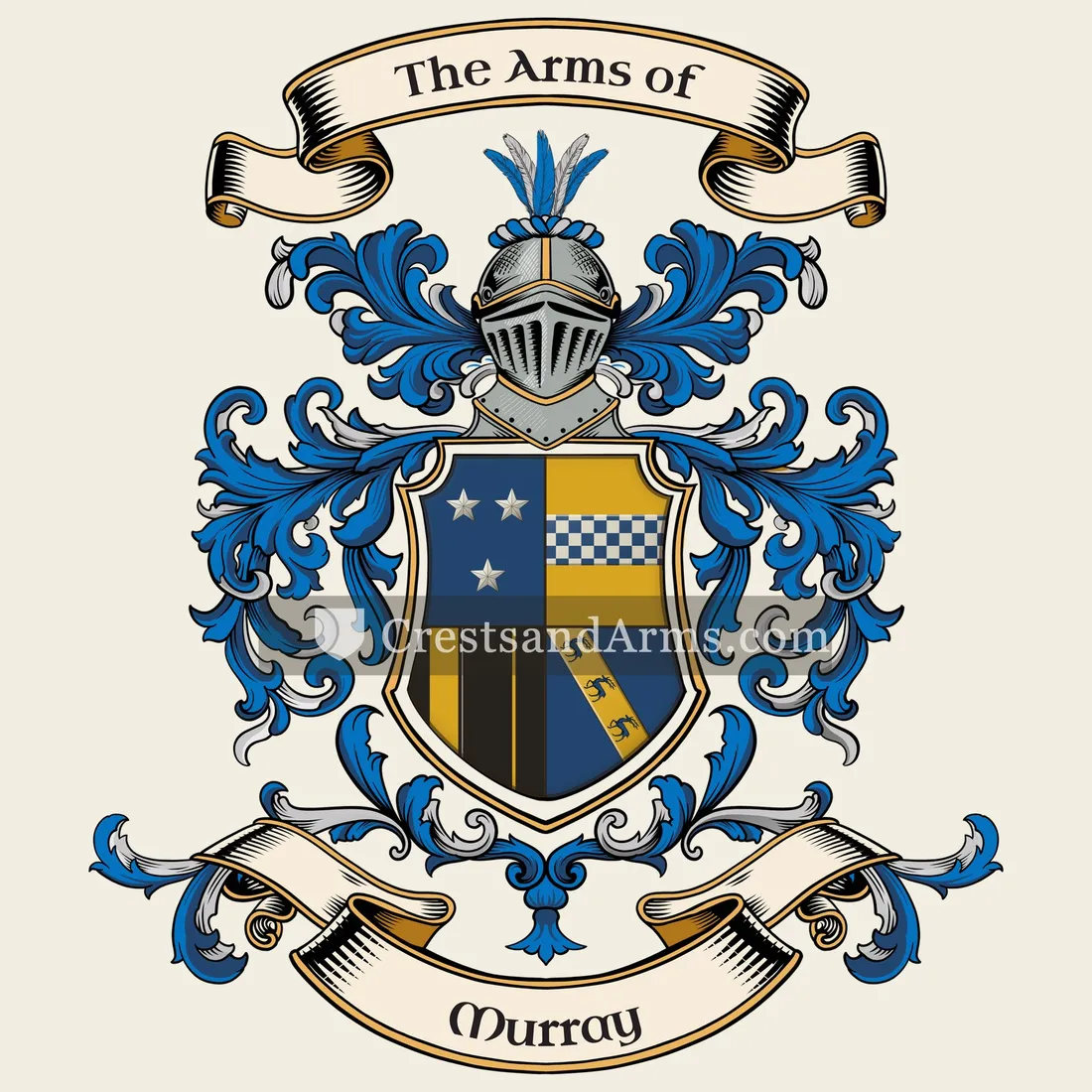
fessThe military belt, and readiness to serve
chequyConstancy, and the counting-board
paleMilitary strength, and a fortified defence
bendDefence, and the scarf of a commander
mulletThe third son, and a divine quality from above
stagPeace and harmony, and one who will not fight unprovoked
Colours
Blue (Azure)Means: Loyalty and truth
Gold (Or)Means: Generosity
Black (Sable)Means: Constancy
Silver (Argent)Means: Peace and sincerity
Historical info
Source
J. B. Rietstap, Armorial Général, Gouda: G. B. van Goor Zonen, 1884–87
Blazon (the actual original written record)
“Coupé d'un trait, parti de deux autres, qui font six quartiers: au 1 d'azur à trois étoiles d'arg., encloses dans un double trêcheur fleur. et c.-fleur. d'or (Murray); au 2 d'or à la fasce échiq. d'arg. et d'azur de trois tires (Stuart); au 3 palé d'or et de sa. (Strabolgie comte d'Atholl); au 4 d'arg. à la bande d'azur, ch. de trois rencontres de cerf d'or, posés dans le sens de la bande (Stanley); au 5 de gu. à trois jambes, arm. au nat., lisérées et éperonnées d'or, réunies par les cuisses en abîme du quartier (île de Man); au 6 de gu. à deux lions léopardés d'arg., l'un sur l'autre (Strange). Cq. cour. C.: un sauvage iss. de carn., ceint et cour. de lierre, les bras étendus, tenant de sa main dextre un poignard d'arg., garni d'or, et de sa. sen. une clé d'or. T.: à dextre un lion de gu., au collier d'azur ch. de trois étoiles d'arg.; à sen. un”
Netherlandsc. 1604
Digital archive packCoat of arms PNG, gold border print PDF, vector SVG and the certificate of authenticity. Sent to your email in minutes.
Map of Netherlands showing where the Murray arms are recorded
The Murray arms were recorded in Netherlands, c. 1604.
Arms such as these were typically recorded in Friesland.
Friesland was low, wet country on the northern coast of the Netherlands, farmed by families who had held the same land for centuries. Free landholders were unusually common there, and a free landholder could carry arms.
This is where the arms were entered in the register. Families often moved to other parts of the country, so the same name can turn up in more than one region.
Region
Friesland
First recorded
1604
Granting Authority for the Murray Arms
Hoge Raad van Adel
Photograph made by me · CC BY-SA 3.0
The body that granted and recorded arms in Netherlands in this period.
How Arms Worked in Netherlands
In the Netherlands, coats of arms were often used by noble families and those who held specific public offices. These arms were passed down through the generations to legitimate descendants. Younger branches of a family usually kept the original design without needing to add special marks. This system ensured that the family identity remained clear and consistent over many years.
Granting authority
The Hoge Raad van Adel is the official body that regulates and manages noble titles and coats of arms in the Netherlands.
How they got arms
Families typically obtained their coats of arms through official royal grants or by proving their long-standing historical use of the symbols.
Where arms were recorded
Coats of arms are officially recorded in the registers held by the Hoge Raad van Adel, which began its work in 1814.
The family's standing
Recorded among the armigerous families of Netherlands.
Origin & History of the Murray Family in Netherlands
The history of the Murray name in the Netherlands begins with the movement of Scottish soldiers and merchants across the North Sea during the late sixteenth and early seventeenth centuries. By 1604, records confirm that members of the family were established in the province of Friesland, likely serving as part of the professional military forces that supported the Dutch Republic in its struggle for independence. These early settlers often integrated into local society by adapting their Scottish surnames to fit the phonetic patterns of the Dutch language. Over time, the family transitioned from their roles as foreign soldiers to becoming part of the local administrative and commercial life in northern Dutch towns. This migration pattern reflects the broader historical trend of Scottish expatriates seeking new opportunities in the Low Countries, where they contributed to the cultural and economic growth of the region while maintaining their distinct ancestral identity.
Meaning of the Murray family crest colors & symbols
Symbols on this shield
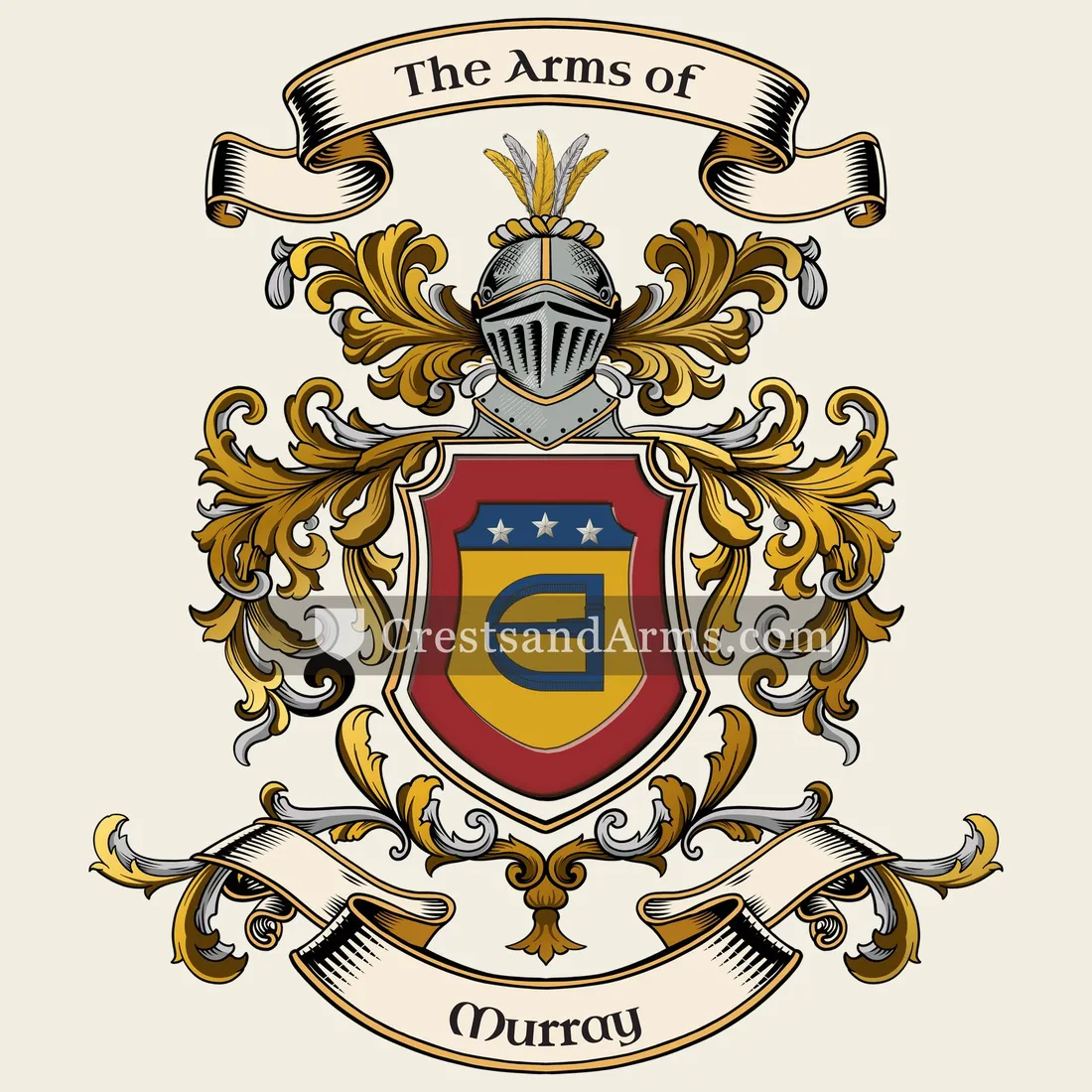
bordureA difference between branches of one family
chiefAuthority, wisdom and dominion
buckleFidelity, and a bond firmly held
mulletThe third son, and a divine quality from above
Colours
Gold (Or)Means: Generosity
Blue (Azure)Means: Loyalty and truth
Red (Gules)Means: Military strength
Silver (Argent)Means: Peace and sincerity
Historical info
Source
Sir Bernard Burke, The General Armory of England, Scotland, Ireland and Wales, London: Harrison & Sons, 1884
Blazon (the actual original written record)
“Or, a fetterlock az. within a bordure embattled gu. on a chief of the second three mullets ar”
FifeClermont · Fife, c. 1626
Digital archive packCoat of arms PNG, gold border print PDF, vector SVG and the certificate of authenticity. Sent to your email in minutes.
Map of Scotland showing where the Murray arms are recorded
The Murray arms were recorded in Fife, c. 1626.
Fife was farming country between two firths, with royal palaces and old burghs along its coast. Its landed families were numerous and close to the court, and closeness to the court brought arms.
This is where the arms were entered in the register. Families often moved to other parts of the country, so the same name can turn up in more than one region.
The body that granted and recorded arms in Scotland in this period.
Charles I of England
Sovereign of the period
Charles I of England
1625–1649
Reigning in Netherlands when the Murray arms are first recorded.
How Arms Worked in Scotland
Scottish heraldry is unique because it treats a coat of arms as a piece of personal property protected by law. Only one person can own a specific design at any given time. When a family grows, the head keeps the original shield while other relatives must apply for their own distinct version with slight changes to prove their specific identity.
Granting authority
The Court of the Lord Lyon acts as the official body that regulates and controls all heraldic matters throughout Scotland.
How they got arms
Individuals obtain a legal right to their arms through a formal petition process that confirms their identity and family connection.
Where arms were recorded
All valid coats of arms are officially entered into the Public Register of All Arms and Bearings starting from 1672.
The family's standing
Recorded among the armigerous families of Fife.
Origin & History of the Murray Family in Scotland
The name Murray is deeply rooted in the history of Scotland and originates from the region of Moray in the north. The name itself is a geographic descriptor, meaning someone who came from the land of the sea settlement. While the family name became prominent across the country, historical records confirm that members of the family were well-established in the region of Fife by 1626. During this period, the family was often involved in the local administration and the complex social structures of the Scottish Lowlands. They were part of a society that placed great importance on land ownership and regional loyalty. As the centuries passed, the family expanded their influence through marriage, trade, and service to the Scottish Crown. This transition from a regional identity to a widespread Scottish surname reflects the broader movement of people and the growth of clan-based influence throughout the seventeenth century.
Meaning of the Murray family crest colors & symbols
Symbols on this shield
bordureA difference between branches of one family
chiefAuthority, wisdom and dominion
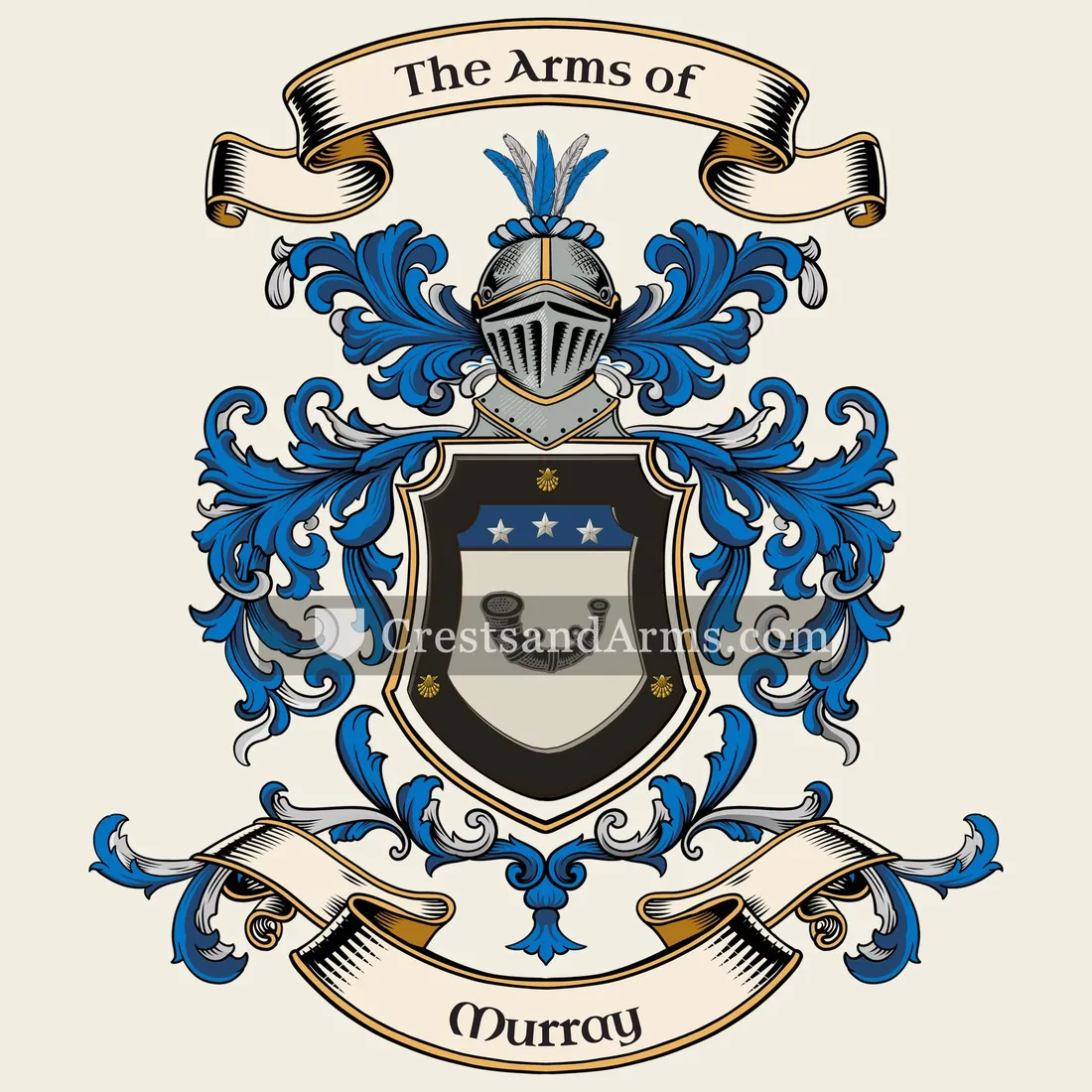
hunting horn stringedOne who delights in the chase
escallopThe pilgrim's shell, and a long journey made
mulletThe third son, and a divine quality from above
Colours
Silver (Argent)Means: Peace and sincerity
Blue (Azure)Means: Loyalty and truth
Black (Sable)Means: Constancy
Gold (Or)Means: Generosity
Historical info
Source
Sir Bernard Burke, The General Armory of England, Scotland, Ireland and Wales, London: Harrison & Sons, 1884
Blazon (the actual original written record)
“Ar. a hunting horn sa. stringed gu. a bordure of the second charged with three escallops or, on a chief az. as many stars of the field”
EnglandBirmingham, c. 1620
Digital archive packCoat of arms PNG, gold border print PDF, vector SVG and the certificate of authenticity. Sent to your email in minutes.
Map of England showing where the Murray arms are recorded
The Murray arms were recorded in Birmingham, c. 1620.
This is where the arms were entered in the register. Families often moved to other parts of the country, so the same name can turn up in more than one region.
The body that granted and recorded arms in England in this period.
James VI and I
Sovereign of the period
James VI and I
1603–1625
Reigning in Netherlands when the Murray arms are first recorded.
How Arms Worked in England
English heraldry allowed arms to be shared by all legitimate descendants of the original owner. These symbols were treated as personal property that moved through the generations to all children. While the eldest son kept the original design, other family members could use the same shield without needing to change it or register their own unique versions.
Granting authority
The College of Arms in London has regulated the use of coats of arms throughout England and Wales since 1484.
How they got arms
Families typically obtained their coats of arms through a formal grant from the Crown or by proving their ancient right to them.
Where arms were recorded
All official coats of arms are recorded in the registers kept at the College of Arms, which date back to the fifteenth century.
The family's standing
Recorded among the armigerous families of England.
Origin & History of the Murray Family in England
The name Murray is traditionally associated with the Scottish region of Moray, but by the early seventeenth century, the family had established a notable presence in the English Midlands. Records confirm that members of the Murray family were living in Birmingham by 1620, a time when the town was rapidly transforming from a small market center into a hub of metalworking and trade. As these families settled into the growing urban landscape, they often integrated into the local craft guilds and merchant classes that defined Birmingham’s economy. This migration from the north to the industrial heart of England reflects a broader pattern of movement during the Stuart period, as individuals sought new opportunities in the expanding towns of the English interior. By establishing themselves in Birmingham during this era, the Murray family became part of the foundational population that helped turn the town into a center of innovation and industry.
Murray Meaning & Related Branches
Root word
Moray
A geographic region in Scotland meaning settlement by the sea.
This name
MurrayDerived from a Scottish place name referring to a coastal or maritime settlement.
also spelled
Murrey
Murry
Muray
Moray
Related arms
Dicksonsame arms
Hillsame arms
Thomsonsame arms
Morayvariant spelling
Documented Sources
J. B. Rietstap, Armorial Général, Gouda: G. B. van Goor Zonen, 1884–87
Furgol, Edward M., A Regimental History of the Covenanting Armies, 1639–1651, 1990
Macinnes, Allan I., Clanship, Commerce and the House of Stuart, 1603–1788, 1996
Tresoar (Fries Historisch en Letterkundig Centrum), Collectie van de Staten van Friesland
Digital archive packCoat of arms PNG, gold border print PDF, vector SVG and the certificate of authenticity. Sent to your email in minutes.


 fessThe military belt, and readiness to serve
 chequyConstancy, and the counting-board
 paleMilitary strength, and a fortified defence
 bendDefence, and the scarf of a commander
 mulletThe third son, and a divine quality from above
 stagPeace and harmony, and one who will not fight unprovoked

 bordureA difference between branches of one family
 chiefAuthority, wisdom and dominion
 buckleFidelity, and a bond firmly held


 hunting horn stringedOne who delights in the chase
 escallopThe pilgrim's shell, and a long journey made