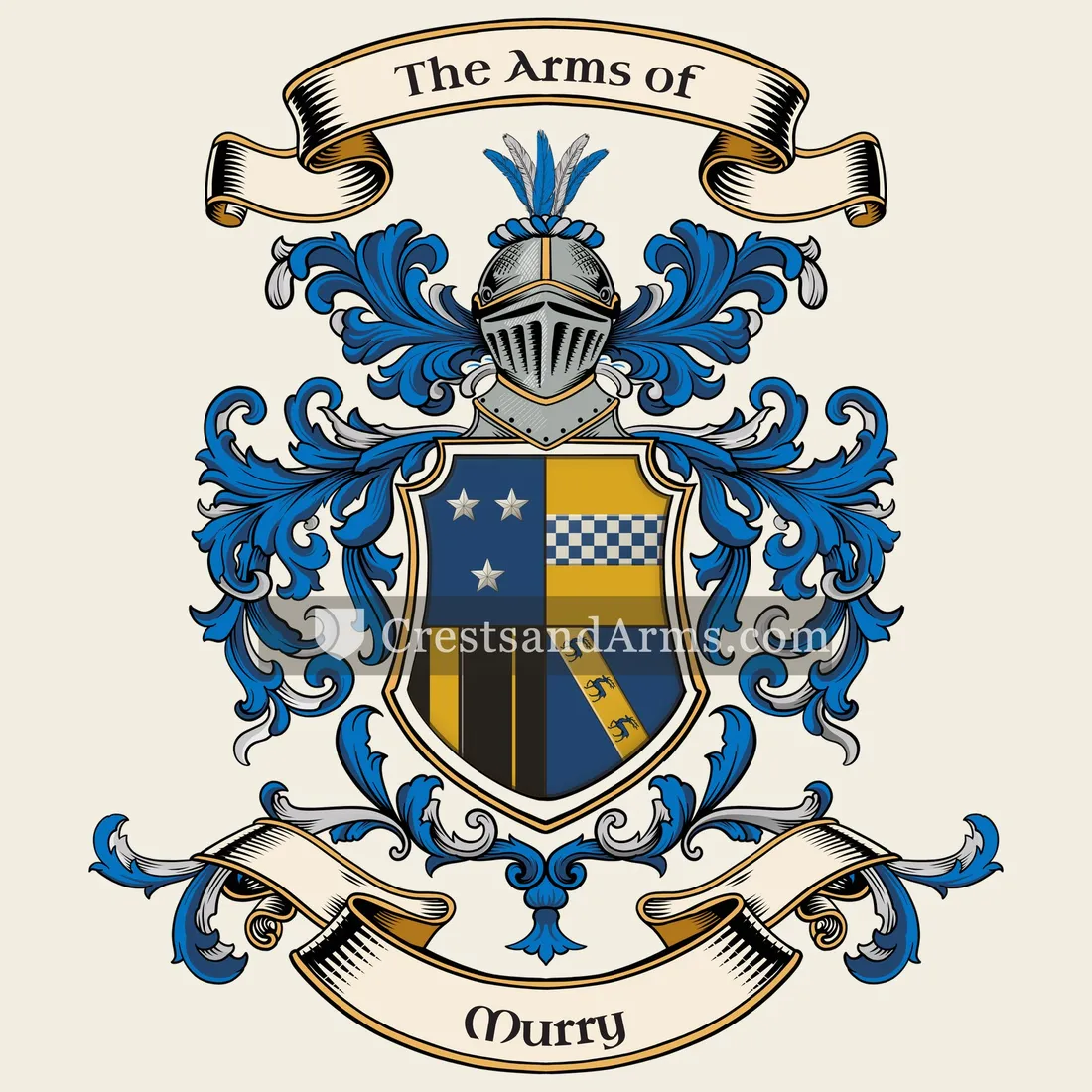
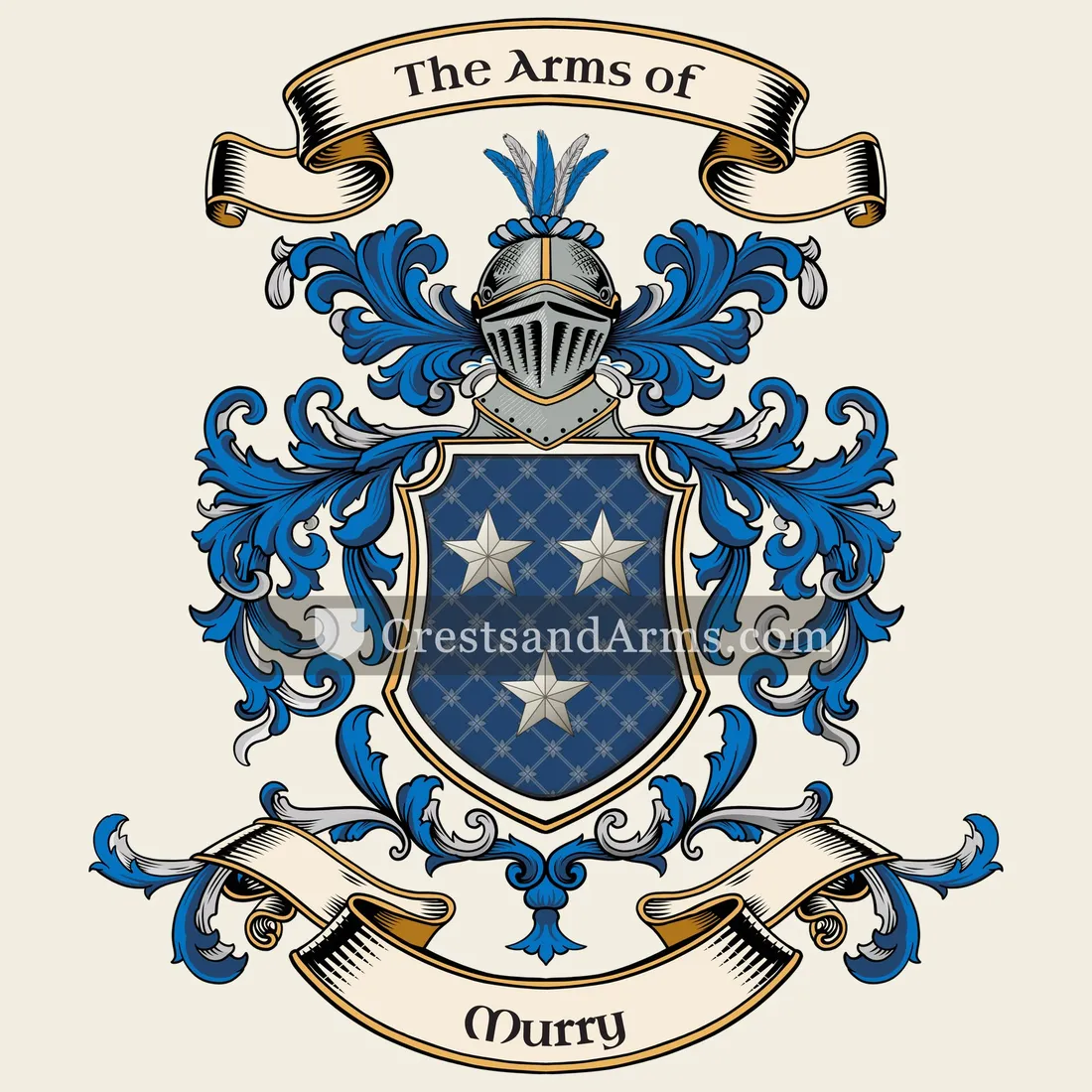
A record of documented arms, meaning and origin, researched for the Murry family lines. Documented in 2 countries.
Reg. 9585 · Dutch, M–O
Meaning of the Murry family crest colors & symbols
Symbols on this shield
fessThe military belt, and readiness to serve
chequyConstancy, and the counting-board
paleMilitary strength, and a fortified defence
bendDefence, and the scarf of a commander
mulletThe third son, and a divine quality from above
stagPeace and harmony, and one who will not fight unprovoked
Colours
Blue (Azure)Means: Loyalty and truth
Gold (Or)Means: Generosity
Black (Sable)Means: Constancy
Silver (Argent)Means: Peace and sincerity
Historical info
Source
J. B. Rietstap, Armorial Général, Gouda: G. B. van Goor Zonen, 1884–87
Blazon (the actual original written record)
“Coupé d'un trait, parti de deux autres, qui font six quartiers: au 1 d'azur à trois étoiles d'arg., encloses dans un double trêcheur fleur. et c.-fleur. d'or (Murray); au 2 d'or à la fasce échiq. d'arg. et d'azur de trois tires (Stuart); au 3 palé d'or et de sa. (Strabolgie comte d'Atholl); au 4 d'arg. à la bande d'azur, ch. de trois rencontres de cerf d'or, posés dans le sens de la bande (Stanley); au 5 de gu. à trois jambes, arm. au nat., lisérées et éperonnées d'or, réunies par les cuisses en abîme du quartier (île de Man); au 6 de gu. à deux lions léopardés d'arg., l'un sur l'autre (Strange). Cq. cour. C.: un sauvage iss. de carn., ceint et cour. de lierre, les bras étendus, tenant de sa main dextre un poignard d'arg., garni d'or, et de sa. sen. une clé d'or. T.: à dextre un lion de gu., au collier d'azur ch. de trois étoiles d'arg.; à sen. un”
Netherlandsc. 1604
Digital archive packCoat of arms PNG, gold border print PDF, vector SVG and the certificate of authenticity. Sent to your email in minutes.
Map of Netherlands showing where the Murry arms are recorded
The Murry arms were recorded in Netherlands, c. 1604.
Arms such as these were typically recorded in Friesland.
Friesland was low, wet country on the northern coast of the Netherlands, farmed by families who had held the same land for centuries. Free landholders were unusually common there, and a free landholder could carry arms.
This is where the arms were entered in the register. Families often moved to other parts of the country, so the same name can turn up in more than one region.
Region
Friesland
First recorded
1604
Granting Authority for the Murry Arms
Hoge Raad van Adel
Photograph made by me · CC BY-SA 3.0
The body that granted and recorded arms in Netherlands in this period.
How Arms Worked in Netherlands
In the Netherlands, coats of arms were often used by noble families and those who held specific public offices. These arms were passed down through the generations to legitimate descendants. Younger branches of a family usually kept the original design without needing to add special marks. This system ensured that the family identity remained clear and consistent over many years.
Granting authority
The Hoge Raad van Adel is the official body that regulates and manages noble titles and coats of arms in the Netherlands.
How they got arms
Families typically obtained their coats of arms through official royal grants or by proving their long-standing historical use of the symbols.
Where arms were recorded
Coats of arms are officially recorded in the registers held by the Hoge Raad van Adel, which began its work in 1814.
The family's standing
Recorded among the armigerous families of Netherlands.
Origin & History of the Murry Family in Netherlands
The family name Murry, often appearing in early Dutch records as a variation of names like Murray or Murre, has deep roots in the northern province of Friesland. By the year 1604, members of the family were already established within this region, which was known for its distinct culture and independent spirit. During this period, Friesland was a hub for trade and agriculture, and families often adopted surnames based on their occupation, physical traits, or the specific village where they lived. Because the Dutch naming system was still evolving at the start of the seventeenth century, the name Murry likely served as a way to distinguish this specific lineage from other local clans. These early ancestors were part of a society that valued community ties and local governance, allowing the family to maintain a consistent presence in the Frisian landscape as they navigated the shifting religious and political tides of the Dutch Golden Age.
Meaning of the Murry family crest colors & symbols
Symbols on this shield
mulletThe third son, and a divine quality from above
Colours
Blue (Azure)Means: Loyalty and truth
Silver (Argent)Means: Peace and sincerity
Historical info
Source
J. B. Rietstap, Armorial Général, Gouda: G. B. van Goor Zonen, 1884–87
Blazon (the actual original written record)
“D'azur à trois étoiles d'arg.”
Germanyc. 1765
Digital archive packCoat of arms PNG, gold border print PDF, vector SVG and the certificate of authenticity. Sent to your email in minutes.
Map of Germany showing where the Murry arms are recorded
The Murry arms were recorded in Germany, c. 1765.
Arms such as these were typically recorded in Bavaria.
Bavaria was a country of old landed families and walled market towns. Estates passed down the same line for centuries, and both the landowners and the leading townsmen kept arms, which is why so many Bavarian names sit in the registers.
This is where the arms were entered in the register. Families often moved to other parts of the country, so the same name can turn up in more than one region.
The body that granted and recorded arms in Germany in this period.
Francis I, Holy Roman Emperor
Sovereign of the period
Francis I, Holy Roman Emperor
1745–1765
Reigning in Netherlands when the Murry arms are first recorded.
How Arms Worked in Germany
In the Holy Roman Empire, coats of arms were often granted to individuals by the Emperor or his representatives. These arms were then passed down through the generations to all legitimate descendants of the original holder. Younger branches of a family usually kept the same shield design without needing to change it, as the arms belonged to the entire lineage.
Granting authority
The Holy Roman Emperor held the sole power to grant new coats of arms throughout his vast imperial territories.
How they got arms
Families typically obtained their coats of arms through a formal imperial grant or by proving their noble status to the authorities.
Where arms were recorded
These grants were officially recorded in the Imperial Chancery registers, which began keeping formal records of such honors during the Middle Ages.
The family's standing
Recorded among the armigerous families of Germany.
Origin & History of the Murry Family in Germany
The family name Murry, often appearing in German records as Mury or Murr, has deep roots tied to the geography and social structure of the Bavarian region. By the mid-18th century, families carrying this name were well-established in the rural landscapes of southern Germany. The name is frequently linked to the Murr River, which flows through the state of Baden-Württemberg and into the broader Germanic territories, suggesting that early ancestors likely took their name from the waterway near their home. In 1765, records confirm that members of the family were active participants in the local Bavarian economy, likely working as farmers or skilled tradespeople within the tight-knit village communities of the time. These early Murry ancestors lived through a period of significant agricultural transition, where families were deeply connected to the land and the local parish churches that kept the vital records of their births, marriages, and deaths. This history reflects a life defined by regional loyalty and the steady rhythms of life in the Holy Roman Empire.
Murry Meaning & Related Branches
Root word
Mauritius
Derived from the Latin word for a person from Mauretania or dark-skinned.
This name
MurryA patronymic surname originating from the personal name Maurice, meaning dark-skinned or moorish.
also spelled
Murrey
Murry
Muray
Moray
Documented Sources
J. B. Rietstap, Armorial Général, Gouda: G. B. van Goor Zonen, 1884–87
Tresoar (Fries Historisch en Letterkundig Centrum), Register van de floreenbelasting in Friesland
Fries Genootschap van Geschied-, Oudheid- en Taalkunde, De Vrije Fries
H.J. Popping, Friesche familienamen in de 17e eeuw (1938)
Digital archive packCoat of arms PNG, gold border print PDF, vector SVG and the certificate of authenticity. Sent to your email in minutes.


 fessThe military belt, and readiness to serve
 chequyConstancy, and the counting-board
 paleMilitary strength, and a fortified defence
 bendDefence, and the scarf of a commander
 mulletThe third son, and a divine quality from above
 stagPeace and harmony, and one who will not fight unprovoked