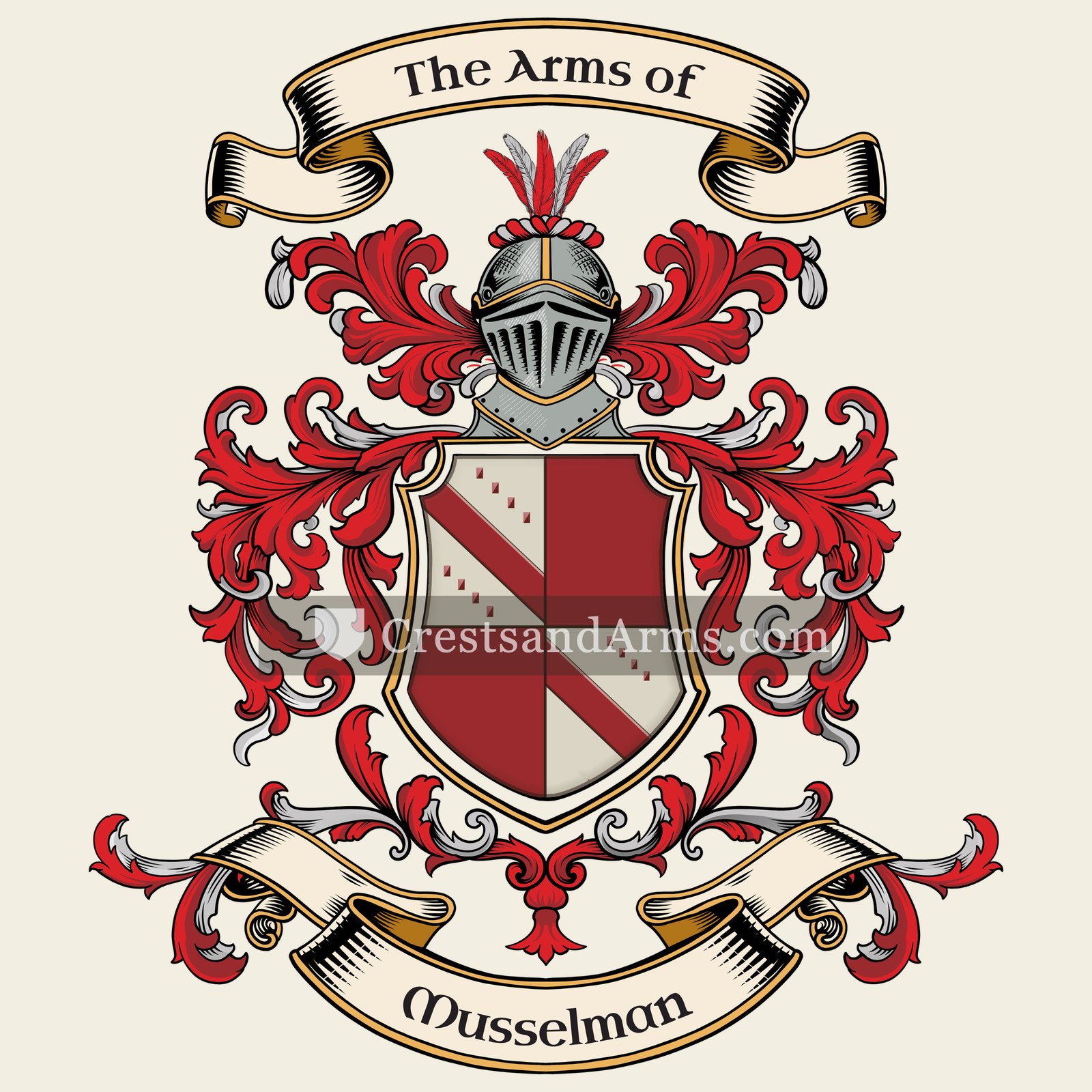
A record of documented arms, meaning and origin, researched for the Musselman family of Belgium.
Reg. 0450 · Belgian, M–O
Coat of Arms & Family Crest Details
Symbols on this shield
bendDefence, and the scarf of a commander
billetThe sealed letter, and a message delivered
Colours
Silver (Argent)Means: Peace and sincerity
Red (Gules)Means: Military strength
Historical info
Source
J. B. Rietstap, Armorial Général, Gouda: G. B. van Goor Zonen, 1884–87
Blazon (the actual original written record)
“Ec.: aux 1 et 4 d'arg. à la bande ondée de gu., acc. de dix bill. du même, rangées en orle; aux 2 et 3 parti-émanché d'arg. et de gu. de dix pièces. Sur le tout de gu. à une tête et col de boeuf d'or et au chef d'azur ch. de trois roses d'arg., bout. d'azur.”
BelgiumBruxelles, c. 1737
Digital archive packCoat of arms PNG, gold border print PDF, vector SVG and the certificate of authenticity. Sent to your email in minutes.
Map of Belgium showing where the Musselman arms are recorded
The Musselman arms were recorded in Bruxelles, c. 1737.
This is where the arms were entered in the register. Families often moved to other parts of the country, so the same name can turn up in more than one region.
The body that granted and recorded arms in Belgium in this period.
Charles VI, Holy Roman Emperor
Sovereign of the period
Charles VI, Holy Roman Emperor
1711–1740
Reigning in Belgium when the Musselman arms are first recorded.
How Arms Worked in Belgium
In Belgium, a coat of arms is considered personal property that is passed down through the male line to legitimate descendants. Families often use the same shield design across generations to show their shared heritage. If a branch of the family wants to change the design, they must apply for an official update to their specific version of the arms.
Granting authority
The Conseil héraldique is the official body that regulates and approves all coats of arms in Belgium.
How they got arms
Families obtain their coats of arms through formal royal grants or by confirming their historical right to use existing designs.
Where arms were recorded
All approved coats of arms are officially recorded in the public registers of the Conseil héraldique since 1844.
The family's standing
Recorded among the armigerous families of Belgium.
Origin & History of the Musselman Family in Belgium
The surname Musselman is rooted in the Germanic linguistic tradition, likely originating as an occupational or descriptive name that evolved over several centuries. Historical records confirm that members of the family were well-established in the city of Bruxelles by 1737, where they participated in the vibrant urban life of the Low Countries. During this period, the family likely navigated the complex social and economic shifts of the eighteenth century, which saw Bruxelles serve as a major hub for trade and craftsmanship. The name itself often suggests a connection to the Middle High German term "muos," which referred to porridge or soft food, potentially identifying an early ancestor as a provider or maker of such goods. As the family moved through different regions of Europe, the spelling and pronunciation adapted to local dialects, eventually solidifying into the form recognized today.
Musselman Meaning & Related Branches
Root word
Musel
A Middle High German term referring to a mussel or shellfish.
This name
MusselmanAn occupational surname for a person who gathered or sold mussels or shellfish.
also spelled
Mosselmann
Mosselmanh
Documented Sources
J. B. Rietstap, Armorial Général, Gouda: G. B. van Goor Zonen, 1884–87
Bahlow, Hans, Deutsches Namenlexikon: Familien- und Vornamen nach Ursprung und Sinn erklärt, 1967
Heintze, Albert, Die deutschen Familiennamen: geschichtlich, geographisch, sprachlich, 1903
Archives de la Ville de Bruxelles, Registres paroissiaux et état civil
Digital archive packCoat of arms PNG, gold border print PDF, vector SVG and the certificate of authenticity. Sent to your email in minutes.


 bendDefence, and the scarf of a commander
 billetThe sealed letter, and a message delivered
 bendDefence, and the scarf of a commander
 billetThe sealed letter, and a message delivered