Map of Belgium showing where the Musson arms are recorded
The Musson arms were recorded in Luxemb, c. 1737.
This is where the arms were entered in the register. Families often moved to other parts of the country, so the same name can turn up in more than one region.
The body that granted and recorded arms in Belgium in this period.
Charles VI, Holy Roman Emperor
Sovereign of the period
Charles VI, Holy Roman Emperor
1711–1740
Reigning in Belgium when the Musson arms are first recorded.
How Arms Worked in Belgium
In Belgium, a coat of arms is considered personal property that is passed down through the male line to legitimate descendants. Families often use the same shield design across generations to show their shared heritage. If a branch of the family wants to change the design, they must apply for an official update to their specific version of the arms.
Granting authority
The Conseil héraldique is the official body that regulates and approves all coats of arms in Belgium.
How they got arms
Families obtain their coats of arms through formal royal grants or by confirming their historical right to use existing designs.
Where arms were recorded
All approved coats of arms are officially recorded in the public registers of the Conseil héraldique since 1844.
The family's standing
Recorded among the armigerous families of Belgium.
Origin & History of the Musson Family in Belgium
The family name Musson has deep roots in the region that now spans the border between modern Belgium and Luxembourg. By the early eighteenth century, the family was well-established in the village of Musson, which sits in the province of Luxembourg in present-day Belgium. Historical records confirm that members of the family were living in this area as early as 1737. The name itself is likely a locative surname, meaning it was adopted by families who lived in or near this specific settlement. During this period, the region was part of the Southern Netherlands under the rule of the Austrian Habsburgs. Life for the Musson family at this time centered on the local parish and the agricultural rhythms of the Gaume region. As the family grew, they became part of the social fabric of this rural landscape, documenting their lives through church registers and local administrative records that tracked births, marriages, and deaths in the community.
Coat of Arms & Family Crest Details
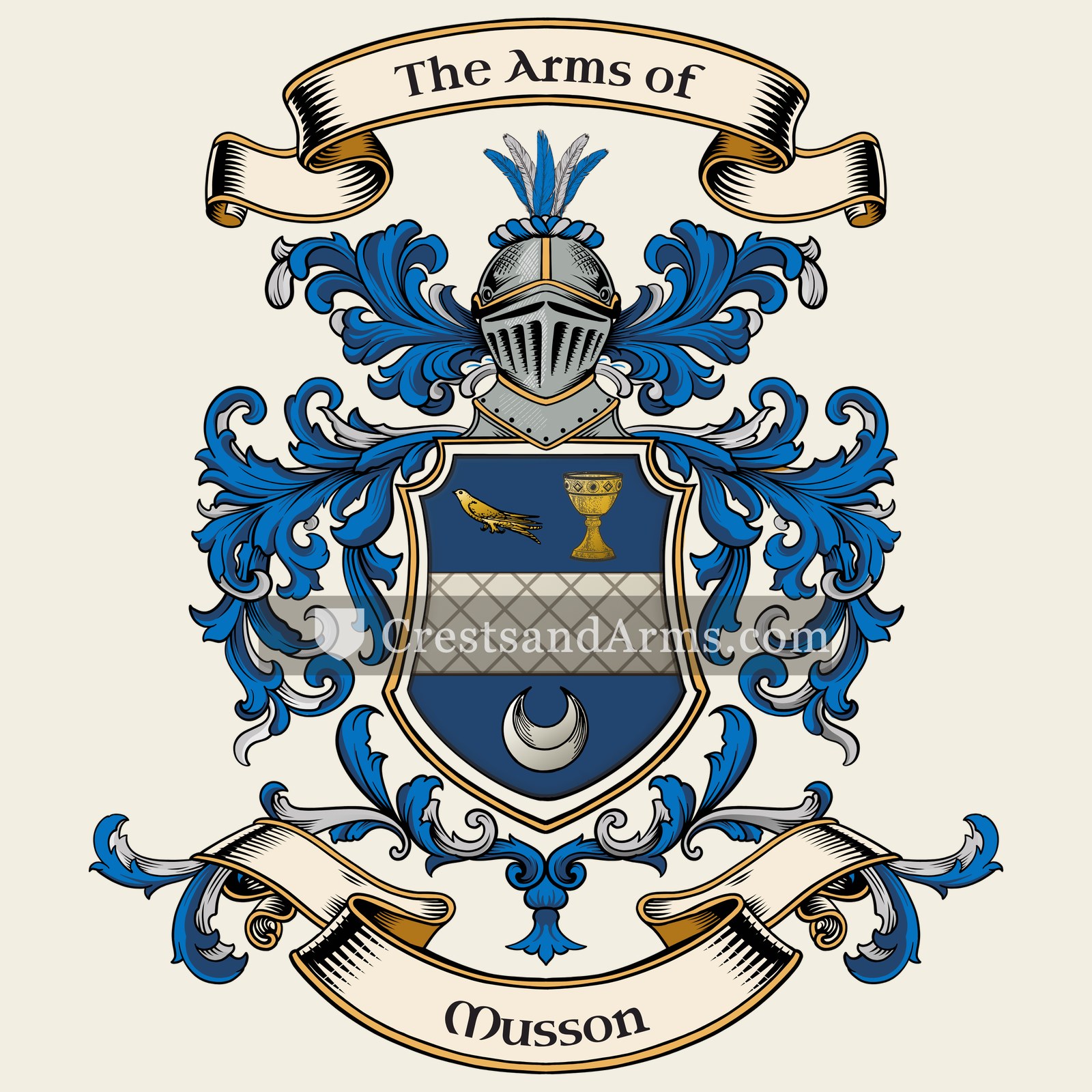
Symbols on this shield
fessThe military belt, and readiness to serve
martletA younger son, who must win his own land
cupFaith, office, and a trust discharged
crescentHonour by the sovereign, and the second son
Colours
Blue (Azure)Means: Loyalty and truth
Silver (Argent)Means: Peace and sincerity
Gold (Or)Means: Generosity
Historical info
Source
J. B. Rietstap, Armorial Général, Gouda: G. B. van Goor Zonen, 1884–87
Blazon (the actual original written record)
“D'azur à la fasce d'arg., acc. en chef d'une merlette d'or et en p. d'une bouteille d'or soutenue d'un croiss. d'arg.”
LorraineLorraine, c. 1663
Digital archive packCoat of arms PNG, gold border print PDF, vector SVG and the certificate of authenticity. Sent to your email in minutes.
Map of France showing where the Musson arms are recorded
The Musson arms were recorded in Lorraine, c. 1663.
Lorraine sat on the border between France and the German lands, and border country bred soldiers. Families here held small estates and served in arms, and a fighting man was exactly the sort who carried a shield of his own.
This is where the arms were entered in the register. Families often moved to other parts of the country, so the same name can turn up in more than one region.
The body that granted and recorded arms in France in this period.
Louis XIV of France
Sovereign of the period
Louis XIV of France
1643–1715
Reigning in Belgium when the Musson arms are first recorded.
How Arms Worked in France
In France, a coat of arms was a mark of honor that passed down through the male line to all legitimate descendants. Families often used the same shield without changes to show their shared heritage. If a branch wanted to stand out, they could add a small mark to their shield to show their specific place in the family tree.
Granting authority
The Juge d'armes de France acted as the official authority that regulated and verified coats of arms across the country.
How they got arms
Families typically inherited their arms from ancestors, though they could also receive them through royal grants or by proving their noble status.
Where arms were recorded
Coats of arms were officially recorded in the Armorial Général de France, which began its main collection in the year 1696.
The family's standing
Recorded among the armigerous families of Lorraine.
Origin & History of the Musson Family in France
The family name Musson finds its deep historical roots in the northeastern region of France known as Lorraine. By the year 1663, records confirm that members of the Musson family were well-established in this area, which served as a vital crossroads between French and Germanic cultures. The name itself is thought to be topographic, likely originating from a small settlement or a specific geographical feature near a marsh or a wooded area. During the seventeenth century, the people of Lorraine lived through a period of significant political transition as the region moved toward closer integration with the French crown. Families like the Mussons were often part of the local agrarian or artisan classes who helped maintain the stability of these borderland communities. Because Lorraine was frequently affected by regional conflicts during this era, the survival and growth of the family name reflect the resilience of the local population during a time of great change.
Related Branches & Arms
Root word
Mous
A diminutive or pet form of the personal name Moses.
This name
MussonA patronymic surname derived from the son of a man named Moses.
also spelled
Mussone
Mussonn
Mussonne
Muson
Related arms
Colassame arms
Documented Sources
J. B. Rietstap, Armorial Général, Gouda: G. B. van Goor Zonen, 1884–87
Archives de l'État à Arlon, Registres paroissiaux de la commune de Musson, 1737
Lefebvre, Alfred, Histoire de la commune de Musson, 1958
Petit, Joseph, Toponymie de la commune de Musson, 1972
Digital archive packCoat of arms PNG, gold border print PDF, vector SVG and the certificate of authenticity. Sent to your email in minutes.


 mulletThe third son, and a divine quality from above
 mulletThe third son, and a divine quality from above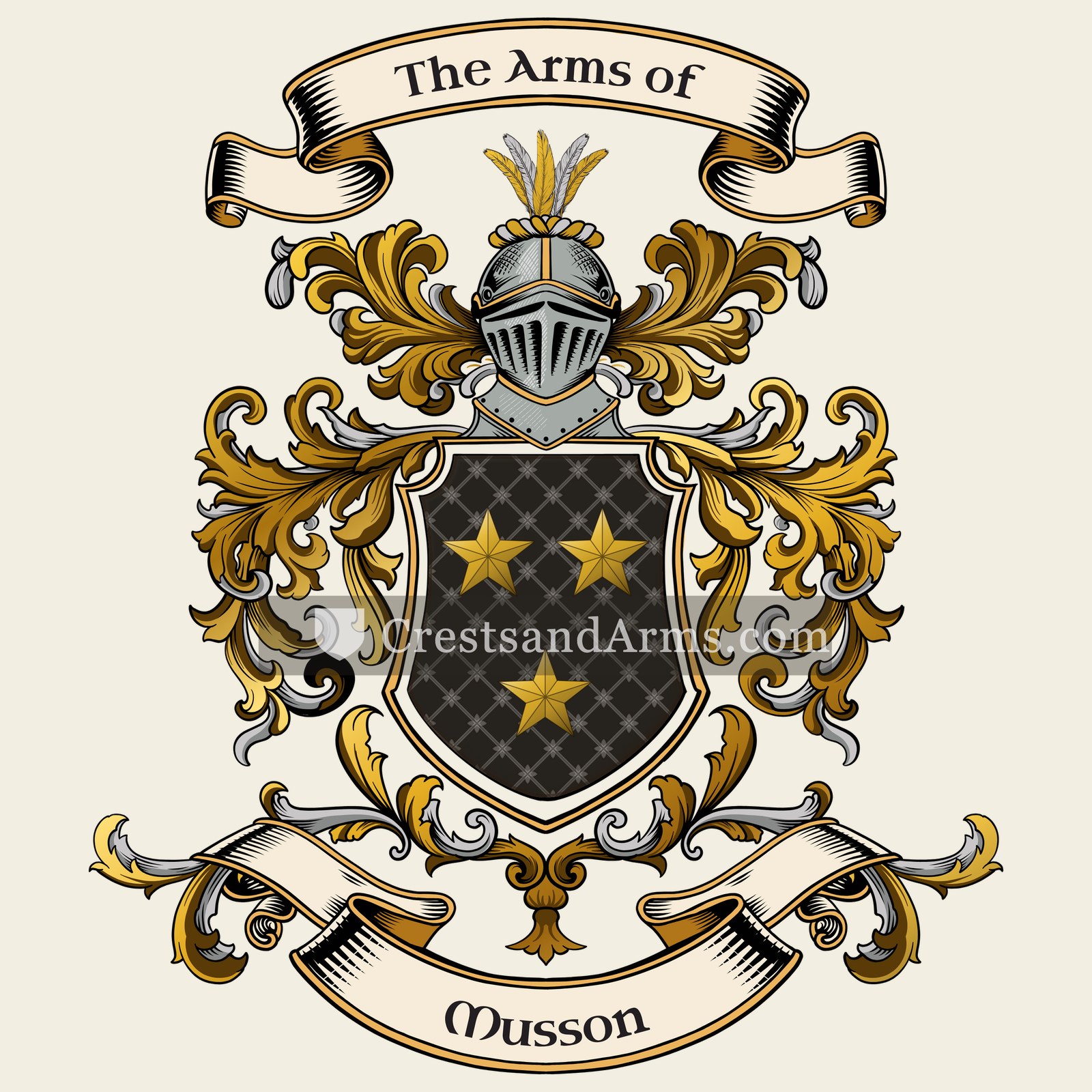


 fessThe military belt, and readiness to serve
 martletA younger son, who must win his own land
 cupFaith, office, and a trust discharged
 crescentHonour by the sovereign, and the second son