Map of Italy showing where the Myron arms are recorded
The Myron arms were recorded in Roussillon, c. 1775.
Roussillon was Pyrenean country that belonged to Spain before it belonged to France. Its families held small estates under both crowns, and serving either one brought a shield.
This is where the arms were entered in the register. Families often moved to other parts of the country, so the same name can turn up in more than one region.
The body that granted and recorded arms in Italy in this period.
Alvise Giovanni Mocenigo
Sovereign of the period
Alvise Giovanni Mocenigo
1763–1778
Reigning in Italy when the Myron arms are first recorded.
How Arms Worked in Italy
In the Italian states, coats of arms were often used by noble families to show their status and history. These symbols were passed down through the generations to all legitimate male descendants. Younger branches of a family usually kept the original design but sometimes added small changes to distinguish their specific line from the main branch.
Granting authority
Various local rulers and city governments controlled the use of coats of arms across the different Italian states.
How they got arms
Families often assumed their own arms or received them as official grants from local lords, popes, or city councils.
Where arms were recorded
Arms were recorded in local city archives or private family books rather than in one single national register.
The family's standing
Recorded among the armigerous families of Roussillon.
Origin & History of the Myron Family in Italy
The name Myron has deep roots that connect to the linguistic and cultural landscape of the Roussillon region in southern France. By the year 1775, families bearing this name were well-established in this area, which sits at the crossroads of French and Catalan influences. The name itself is thought to derive from the ancient Greek word for fragrant oil or perfume, suggesting that early ancestors may have been associated with trade, craftsmanship, or religious roles where such substances were common. As the family lived in Roussillon during the late eighteenth century, they existed in a time of significant social change just before the French Revolution. This region was known for its unique blend of mountain traditions and Mediterranean commerce, and the Myron family likely participated in the agricultural and artisanal life that defined these historic borderlands. Through their presence in local parish registers and land records, these early generations helped shape the identity of the community long before the modern era.
Related Branches & Arms
Root word
Myron
Derived from the Greek word for fragrant oil or perfume.
This name
MyronA name of Greek origin signifying someone who is sweet-smelling or fragrant.
also spelled
Myron
Mirron
Documented Sources
J. B. Rietstap, Armorial Général, Gouda: G. B. van Goor Zonen, 1884–87
Archives départementales des Pyrénées-Orientales, Registres paroissiaux et d'état civil
Archives nationales de France, Série E: Familles et seigneuries
Capeille, Jean, Dictionnaire de biographies roussillonnaises, 1914
Pélissier, Jean-Pierre, Paroisses et communes de France: Pyrénées-Orientales, 1986
Digital archive packCoat of arms PNG, gold border print PDF, vector SVG and the certificate of authenticity. Sent to your email in minutes.


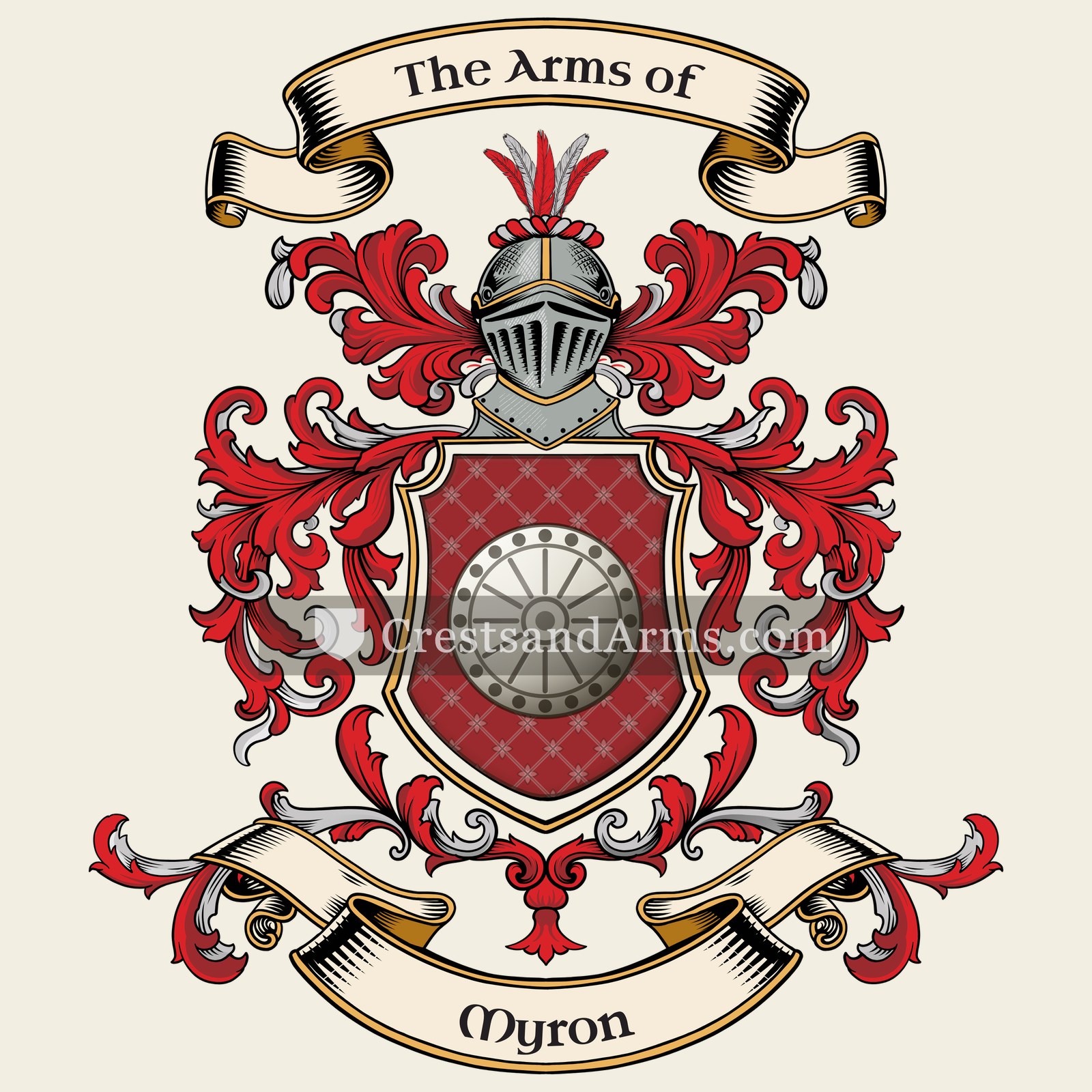
 roundelA coin, and one who has been to the crusades
 roundelA coin, and one who has been to the crusades