Map of Switzerland showing where the Naff arms are recorded
The Naff arms were recorded in Winterthur, c. 1725.
This is where the arms were entered in the register. Families often moved to other parts of the country, so the same name can turn up in more than one region.
The body that granted and recorded arms in Switzerland in this period.
How Arms Worked in Switzerland
In Switzerland, coats of arms were not restricted to the nobility and were often adopted by common citizens and families. These symbols were passed down through generations to show family identity. When branches of a family grew, they often changed small details of the design to distinguish their own line from the original group.
Granting authority
Cantonal and civic authorities managed the use of coats of arms within their specific regions and local jurisdictions.
How they got arms
Families typically assumed their own coats of arms based on local custom rather than receiving them from a central monarch.
Where arms were recorded
Arms were recorded in various cantonal and civic registers starting from the fourteenth century throughout the Swiss region.
The family's standing
Recorded among the armigerous families of Switzerland.
Origin & History of the Naff Family in Switzerland
The Naff family name has deep roots in the region surrounding Winterthur, Switzerland, where records confirm their presence as early as 1725. Historically, the name is associated with the Alemannic German linguistic tradition, likely evolving from local dialects spoken in the cantons near Zurich. Families with this surname were typically integrated into the agricultural and craft-based economy of the Swiss plateau during the eighteenth century. As members of the community, they participated in the local parish systems, which served as the primary method for tracking births, marriages, and deaths before modern civil registration began. Many individuals carrying this name eventually sought new opportunities abroad, contributing to the migration patterns that saw Swiss families settle in various parts of Europe and North America throughout the following decades.
Related Branches & Arms
Root word
Nave
A ship or a vessel used for transport.
This name
NaffA topographical name for someone who lived near a ship or worked as a boatman.
also spelled
Naef
Naf
Nef
Neff
Documented Sources
J. B. Rietstap, Armorial Général, Gouda: G. B. van Goor Zonen, 1884–87
Staatsarchiv des Kantons Zürich, Kirchenbücher der Gemeinde Winterthur (1725)
Heer, Traugott, Die Familiennamen der Stadt Winterthur (1938)
Digital archive packCoat of arms PNG, gold border print PDF, vector SVG and the certificate of authenticity. Sent to your email in minutes.


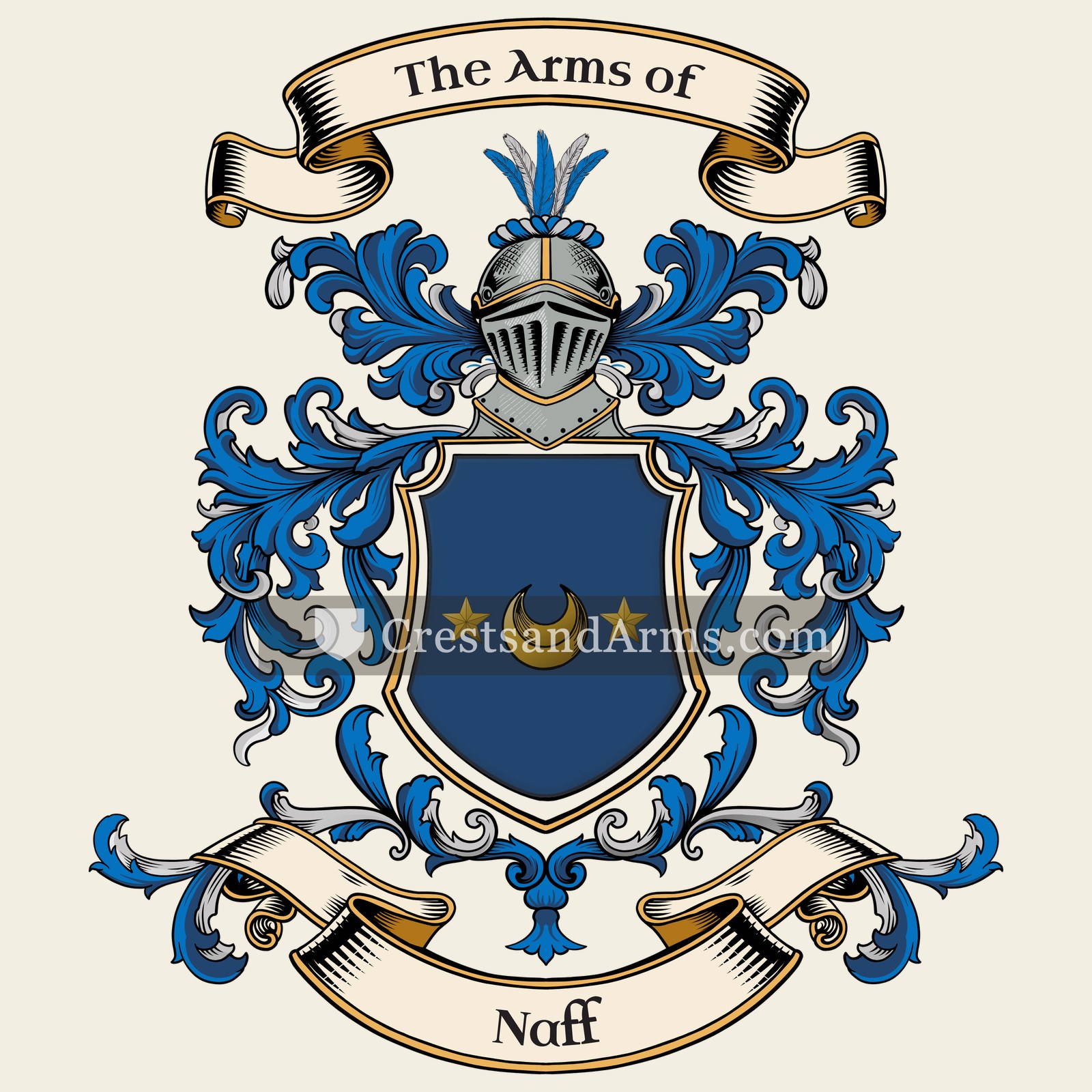
 crescentHonour by the sovereign, and the second son
 mulletThe third son, and a divine quality from above
 crescentHonour by the sovereign, and the second son
 mulletThe third son, and a divine quality from above