Map of France showing where the Nardini arms are recorded
The Nardini arms were recorded in Besançon, c. 1526.
This is where the arms were entered in the register. Families often moved to other parts of the country, so the same name can turn up in more than one region.
The body that granted and recorded arms in France in this period.
Francis I of France
Sovereign of the period
Francis I of France
1515–1547
Reigning in France when the Nardini arms are first recorded.
How Arms Worked in France
In France, a coat of arms was a mark of honor that passed down through the male line to all legitimate descendants. Families often used the same shield without changes to show their shared heritage. If a branch wanted to stand out, they could add a small mark to their shield to show their specific place in the family tree.
Granting authority
The Juge d'armes de France acted as the official authority that regulated and verified coats of arms across the country.
How they got arms
Families typically inherited their arms from ancestors, though they could also receive them through royal grants or by proving their noble status.
Where arms were recorded
Coats of arms were officially recorded in the Armorial Général de France, which began its main collection in the year 1696.
The family's standing
Recorded among the armigerous families of France.
Origin & History of the Nardini Family in France
The Nardini family name originates from the Italian word "nardo," which refers to the aromatic spikenard plant. Historically, this name was often given as a nickname to someone who worked as an herbalist or a merchant of medicinal spices. By the early 16th century, members of the family had moved beyond their Italian roots and established a presence in the city of Besançon. In 1526, records confirm that individuals bearing the Nardini name were living in this region, which was then a strategic crossroads between the Holy Roman Empire and the Kingdom of France. These early family members likely integrated into the local merchant class, utilizing their traditional knowledge of trade and goods to build a stable life in their new home. This migration highlights how families during the Renaissance period moved across borders to pursue new economic opportunities while maintaining their unique ancestral identity.
Related Branches & Arms
Root word
Nardus
A fragrant plant or ointment derived from the spikenard flower.
This name
NardiniA patronymic surname derived from the personal name Nardo, meaning son of Nardo.
also spelled
Nardins
Nardine
Nardyn
Documented Sources
J. B. Rietstap, Armorial Général, Gouda: G. B. van Goor Zonen, 1884–87
Archives départementales du Doubs, Série B: Cours et juridictions
Archives municipales de Besançon, Registres de délibérations communales
Benoit, A., Histoire de Besançon et de la Franche-Comté, 1905
Foisil, M., Le monde des marchands en France au XVIe siècle, 1988
Digital archive packCoat of arms PNG, gold border print PDF, vector SVG and the certificate of authenticity. Sent to your email in minutes.


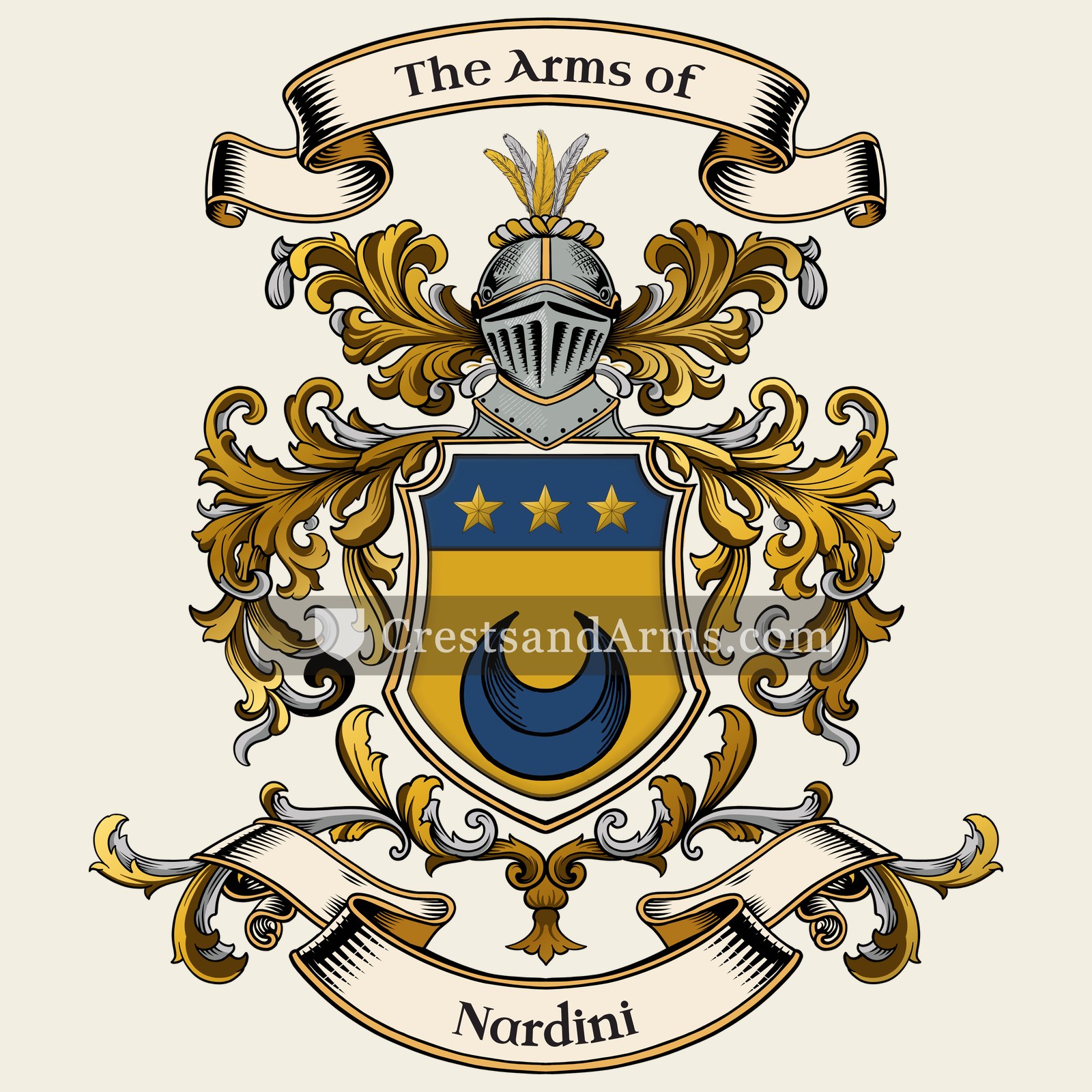
 chiefAuthority, wisdom and dominion
 crescentHonour by the sovereign, and the second son
 mulletThe third son, and a divine quality from above
 chiefAuthority, wisdom and dominion
 crescentHonour by the sovereign, and the second son
 mulletThe third son, and a divine quality from above