Map of England showing where the Nasti arms are recorded
The Nasti arms were recorded in Worcester, c. 1634.
Worcestershire was orchard and farming country with a scattering of old manors. Its gentry were middling rather than great, but a manor was a manor, and holding one was what brought arms.
This is where the arms were entered in the register. Families often moved to other parts of the country, so the same name can turn up in more than one region.
The body that granted and recorded arms in England in this period.
Charles I of England
Sovereign of the period
Charles I of England
1625–1649
Reigning in England when the Nasti arms are first recorded.
How Arms Worked in England
English heraldry allowed arms to be shared by all legitimate descendants of the original owner. These symbols were treated as personal property that moved through the generations to all children. While the eldest son kept the original design, other family members could use the same shield without needing to change it or register their own unique versions.
Granting authority
The College of Arms in London has regulated the use of coats of arms throughout England and Wales since 1484.
How they got arms
Families typically obtained their coats of arms through a formal grant from the Crown or by proving their ancient right to them.
Where arms were recorded
All official coats of arms are recorded in the registers kept at the College of Arms, which date back to the fifteenth century.
The family's standing
Recorded among the armigerous families of Worcester.
Origin & History of the Nasti Family in England
The history of the Nasti family name is deeply connected to the movement of people across Europe and eventually into the American colonies. While the name has strong roots in Southern Italy, early records show that individuals bearing this name were established in Worcester, Massachusetts, as early as 1634. During this period, the region was part of a rapidly growing frontier where settlers relied on agriculture and trade to survive. Families like the Nastis often played essential roles in building these early communities by clearing land and establishing local businesses. As they settled into their new environment, they helped shape the social and economic landscape of the Massachusetts Bay Colony. Over the centuries, the family name became a bridge between their Mediterranean heritage and the evolving identity of colonial America.
Related Branches & Arms
Root word
Anastasius
Derived from the Greek word for resurrection or rising again.
This name
NastiA diminutive or variant form of names originating from the Greek term for resurrection.
also spelled
Neest
Neste
Neist
Documented Sources
Sir Bernard Burke, The General Armory of England, Scotland, Ireland and Wales, London: Harrison & Sons, 1884
Anderson, Robert Charles. The Great Migration Begins: Immigrants to New England, 1620–1633. 1995
Massachusetts State Archives. Colonial Records of the Massachusetts Bay Colony. 1628–1686
Digital archive packCoat of arms PNG, gold border print PDF, vector SVG and the certificate of authenticity. Sent to your email in minutes.


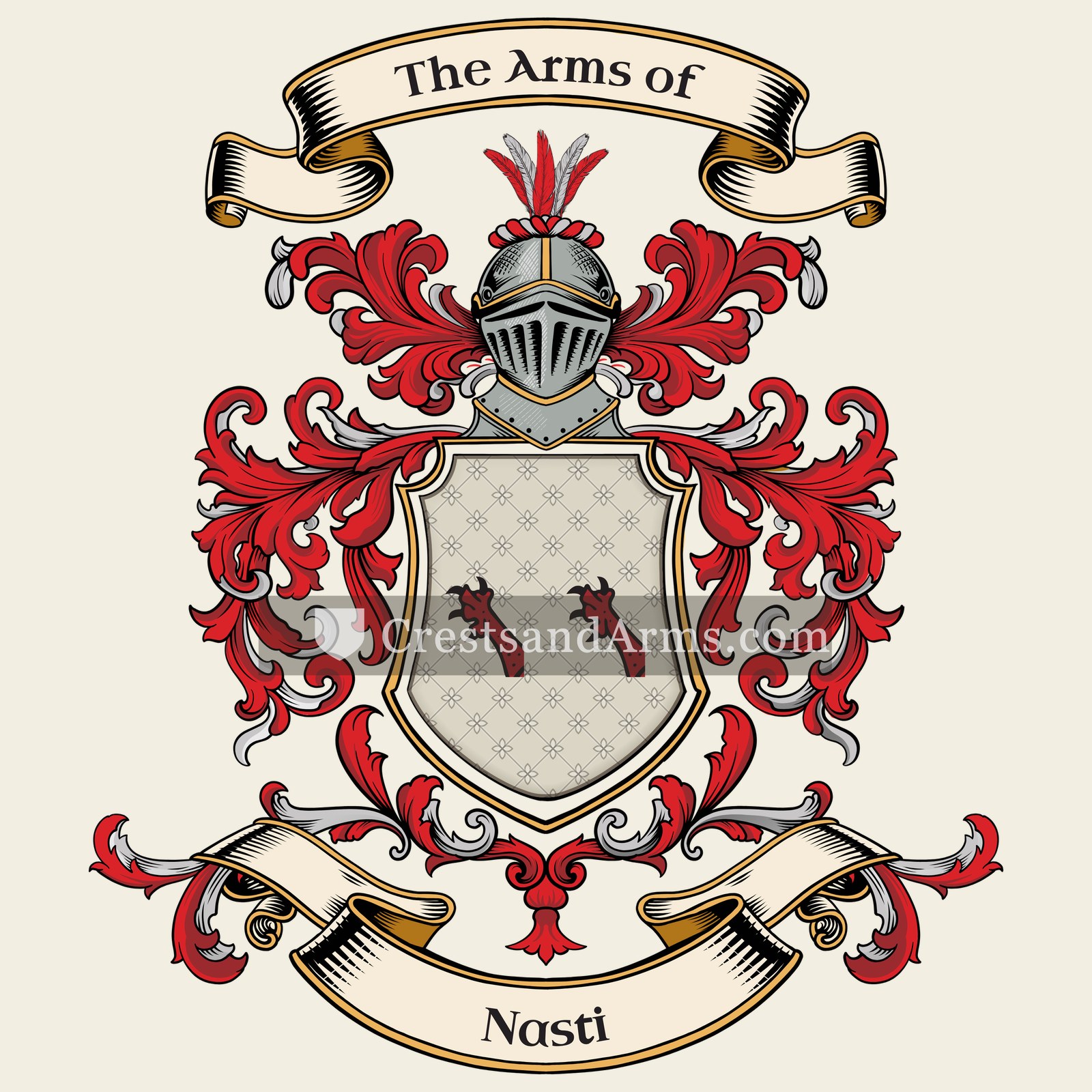
 pawStrength held ready, the beast's power in a single limb
 pawStrength held ready, the beast's power in a single limb