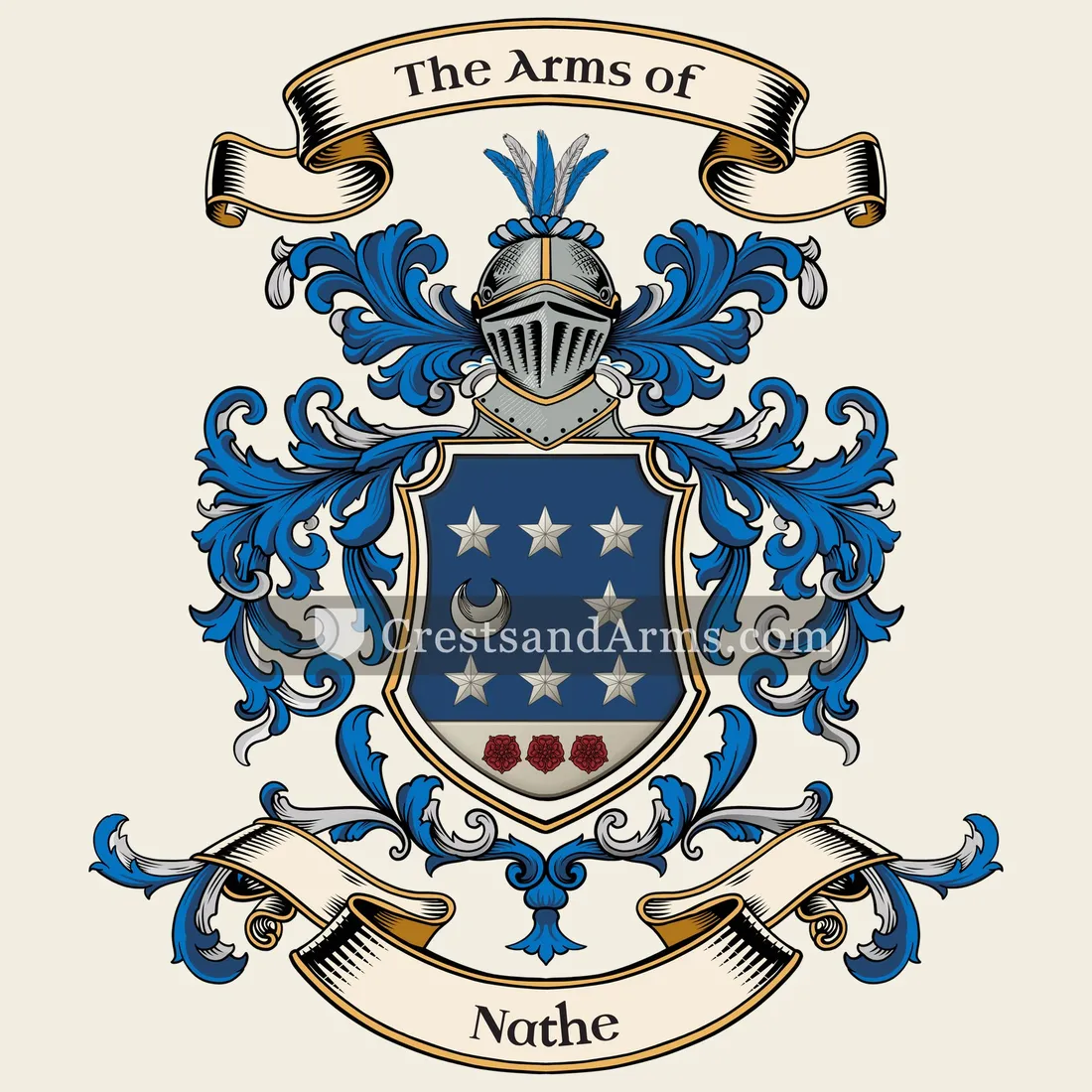
A record of documented arms, meaning and origin, researched for the Nathe family of Switzerland.
Reg. 8904 · Swiss, M–O
Meaning of the Nathe family crest colors & symbols
Symbols on this shield
crescentHonour by the sovereign, and the second son
mulletThe third son, and a divine quality from above
roseThe seventh son, and beauty with grace
Colours
Blue (Azure)Means: Loyalty and truth
Silver (Argent)Means: Peace and sincerity
Red (Gules)Means: Military strength
Historical info
Source
J. B. Rietstap, Armorial Général, Gouda: G. B. van Goor Zonen, 1884–87
Blazon (the actual original written record)
“D'azur à un croiss. tourné d'arg., acc. de sept étoiles du même, dont six rangées en deux pals et la septième en p., entre les deux étoiles plus basses; à la champagne d'arg., ch. de trois roses mal-ordonnées de gu., mouv. d'une seule tige de sin., feuillée du même.”
Switzerlandc. 1745
Digital archive packCoat of arms PNG, gold border print PDF, vector SVG and the certificate of authenticity. Sent to your email in minutes.
Map of Switzerland showing where the Nathe arms are recorded
The Nathe arms were recorded in Switzerland, c. 1745.
Arms such as these were typically recorded in Bern.
Bern was the largest of the Swiss cantons and ran itself, with its own council and its own courts. Its governing families held office for generations, and office of that kind carried a shield with it.
This is where the arms were entered in the register. Families often moved to other parts of the country, so the same name can turn up in more than one region.
The body that granted and recorded arms in Switzerland in this period.
How Arms Worked in Switzerland
In Switzerland, coats of arms were not restricted to the nobility and were often adopted by common citizens and families. These symbols were passed down through generations to show family identity. When branches of a family grew, they often changed small details of the design to distinguish their own line from the original group.
Granting authority
Cantonal and civic authorities managed the use of coats of arms within their specific regions and local jurisdictions.
How they got arms
Families typically assumed their own coats of arms based on local custom rather than receiving them from a central monarch.
Where arms were recorded
Arms were recorded in various cantonal and civic registers starting from the fourteenth century throughout the Swiss region.
The family's standing
Recorded among the armigerous families of Switzerland.
Origin & History of the Nathe Family in Switzerland
The family name Nathe has deep roots in the Swiss canton of Bern, where records confirm members of the family were established by the mid-18th century. During the year 1745, the region was characterized by a stable social structure where families often remained in the same rural or urban districts for generations. The name likely evolved as a localized variation of Germanic naming traditions, which frequently linked individuals to their specific trade, geographic origin, or a shortened form of a given name. As residents of Bern, the early Nathe family would have been part of a society governed by a mix of local councils and traditional customs. Over time, the family members moved through the Swiss landscape, eventually spreading the name to other regions as they sought new opportunities in agriculture or craftsmanship. This historical presence in Bern serves as the anchor for the family lineage and highlights their long-standing connection to the cultural history of central Europe.
Nathe Meaning & Related Branches
Root word
Nathan
Derived from the Hebrew verb meaning to give or to bestow.
This name
NatheA patronymic surname indicating descent from an ancestor named Nathan or Nathaniel.
also spelled
Natthei
Nattheye
Nattheig
Natay
Documented Sources
J. B. Rietstap, Armorial Général, Gouda: G. B. van Goor Zonen, 1884–87
Staatsarchiv des Kantons Bern, Kirchenbücher der Kirchgemeinde Bern (1745)
Dubler, Anne-Marie, Der Kanton Bern im 18. Jahrhundert (1995)
Digital archive packCoat of arms PNG, gold border print PDF, vector SVG and the certificate of authenticity. Sent to your email in minutes.


 crescentHonour by the sovereign, and the second son
 mulletThe third son, and a divine quality from above
 roseThe seventh son, and beauty with grace
 crescentHonour by the sovereign, and the second son
 mulletThe third son, and a divine quality from above
 roseThe seventh son, and beauty with grace