A record of documented arms, meaning and origin, researched for the Necker family lines. Documented in 2 countries.
Reg. 4378 · German, M–O
Coat of Arms & Family Crest Details
Symbols on this shield
fessThe military belt, and readiness to serve
horseReadiness to serve king and country
fishA true and generous mind, and Christian faith
Colours
Blue (Azure)Means: Loyalty and truth
Black (Sable)Means: Constancy
Silver (Argent)Means: Peace and sincerity
Gold (Or)Means: Generosity
Historical info
Source
J. B. Rietstap, Armorial Général, Gouda: G. B. van Goor Zonen, 1884–87
Blazon (the actual original written record)
“D'azur à la fasce ondée de sa., acc. en chef d'un cheval naiss. d'arg., mouv. de la fasce, et en p. d'un turbot nageant et cont. d'or. Brl. d'or et de sa. C.: un More iss. de sa. hab. d'azur à brandebourgs d'or, tort. du même; entre deux prob. coupées alt. d'or et de sa. qu'il empoigne de ses mains. L.: d'or, d'azur et de sa.”
SilesiaSilesia, c. 1653
Digital archive packCoat of arms PNG, gold border print PDF, vector SVG and the certificate of authenticity. Sent to your email in minutes.
Map of Germany showing where the Necker arms are recorded
The Necker arms were recorded in Silesia, c. 1653.
Silesia was farming country in the east of the German lands, held in large estates by families who stayed put for generations. Owning land was what entitled a family to arms, so the region fills a good deal of the register.
This is where the arms were entered in the register. Families often moved to other parts of the country, so the same name can turn up in more than one region.
The body that granted and recorded arms in Germany in this period.
Ferdinand III, Holy Roman Emperor
Sovereign of the period
Ferdinand III, Holy Roman Emperor
1637–1657
Reigning in Germany when the Necker arms are first recorded.
How Arms Worked in Germany
In the Holy Roman Empire, coats of arms were often granted to individuals by the Emperor or his representatives. These arms were then passed down through the generations to all legitimate descendants of the original holder. Younger branches of a family usually kept the same shield design without needing to change it, as the arms belonged to the entire lineage.
Granting authority
The Holy Roman Emperor held the sole power to grant new coats of arms throughout his vast imperial territories.
How they got arms
Families typically obtained their coats of arms through a formal imperial grant or by proving their noble status to the authorities.
Where arms were recorded
These grants were officially recorded in the Imperial Chancery registers, which began keeping formal records of such honors during the Middle Ages.
The family's standing
Recorded among the armigerous families of Silesia.
Origin & History of the Necker Family in Germany
The surname Necker emerged as a distinct family identifier within the German-speaking regions of Central Europe, with documented roots tracing back to the mid-17th century. Historical records confirm the presence of the family in the region of Silesia by 1653, a time when the area was a complex crossroads of cultural and religious shifts. The name itself is often linked to the geography of the German landscape, specifically relating to those who lived near the Neckar River or worked in occupations associated with the waterway. As the family established itself in Silesia, they became part of the local social fabric during a period of significant reconstruction following the Thirty Years' War. Over the following generations, members of the Necker family integrated into the administrative and professional life of the German states, moving from their early regional origins into broader roles within the evolving European society.
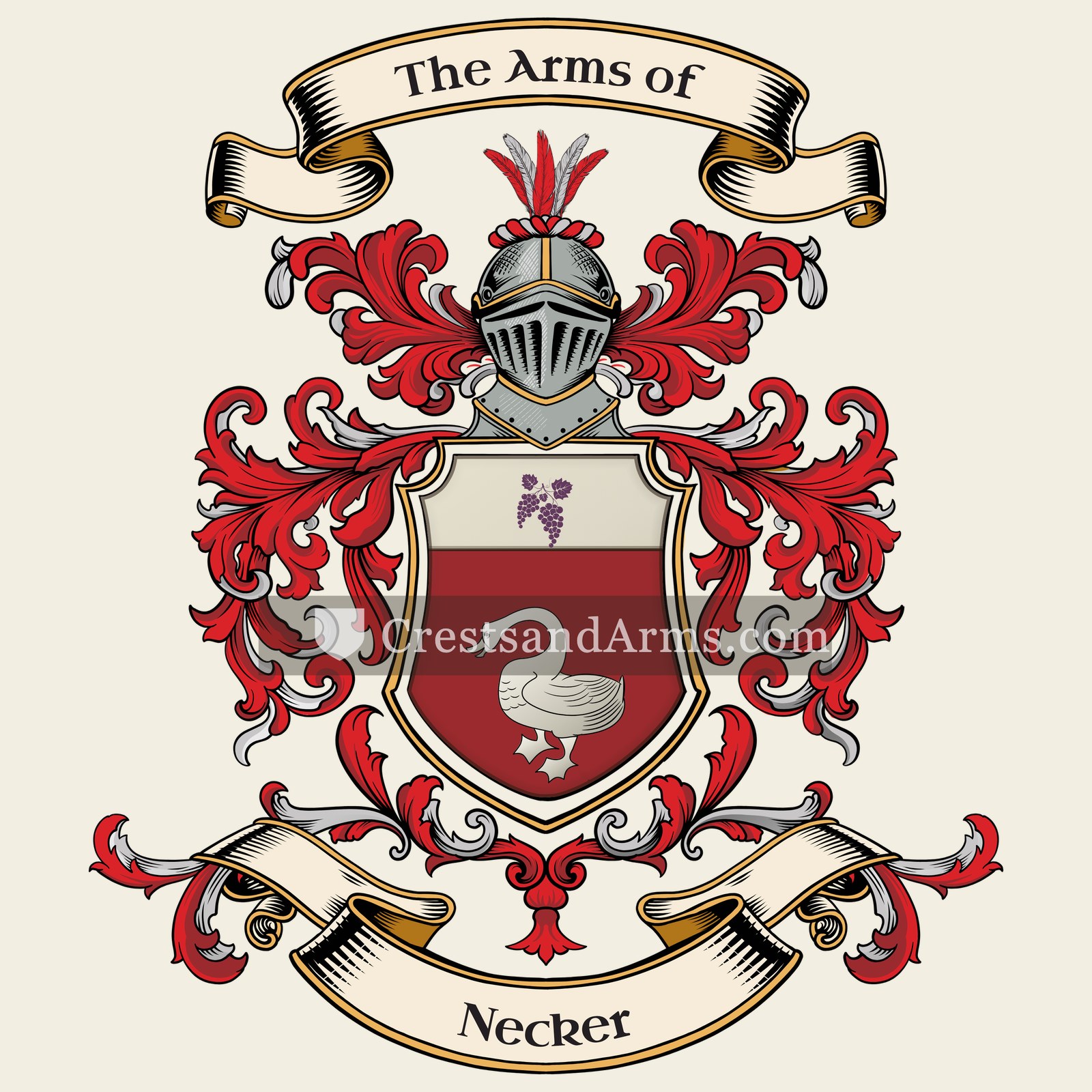
Coat of Arms & Family Crest Details
Symbols on this shield
chiefAuthority, wisdom and dominion
swanGrace, light and the poet's art
grapesPlenty, and the labour of the vine
Colours
Red (Gules)Means: Military strength
Silver (Argent)Means: Peace and sincerity
Purple (Purpure)Means: Royal majesty
Historical info
Source
J. B. Rietstap, Armorial Général, Gouda: G. B. van Goor Zonen, 1884–87
Blazon (the actual original written record)
“De gu. à un cygne d'arg., nageant dans une mer du même; au chef du sec., ch. d'une grappe de raisins de pourpre, pamprée de sin., posée en fasce, la tige à sen. [Armes de Jacques N., contrôleur-général des finances sous Louis XVI.]”
SwitzerlandGenève, c. 1745
Digital archive packCoat of arms PNG, gold border print PDF, vector SVG and the certificate of authenticity. Sent to your email in minutes.
Map of Switzerland showing where the Necker arms are recorded
The Necker arms were recorded in Genève, c. 1745.
This is where the arms were entered in the register. Families often moved to other parts of the country, so the same name can turn up in more than one region.
The body that granted and recorded arms in Switzerland in this period.
How Arms Worked in Switzerland
In Switzerland, coats of arms were not restricted to the nobility and were often adopted by common citizens and families. These symbols were passed down through generations to show family identity. When branches of a family grew, they often changed small details of the design to distinguish their own line from the original group.
Granting authority
Cantonal and civic authorities managed the use of coats of arms within their specific regions and local jurisdictions.
How they got arms
Families typically assumed their own coats of arms based on local custom rather than receiving them from a central monarch.
Where arms were recorded
Arms were recorded in various cantonal and civic registers starting from the fourteenth century throughout the Swiss region.
The family's standing
Recorded among the armigerous families of Switzerland.
Origin & History of the Necker Family in Switzerland
The Necker family established a significant presence in Geneva by the mid-eighteenth century, marking a transition from their origins in the German-speaking territories of the Holy Roman Empire to the intellectual heart of Switzerland. The name itself is rooted in the German language, likely derived from a geographic reference or a descriptive nickname common in the regions surrounding the Neckar River. By 1745, members of the family had fully integrated into the social and professional fabric of Geneva, which was then a thriving independent republic known for its banking and scholarly culture. This migration was part of a broader trend where talented individuals moved to Geneva to participate in its unique political and economic environment. The family quickly rose to prominence, eventually producing figures who influenced both Swiss local affairs and the wider European political landscape. Their success in Geneva highlights how families from neighboring regions could settle in the city and become essential contributors to its history during the Enlightenment era.
Related Branches & Arms
Root word
Neckar
A river name derived from the Celtic word for violent water.
This name
NeckerA topographic name for someone who lived near the Neckar river.
also spelled
Neker
Documented Sources
J. B. Rietstap, Armorial Général, Gouda: G. B. van Goor Zonen, 1884–87
Bahlow, Hans, Deutsches Namenlexikon: Familien- und Vornamen nach Ursprung und Sinn erklärt, 1967
Heintze, Albert, Die deutschen Familien-Namen: geschichtlich, geographisch, sprachlich, 1903
State Archive in Wrocław (Archiwum Państwowe we Wrocławiu), Księgi metrykalne i akta stanu cywilnego, 1653
Digital archive packCoat of arms PNG, gold border print PDF, vector SVG and the certificate of authenticity. Sent to your email in minutes.


 fessThe military belt, and readiness to serve
 horseReadiness to serve king and country
 fishA true and generous mind, and Christian faith
 fessThe military belt, and readiness to serve
 horseReadiness to serve king and country
 fishA true and generous mind, and Christian faith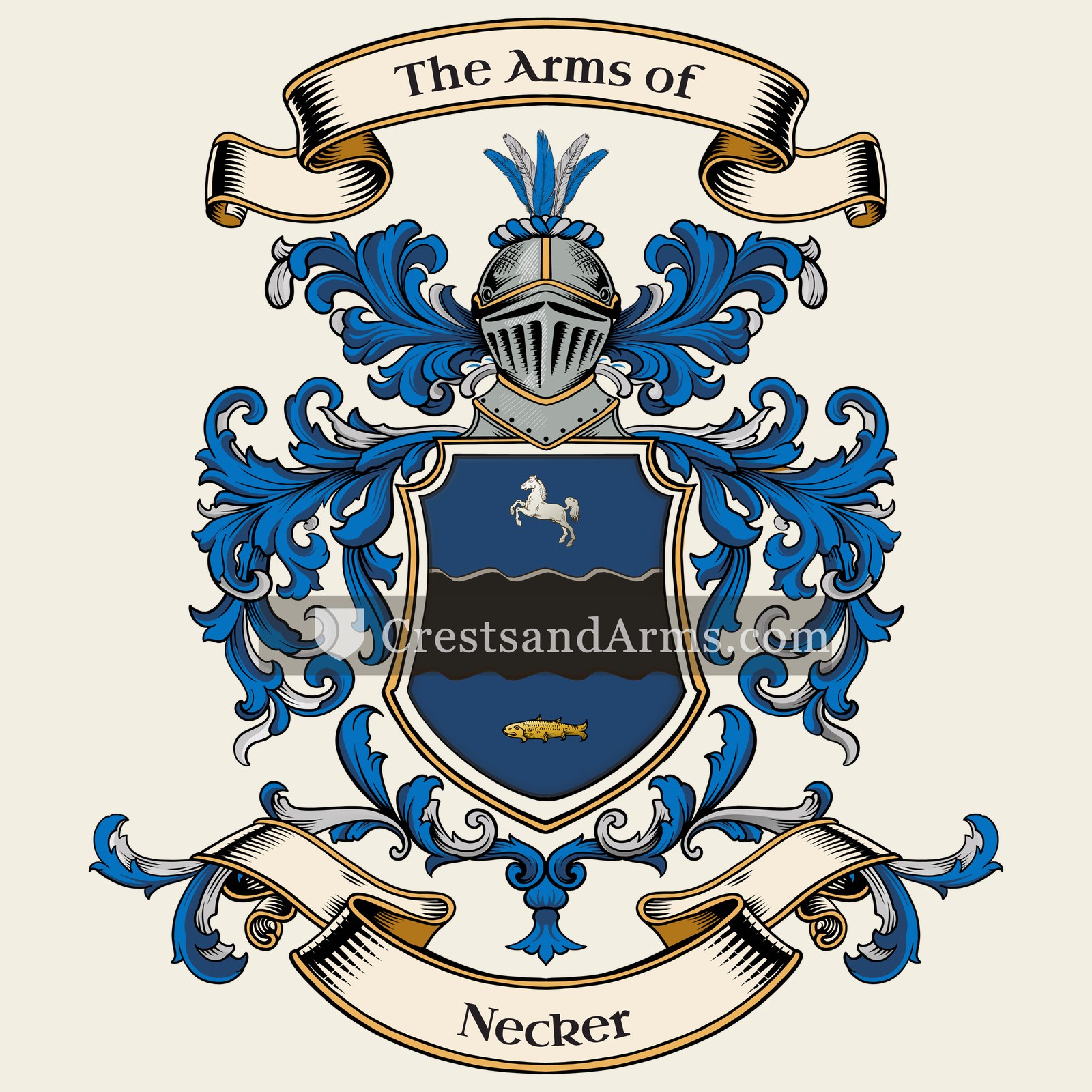


 chiefAuthority, wisdom and dominion
 swanGrace, light and the poet's art
 grapesPlenty, and the labour of the vine