A record of documented arms, meaning and origin, researched for the Neidert family lines. Documented in 2 countries.
Reg. 9480 · German, M–O
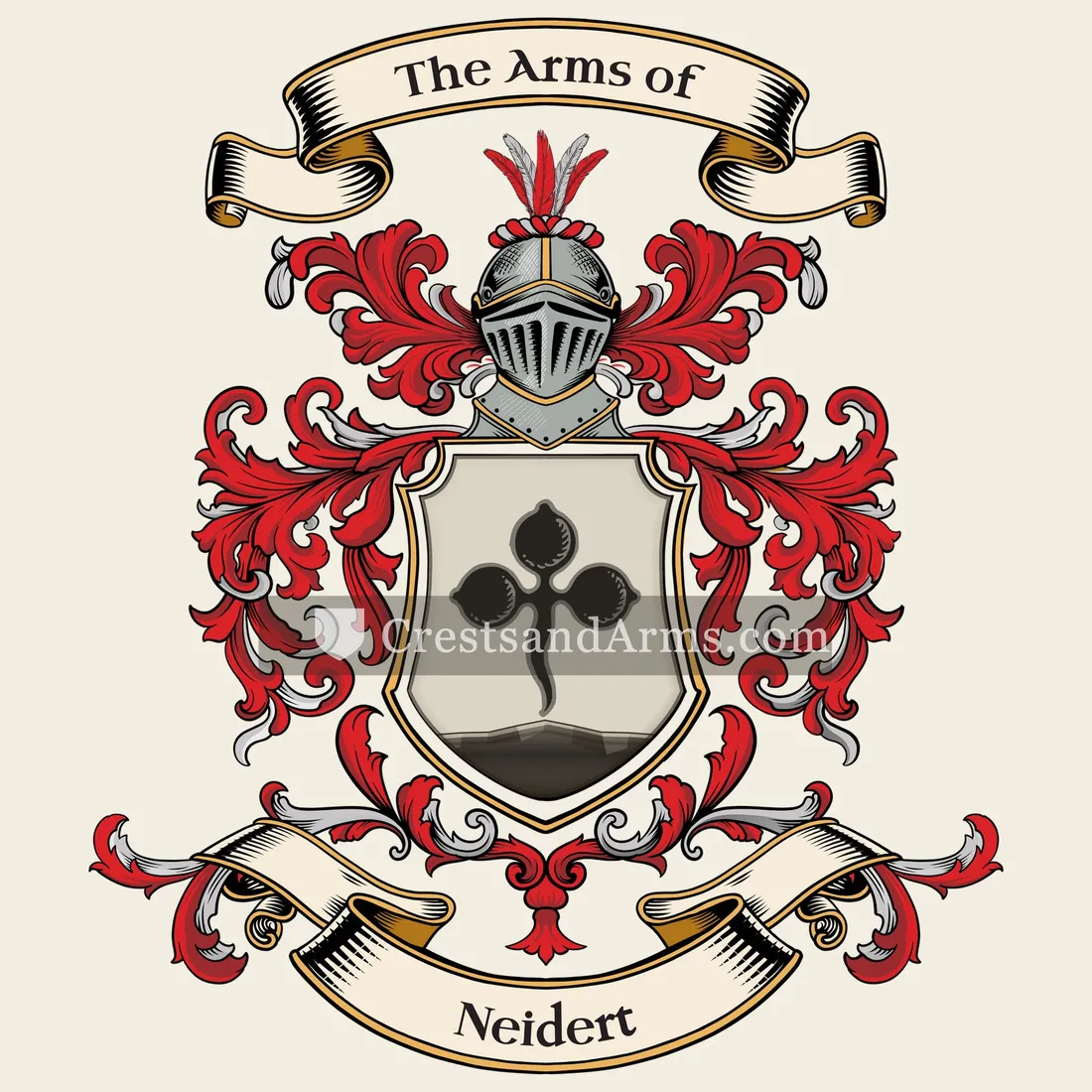
Meaning of the Neidert family crest colors & symbols
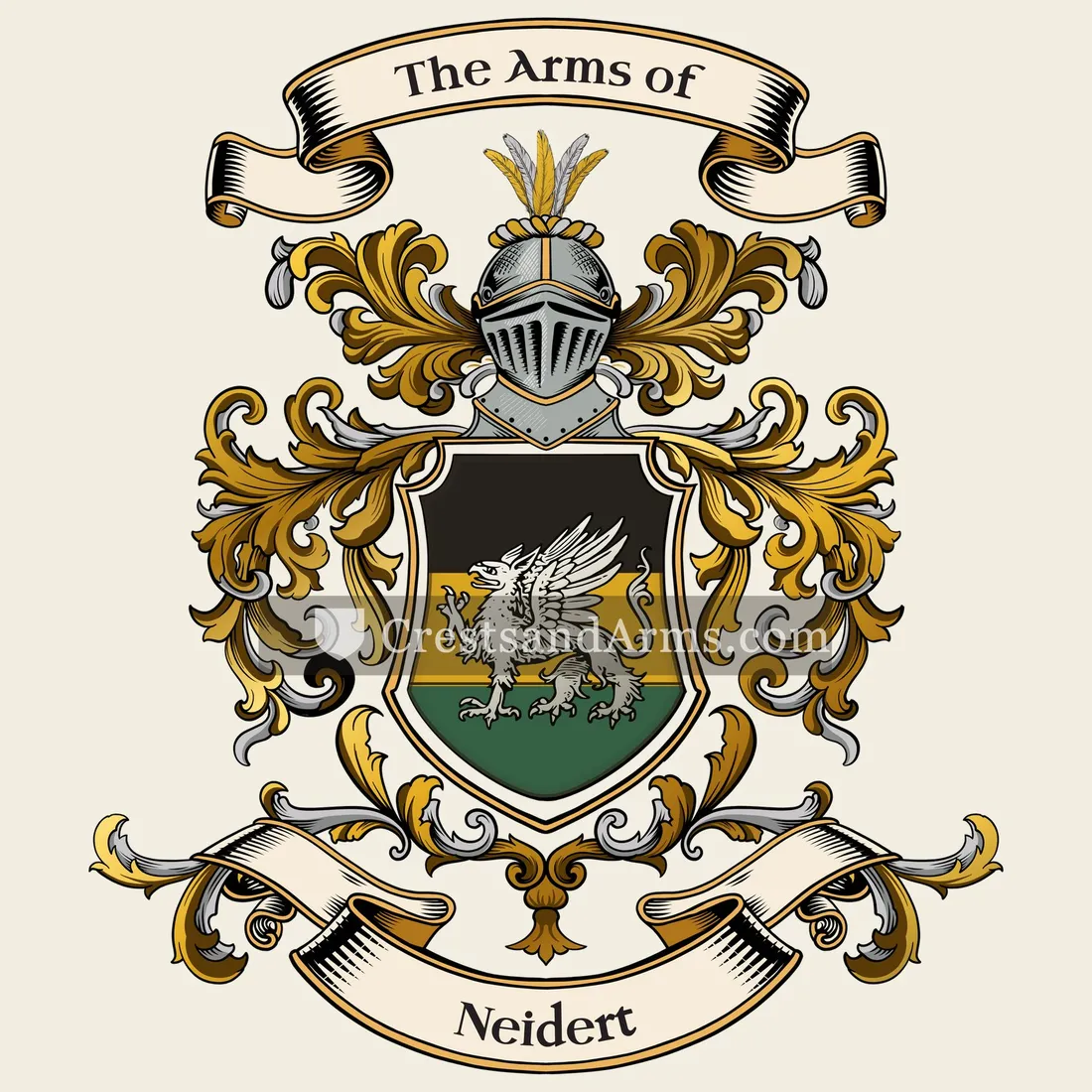
Symbols on this shield
griffinValour and vigilance, guarding great treasure
Colours
Black (Sable)Means: Constancy
Gold (Or)Means: Generosity
Green (Vert)Means: Hope
Silver (Argent)Means: Peace and sincerity
Historical info
Source
J. B. Rietstap, Armorial Général, Gouda: G. B. van Goor Zonen, 1884–87
Blazon (the actual original written record)
“Tiercé en fasce de sa., d'or et de sin.; à un griffon d'arg., bq. d'or, br. sur le tout, tenant un caducée d'or, ailé d'arg., les serpents au nat. Brl. de sa., d'or et de sin. C.: le griffon, iss. L.: à dextre d'or et de sin., à sen. d'or et de sa.”
WurttembergWurttemberg, c. 1765
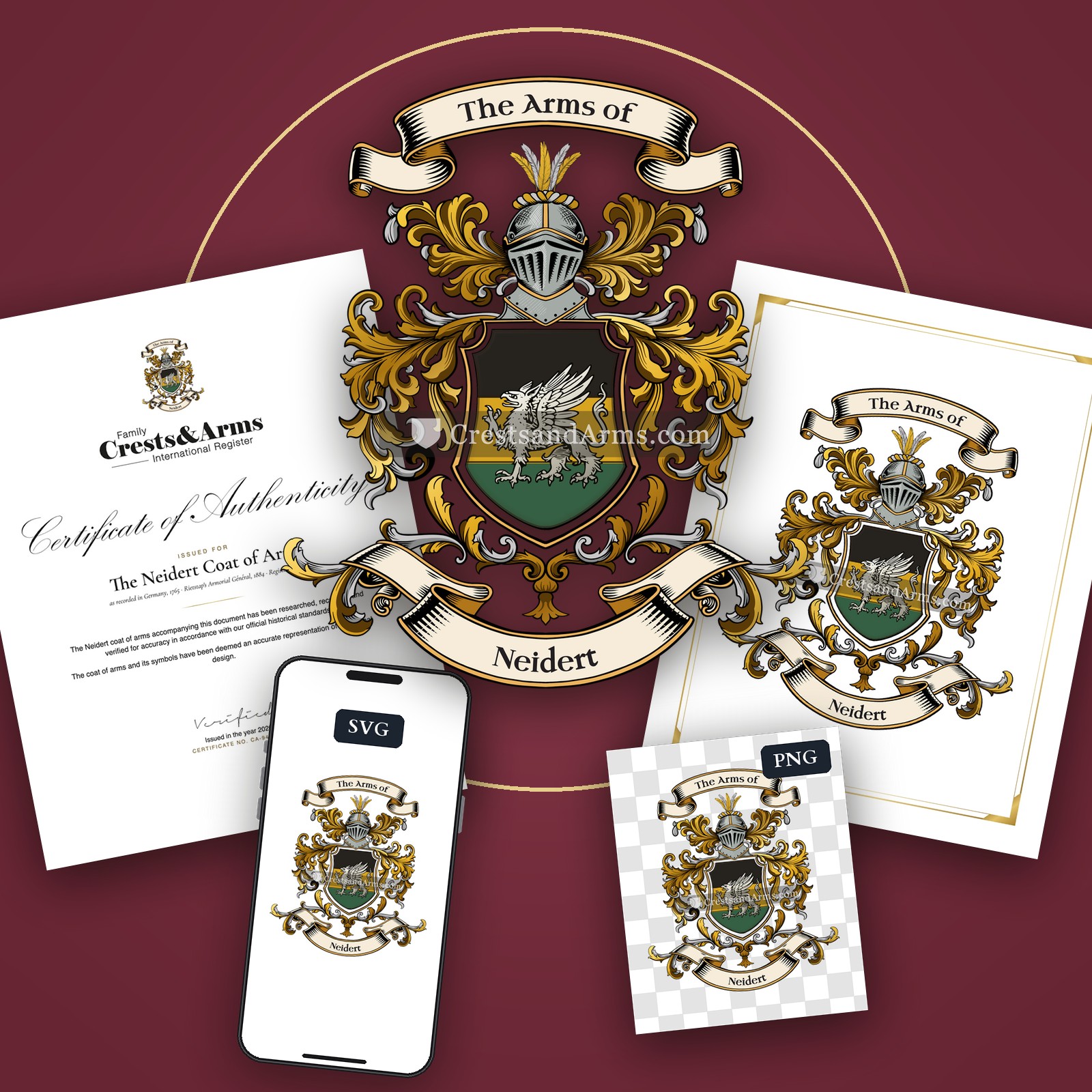
Digital archive packCoat of arms PNG, gold border print PDF, vector SVG and the certificate of authenticity. Sent to your email in minutes.
Map of Germany showing where the Neidert arms are recorded
The Neidert arms were recorded in Wurttemberg, c. 1765.
Wurttemberg was southern German country of small estates and well-off market towns. Both landowners and leading townsmen kept arms there, so the region carries far more names than its size suggests.
This is where the arms were entered in the register. Families often moved to other parts of the country, so the same name can turn up in more than one region.
The body that granted and recorded arms in Germany in this period.
Francis I, Holy Roman Emperor
Sovereign of the period
Francis I, Holy Roman Emperor
1745–1765
Reigning in Germany when the Neidert arms are first recorded.
How Arms Worked in Germany
In the Holy Roman Empire, coats of arms were often granted to individuals by the Emperor or his representatives. These arms were then passed down through the generations to all legitimate descendants of the original holder. Younger branches of a family usually kept the same shield design without needing to change it, as the arms belonged to the entire lineage.
Granting authority
The Holy Roman Emperor held the sole power to grant new coats of arms throughout his vast imperial territories.
How they got arms
Families typically obtained their coats of arms through a formal imperial grant or by proving their noble status to the authorities.
Where arms were recorded
These grants were officially recorded in the Imperial Chancery registers, which began keeping formal records of such honors during the Middle Ages.
The family's standing
Recorded among the armigerous families of Wurttemberg.
Origin & History of the Neidert Family in Germany
The surname Neidert finds its roots in the southwestern region of Germany, specifically within the historic territory of Württemberg. Linguistically, the name is derived from Middle High German terms that often described a person’s temperament or their standing within a local community. By the mid-18th century, records confirm that families bearing this name were well-established in the rural landscapes of this region. Life in Württemberg during the 1760s was defined by a strong connection to the land, as most families worked as farmers or skilled craftsmen in small village settings. Because the region was composed of many independent territories, the Neidert family likely lived under the influence of local nobility while maintaining their own traditions and trades. These early ancestors were part of a stable social structure that relied on parish records and local administrative documents to track births, marriages, and property ownership. This history reflects the broader experience of many families in the German southwest who built their lives through generations of agricultural labor and community involvement.
Meaning of the Neidert family crest colors & symbols
Symbols on this shield
mountThe ground held, and steadfastness upon it
trefoilPerpetuity, and the Trinity
Colours
Silver (Argent)Means: Peace and sincerity
Black (Sable)Means: Constancy
Historical info
Source
J. B. Rietstap, Armorial Général, Gouda: G. B. van Goor Zonen, 1884–87
Blazon (the actual original written record)
“D'arg. à un trèfle de sa., posé sur un tertre de trois coupeaux du même. Cq. cour. C.: un vol à l'antique, aux armes de l'écu.”
BavariaBavaria, c. 1772
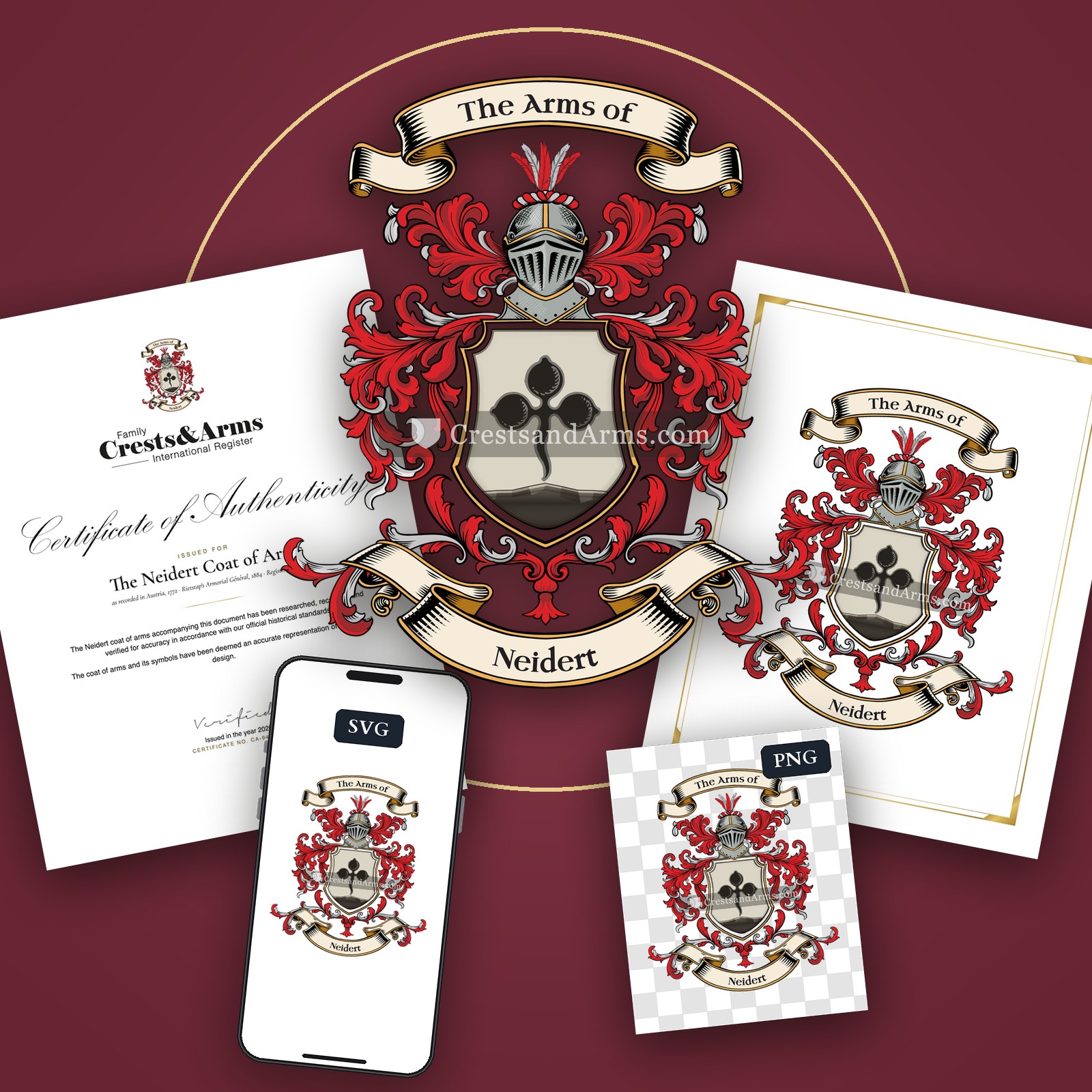
Digital archive packCoat of arms PNG, gold border print PDF, vector SVG and the certificate of authenticity. Sent to your email in minutes.
Map of Austria showing where the Neidert arms are recorded
The Neidert arms were recorded in Bavaria, c. 1772.
Bavaria was a country of old landed families and walled market towns. Estates passed down the same line for centuries, and both the landowners and the leading townsmen kept arms, which is why so many Bavarian names sit in the registers.
This is where the arms were entered in the register. Families often moved to other parts of the country, so the same name can turn up in more than one region.
Region
Bavaria
First recorded
1772
Granting Authority for the Neidert Arms
Imperial and Royal chancery
Sodacan · CC BY-SA 3.0
The body that granted and recorded arms in Austria in this period.
Joseph II, Holy Roman Emperor
Sovereign of the period
Joseph II, Holy Roman Emperor
1765–1790
Reigning in Germany when the Neidert arms are first recorded.
How Arms Worked in Austria
Austrian coats of arms were often linked directly to noble titles granted by the Emperor. These symbols belonged to the entire family line rather than just one individual. When a family grew, new branches kept the original design without needing to change it. This system allowed all members of a noble house to share the same identity across many generations.
Granting authority
The Imperial and Royal chancery managed all heraldic matters and controlled the official granting of arms throughout the Austrian lands.
How they got arms
Families typically received their arms through a formal imperial decree that often accompanied the elevation of a person to noble status.
Where arms were recorded
Official records of these grants were kept in the Imperial Register of Nobility which began its formal documentation process in 1453.
The family's standing
Recorded among the armigerous families of Bavaria.
Origin & History of the Neidert Family in Austria
The name Neidert finds its roots in the German-speaking regions of Central Europe, with strong historical ties to the borderlands between Bavaria and Austria. Etymologically, the name is derived from the Middle High German word "neid," which originally carried the meaning of zeal, ambition, or intense striving rather than its modern connotation of envy. Families bearing this name were often associated with the agrarian and artisan classes that moved fluidly across the permeable borders of the Holy Roman Empire. By the late 18th century, as administrative record-keeping became more standardized in the Austrian Empire, the Neidert family was already well-established in the region. These early ancestors likely lived as independent farmers or skilled tradespeople, taking advantage of the economic shifts occurring in the Danube basin. Their presence in Bavaria by 1772 suggests a lineage deeply connected to the regional trade routes that linked Munich to the Austrian heartland, reflecting a history of movement and adaptation within the changing political landscape of the era.
Neidert Meaning & Related Branches
Root word
Neid
Envy, jealousy, or intense desire.
This name
NeidertA descriptive nickname for an envious person or one who is covetous.
also spelled
Neidhart
Neidhard
Naidhart
Documented Sources
J. B. Rietstap, Armorial Général, Gouda: G. B. van Goor Zonen, 1884–87
Brechenmacher, Josef Karlmann. Etymologisches Wörterbuch der deutschen Familiennamen. 1957
Hauptstaatsarchiv Stuttgart. Kirchenbücher der evangelischen Landeskirche in Württemberg. 1765
Heintze, Albert. Die deutschen Familiennamen: geschichtlich, geographisch, sprachlich. 1903
Digital archive packCoat of arms PNG, gold border print PDF, vector SVG and the certificate of authenticity. Sent to your email in minutes.


 griffinValour and vigilance, guarding great treasure
 griffinValour and vigilance, guarding great treasure


 mountThe ground held, and steadfastness upon it
 trefoilPerpetuity, and the Trinity