Map of Germany showing where the Neidlinger arms are recorded
The Neidlinger arms were recorded in Swabia, c. 1765.
Swabia was broken into a great many small territories in southern Germany, and each had its own landowners and its own leading townsmen. That fragmentation produced an unusual number of families with arms.
This is where the arms were entered in the register. Families often moved to other parts of the country, so the same name can turn up in more than one region.
The body that granted and recorded arms in Germany in this period.
Francis I, Holy Roman Emperor
Sovereign of the period
Francis I, Holy Roman Emperor
1745–1765
Reigning in Germany when the Neidlinger arms are first recorded.
How Arms Worked in Germany
In the Holy Roman Empire, coats of arms were often granted to individuals by the Emperor or his representatives. These arms were then passed down through the generations to all legitimate descendants of the original holder. Younger branches of a family usually kept the same shield design without needing to change it, as the arms belonged to the entire lineage.
Granting authority
The Holy Roman Emperor held the sole power to grant new coats of arms throughout his vast imperial territories.
How they got arms
Families typically obtained their coats of arms through a formal imperial grant or by proving their noble status to the authorities.
Where arms were recorded
These grants were officially recorded in the Imperial Chancery registers, which began keeping formal records of such honors during the Middle Ages.
The family's standing
Recorded among the armigerous families of Swabia.
Origin & History of the Neidlinger Family in Germany
The surname Neidlinger originates from the historical region of Swabia in southwestern Germany. The name is locative in nature, meaning it was likely adopted by families who lived in or near the town of Neidlingen, located at the foot of the Swabian Jura mountains. During the eighteenth century, the family was well-established in this area, with records confirming their presence by 1765. The name itself is derived from the Old High German language, where the suffix "inger" denotes people who belong to a specific place. Families with this name were typically part of the rural agricultural society common to the region, often working as farmers or skilled tradespeople within their local village communities. As the population grew, some members of the family began to migrate to neighboring towns, carrying the name across the Swabian landscape while maintaining their ancestral ties to the region.
Neidlinger Meaning & Related Branches
Root word
Neid
Germanic term for envy, jealousy, or intense desire.
This name
NeidlingerA habitational name for someone originating from a place called Neidlingen, meaning people from the envious one's settlement.
also spelled
Neidling
Naidlingen
Documented Sources
J. B. Rietstap, Armorial Général, Gouda: G. B. van Goor Zonen, 1884–87
Bohnenberger, Friedrich. Die Ortsnamen des Königreichs Württemberg. 1928
Kohlhammer, W. Württembergisches Urkundenbuch. 1907
Hauptstaatsarchiv Stuttgart, Kirchenbücher der evangelischen Landeskirche in Württemberg
Digital archive packCoat of arms PNG, gold border print PDF, vector SVG and the certificate of authenticity. Sent to your email in minutes.


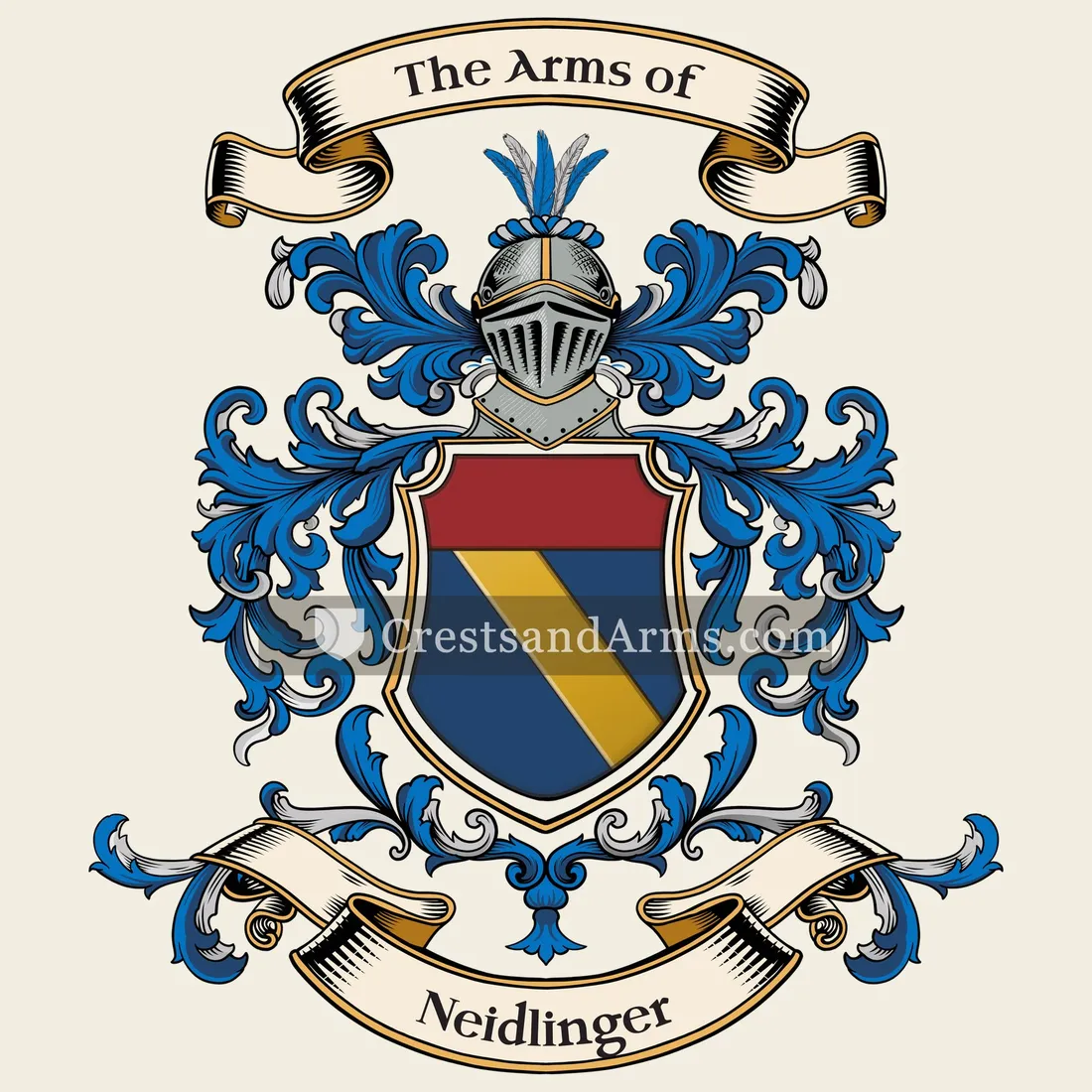
 bendDefence, and the scarf of a commander
 chiefAuthority, wisdom and dominion
 bendDefence, and the scarf of a commander
 chiefAuthority, wisdom and dominion