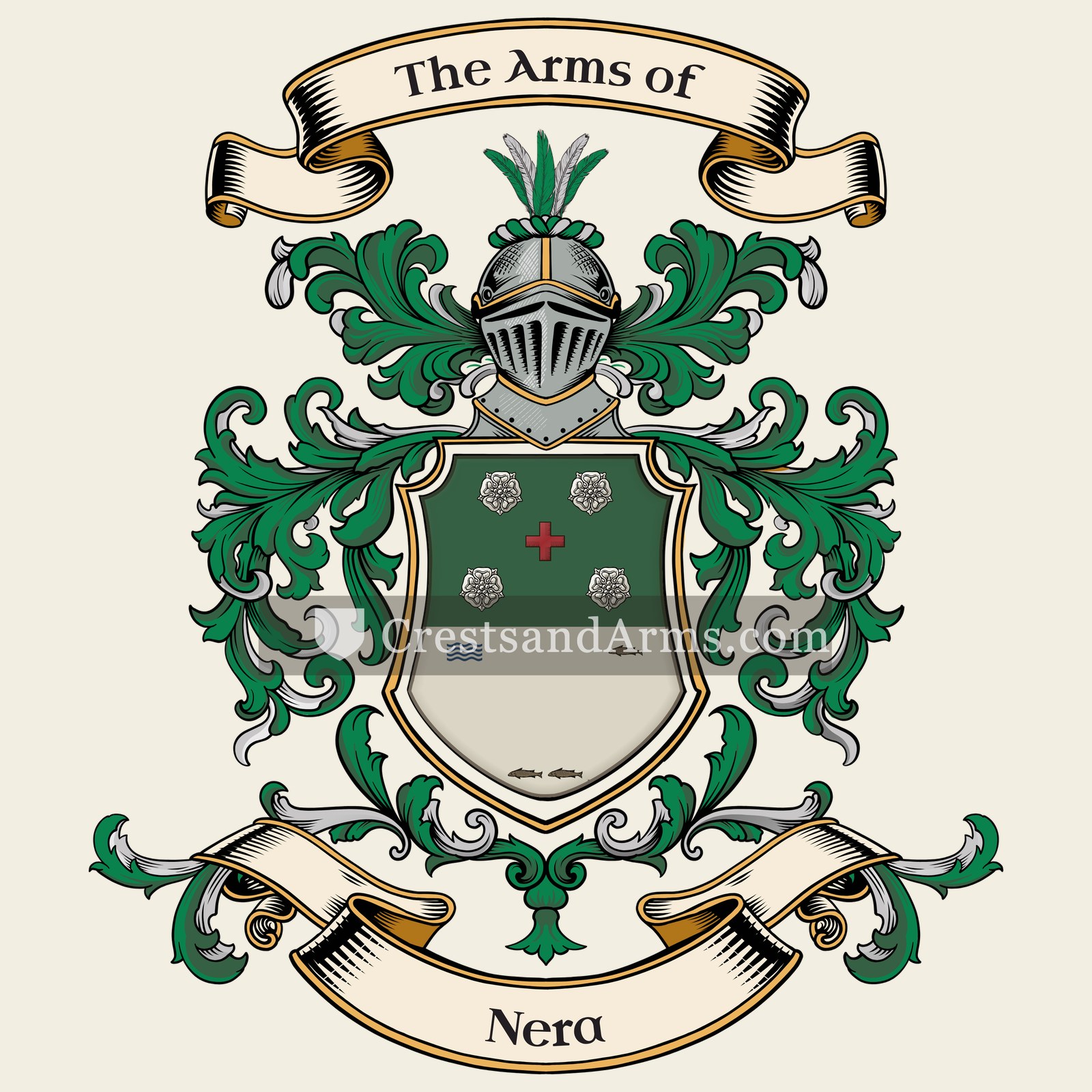
A record of documented arms, meaning and origin, researched for the Nera family of Spain.
Reg. 4332 · Spanish, M–O
Coat of Arms & Family Crest Details
Symbols on this shield
cross symbolChristian faith and service
roseThe seventh son, and beauty with grace
riverThe bounds of a land, and life carried through it
troutPlenty, and the rivers of the family's country
Colours
Green (Vert)Means: Hope
Silver (Argent)Means: Peace and sincerity
Red (Gules)Means: Military strength
Blue (Azure)Means: Loyalty and truth
Historical info
Source
J. B. Rietstap, Armorial Général, Gouda: G. B. van Goor Zonen, 1884–87
Blazon (the actual original written record)
“Coupé: au 1 de sin. à la croix de Calatrava de gu., sommée de quatre roses d'arg., tigées et feuillée de sin., deux sur le bras supérieur et deux sur les branches; au 2 d'arg. à une mer d'azur agitée d'arg. en p., dans laquelle nagent trois truites au nat., 1 et 2.”
AragonAragon, c. 1722
Digital archive packCoat of arms PNG, gold border print PDF, vector SVG and the certificate of authenticity. Sent to your email in minutes.
Map of Spain showing where the Nera arms are recorded
The Nera arms were recorded in Aragon, c. 1722.
Aragon was mountain and river country in north-eastern Spain, with a strong tradition of small independent landholders. A great many families counted as gentry there, and each one needed a shield to be told apart.
This is where the arms were entered in the register. Families often moved to other parts of the country, so the same name can turn up in more than one region.
The body that granted and recorded arms in Spain in this period.
Philip V of Spain
Sovereign of the period
Philip V of Spain
1714–1724
Reigning in Spain when the Nera arms are first recorded.
How Arms Worked in Spain
In Spain, a coat of arms was considered a form of property that belonged to the entire family line. These arms were passed down from a father to all his children equally. Younger branches of the family usually kept the original design without needing to add any special marks to distinguish their specific line.
Granting authority
The Cronista Rey de Armas was the official body that regulated and granted coats of arms throughout Spain.
How they got arms
Families often obtained their arms through royal grants or by proving their noble status to the official heraldic authority.
Where arms were recorded
Coats of arms were officially recorded in the registers of the Cronista Rey de Armas starting in 1496.
The family's standing
Recorded among the armigerous families of Aragon.
Origin & History of the Nera Family in Spain
The family name Nera has deep roots in the historical region of Aragon, Spain, where members of the family were documented as early as 1722. During the eighteenth century, Aragon was a land defined by its transition from a kingdom into a centralized administrative province under the Spanish Crown. Families living in this area often worked in agriculture or local trade, contributing to the distinct cultural identity of the Ebro River valley. The name itself likely evolved from local geographic markers or descriptive nicknames used by neighbors to identify specific households in small mountain villages. As the family grew, they became part of the social fabric of the region, participating in the local parish life and the rural economy that sustained the Aragonese people during this era of change.
Related Branches & Arms
Root word
Niger
Latin term meaning black or dark in color.
This name
NeraA topographic or descriptive surname referring to someone with dark hair or complexion.
also spelled
Neirah
Neirae
Naira
Documented Sources
J. B. Rietstap, Armorial Général, Gouda: G. B. van Goor Zonen, 1884–87
Archivo de la Corona de Aragón, Archivo de Protocolos de Zaragoza
García Ciprés, Gregorio, Linajes de Aragón, 1915
Ubieto Arteta, Antonio, Historia de Aragón, 1981
Digital archive packCoat of arms PNG, gold border print PDF, vector SVG and the certificate of authenticity. Sent to your email in minutes.


 cross symbolChristian faith and service
 roseThe seventh son, and beauty with grace
 riverThe bounds of a land, and life carried through it
 troutPlenty, and the rivers of the family's country
 cross symbolChristian faith and service
 roseThe seventh son, and beauty with grace
 riverThe bounds of a land, and life carried through it
 troutPlenty, and the rivers of the family's country