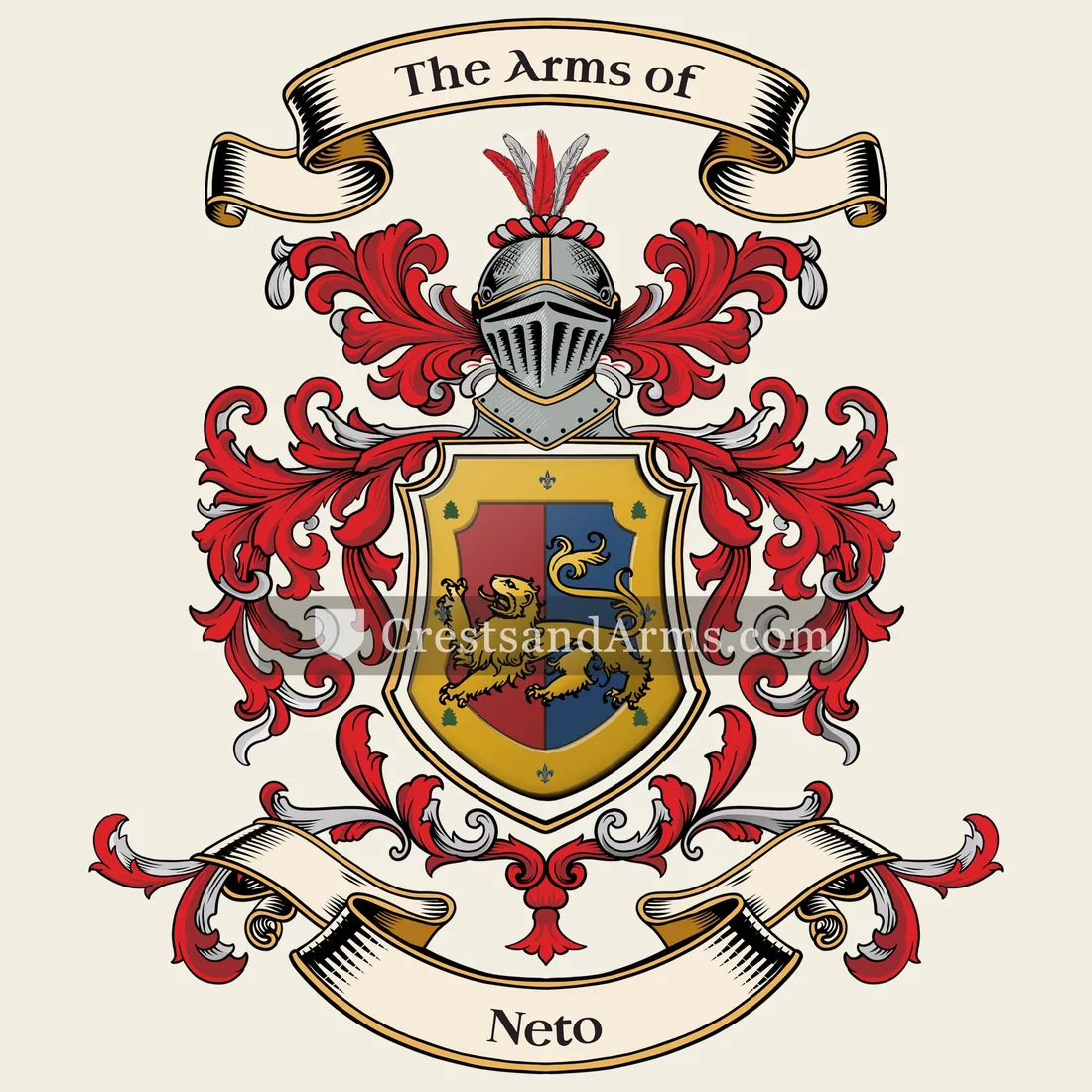
A record of documented arms, meaning and origin, researched for the Neto family of Portugal.
Reg. 2615 · Portuguese, M–O
Meaning of the Neto family crest colors & symbols
Symbols on this shield
lionCourage, strength and royalty
fleur de lisPurity, light, and the sixth son
leafHappiness and abundance
Colours
Red (Gules)Means: Military strength
Blue (Azure)Means: Loyalty and truth
Gold (Or)Means: Generosity
Green (Vert)Means: Hope
Historical info
Source
J. B. Rietstap, Armorial Général, Gouda: G. B. van Goor Zonen, 1884–87
Blazon (the actual original written record)
“Parti de gu. et d'azur; au lion d'or, br. sur le coupé. L'écu entouré d'une bord. d'or, ch. de quatre fleurs-de-lis d'azur aux quatre angles, alternant avec quatre feuilles de figuier de sin. [V. França-Netto.]”
Portugalc. 1706
Digital archive packCoat of arms PNG, gold border print PDF, vector SVG and the certificate of authenticity. Sent to your email in minutes.
Map of Portugal showing where the Neto arms are recorded
The Neto arms were recorded in Portugal, c. 1706.
Arms such as these were typically recorded in Lisboa.
Lisbon was the seat of the Portuguese crown and the port its wealth came through. Families made rich by trade and by service to the king took arms, and the crown's heralds recorded them there.
This is where the arms were entered in the register. Families often moved to other parts of the country, so the same name can turn up in more than one region.
The body that granted and recorded arms in Portugal in this period.
Peter II of Portugal
Sovereign of the period
Peter II of Portugal
1683–1706
Reigning in Portugal when the Neto arms are first recorded.
How Arms Worked in Portugal
In Portugal, a coat of arms was a family possession that passed from a father to his children. Every legitimate descendant had the right to use the family shield without needing to change it. Younger branches of the family kept the original design, though they sometimes added small symbols to distinguish their specific line from the main branch.
Granting authority
The Cartório da Nobreza acted as the official body that managed and regulated noble titles and coats of arms in Portugal.
How they got arms
Families typically inherited their arms through bloodline, though they could also receive new grants from the crown for distinguished service.
Where arms were recorded
Coats of arms were officially recorded in the books of the Cartório da Nobreza starting in the year 1512.
The family's standing
Recorded among the armigerous families of Portugal.
Origin & History of the Neto Family in Portugal
The surname Neto originated as a descriptive nickname in the Portuguese language, functioning as a way to distinguish family members within a community. In Portuguese, the word "neto" translates directly to "grandson," and it was historically used to identify a younger man who shared the same given name as his grandfather. By the early 18th century, the name was well-established among the urban population of Lisboa. Records from 1706 confirm that families bearing this name were active participants in the social and economic life of the capital city during this period. As the name transitioned from a simple nickname to a formal hereditary surname, it became a permanent marker of lineage for families living in the bustling neighborhoods of Lisbon.
Neto Meaning & Related Branches
Root word
Nepos
Latin term meaning grandson or descendant.
This name
NetoA Portuguese surname historically used to distinguish a grandson from a grandfather with the same name.
also spelled
Nettoe
Nettoo
Neto
Documented Sources
J. B. Rietstap, Armorial Général, Gouda: G. B. van Goor Zonen, 1884–87
Antenor Nascentes, Dicionário Etimológico da Língua Portuguesa, 1932
José Pedro Machado, Dicionário Onomástico Etimológico da Língua Portuguesa, 1981
Arquivo Nacional da Torre do Tombo, Registos Paroquiais de Lisboa, 1706
Digital archive packCoat of arms PNG, gold border print PDF, vector SVG and the certificate of authenticity. Sent to your email in minutes.


 lionCourage, strength and royalty
 fleur de lisPurity, light, and the sixth son
 leafHappiness and abundance
 lionCourage, strength and royalty
 fleur de lisPurity, light, and the sixth son
 leafHappiness and abundance