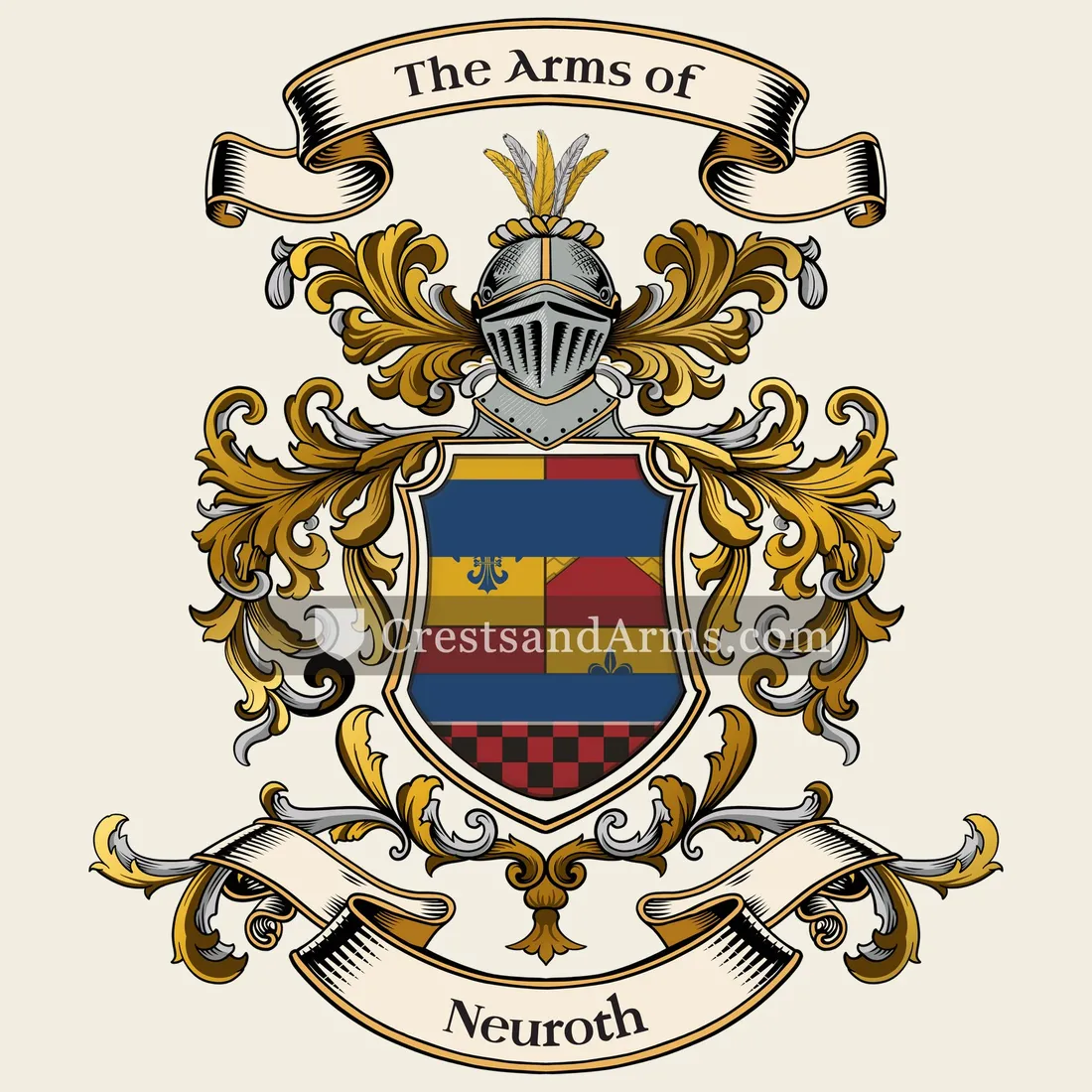
A record of documented arms, meaning and origin, researched for the Neuroth family lines. Documented in 2 countries.
Reg. 6021 · Russian, M–O
Meaning of the Neuroth family crest colors & symbols
Symbols on this shield
chiefAuthority, wisdom and dominion
chequyConstancy, and the counting-board
lionCourage, strength and royalty
Colours
Red (Gules)Means: Military strength
Gold (Or)Means: Generosity
Historical info
Source
J. B. Rietstap, Armorial Général, Gouda: G. B. van Goor Zonen, 1884–87
Blazon (the actual original written record)
“de gu. au lion d'or, cour. du même, tenant une hache d'arg. au manche arrondi d'or; au chef échiq. d'arg. et de gu. de deux tires. Sur le tout d'or à trois bandes d'azur. Deux cq. cour. C.: 1° deux pl. d'aut., d'or et d'azur; 1. d'arg. et de gu.; 2° un lion iss. d'or; 1. d'or et d'azur. S.: deux griffons reg. d'or.”
Russiac. 1784
Digital archive packCoat of arms PNG, gold border print PDF, vector SVG and the certificate of authenticity. Sent to your email in minutes.
Map of Russia showing where the Neuroth arms are recorded
The Neuroth arms were recorded in Russia, c. 1784.
Arms such as these were typically recorded in Moscow.
Moscow held the Russian court, and rank there came from service rather than land. Families who served the Tsar were entered in the registers of nobility, and that entry is where their arms are recorded.
This is where the arms were entered in the register. Families often moved to other parts of the country, so the same name can turn up in more than one region.
The body that granted and recorded arms in Russia in this period.
Catherine II of Russia
Sovereign of the period
Catherine II of Russia
1762–1796
Reigning in Russia when the Neuroth arms are first recorded.
How Arms Worked in Russia
Russian heraldry was strictly tied to the nobility and the state service system. Families proved their ancient status or earned new rank to receive an official grant from the Tsar. These symbols were then inherited by all legitimate children of the noble line. If a family lacked proof of their status, they were often excluded from the official records entirely.
Granting authority
The Herald Master's Office acted as the central state body that strictly regulated and verified all noble heraldic symbols.
How they got arms
Families typically received their arms through a formal state grant or by proving their noble status to the government authorities.
Where arms were recorded
All approved coats of arms were officially recorded in the General Armorial of the Noble Families of the Russian Empire starting in 1797.
The family's standing
Recorded among the armigerous families of Russia.
Origin & History of the Neuroth Family in Russia
The Neuroth family name first appeared in the historical records of Moscow in 1784, marking the beginning of their documented presence in the Russian Empire. During this era, many families with European roots moved to Russia to serve in the imperial administration, the military, or the growing professional classes of the capital. The Neuroths likely integrated into the cosmopolitan society of Moscow, where they lived alongside other foreign-born families who contributed to the city's intellectual and commercial development. As they established themselves in their new home, the family navigated the complex social hierarchies of the late eighteenth century. Their presence in the city during this period suggests they were part of the wave of migration that helped shape the modern character of Moscow. By maintaining their identity while adapting to Russian customs, the early members of the Neuroth family became a small but permanent part of the city's long and diverse history.
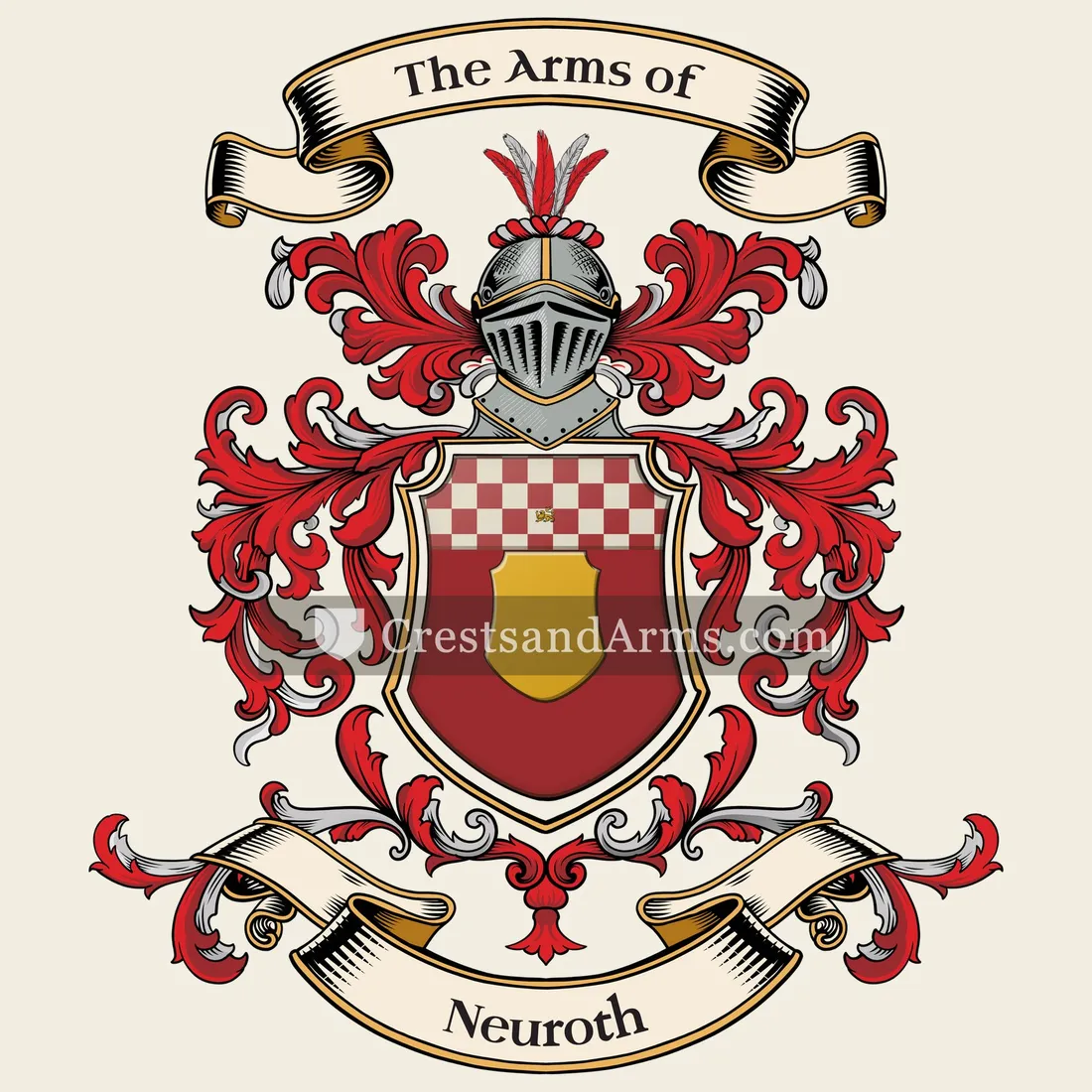
Meaning of the Neuroth family crest colors & symbols
Symbols on this shield
fessThe military belt, and readiness to serve
chevronProtection, and faithful service completed
chequyConstancy, and the counting-board
fleur de lisPurity, light, and the sixth son
Colours
Gold (Or)Means: Generosity
Red (Gules)Means: Military strength
Blue (Azure)Means: Loyalty and truth
Historical info
Source
J. B. Rietstap, Armorial Général, Gouda: G. B. van Goor Zonen, 1884–87
Blazon (the actual original written record)
“Ec.: aux 1 et 4 d'or à deux fasces d'azur, haussées au-dessus d'une fleur-de-lis du même; au 2 de gu. au chev. d'or, et à la champagne échiq. d'arg. et de gu. de deux tires; au”
Swedenc. 1687
Digital archive packCoat of arms PNG, gold border print PDF, vector SVG and the certificate of authenticity. Sent to your email in minutes.
Map of Sweden showing where the Neuroth arms are recorded
The Neuroth arms were recorded in Sweden, c. 1687.
Arms such as these were typically recorded in Stockholm.
Stockholm held the Swedish court and the House of Nobility, where every noble family's arms were entered and kept. Families ennobled for service registered there, which is why so many are recorded around the city.
This is where the arms were entered in the register. Families often moved to other parts of the country, so the same name can turn up in more than one region.
The body that granted and recorded arms in Sweden in this period.
Charles XI of Sweden
Sovereign of the period
Charles XI of Sweden
1660–1697
Reigning in Russia when the Neuroth arms are first recorded.
How Arms Worked in Sweden
In Sweden, a coat of arms belonged to a noble family as a whole rather than just one individual. These arms were passed down through the generations to all legitimate descendants. Younger branches of the family used the same shield without needing to change it. This system ensured that the entire lineage shared the same identity and status under the law.
Granting authority
The Riddarhuset, or House of Nobility, regulated all noble coats of arms in Sweden under royal authority.
How they got arms
Families received their coats of arms through royal grants of nobility which were then officially registered with the House.
Where arms were recorded
Coats of arms were officially recorded in the Swedish House of Nobility register starting in the year 1626.
The family's standing
Recorded among the armigerous families of Sweden.
Origin & History of the Neuroth Family in Sweden
The Neuroth family name first appears in the historical records of Stockholm during the late seventeenth century, specifically documented in the year 1687. During this era, Sweden was a major European power, and the capital city served as a bustling hub for skilled tradespeople and administrative officials. The name likely arrived in the city through the movement of professionals seeking opportunities within the growing Swedish bureaucracy or the expanding urban merchant class. Because the name does not follow traditional Swedish naming patterns, which often relied on patronymics like Andersson or Nilsson, it suggests that the family may have originated from continental Europe before settling in the Swedish capital. Once in Stockholm, these early family members integrated into the local society, participating in the daily life and economic development of a city that was rapidly modernizing under the Swedish Empire.
Neuroth Meaning & Related Branches
Root word
Neureut
A clearing or area of land reclaimed from a forest.
This name
NeurothRefers to a person who originated from a settlement established in a cleared forest area.
also spelled
Niroth
Documented Sources
J. B. Rietstap, Armorial Général, Gouda: G. B. van Goor Zonen, 1884–87
Russian State Historical Archive (RGIA), Fond 1343, Opis 26 (Records of the Department of Heraldry of the Governing Senate regarding noble families)
Central State Archive of Moscow (TsIAM), Fond 4, Opis 1 (Records of the Moscow City Duma and population registers)
Brodsky, B., Moskva ot A do Ya (1994)
Pfeiffer, G., Die Deutschen in Russland (1988)
Digital archive packCoat of arms PNG, gold border print PDF, vector SVG and the certificate of authenticity. Sent to your email in minutes.


 chiefAuthority, wisdom and dominion
 chequyConstancy, and the counting-board
 lionCourage, strength and royalty
 chiefAuthority, wisdom and dominion
 chequyConstancy, and the counting-board
 lionCourage, strength and royalty


 fessThe military belt, and readiness to serve
 chevronProtection, and faithful service completed
 fleur de lisPurity, light, and the sixth son