Map of England showing where the Newbold arms are recorded
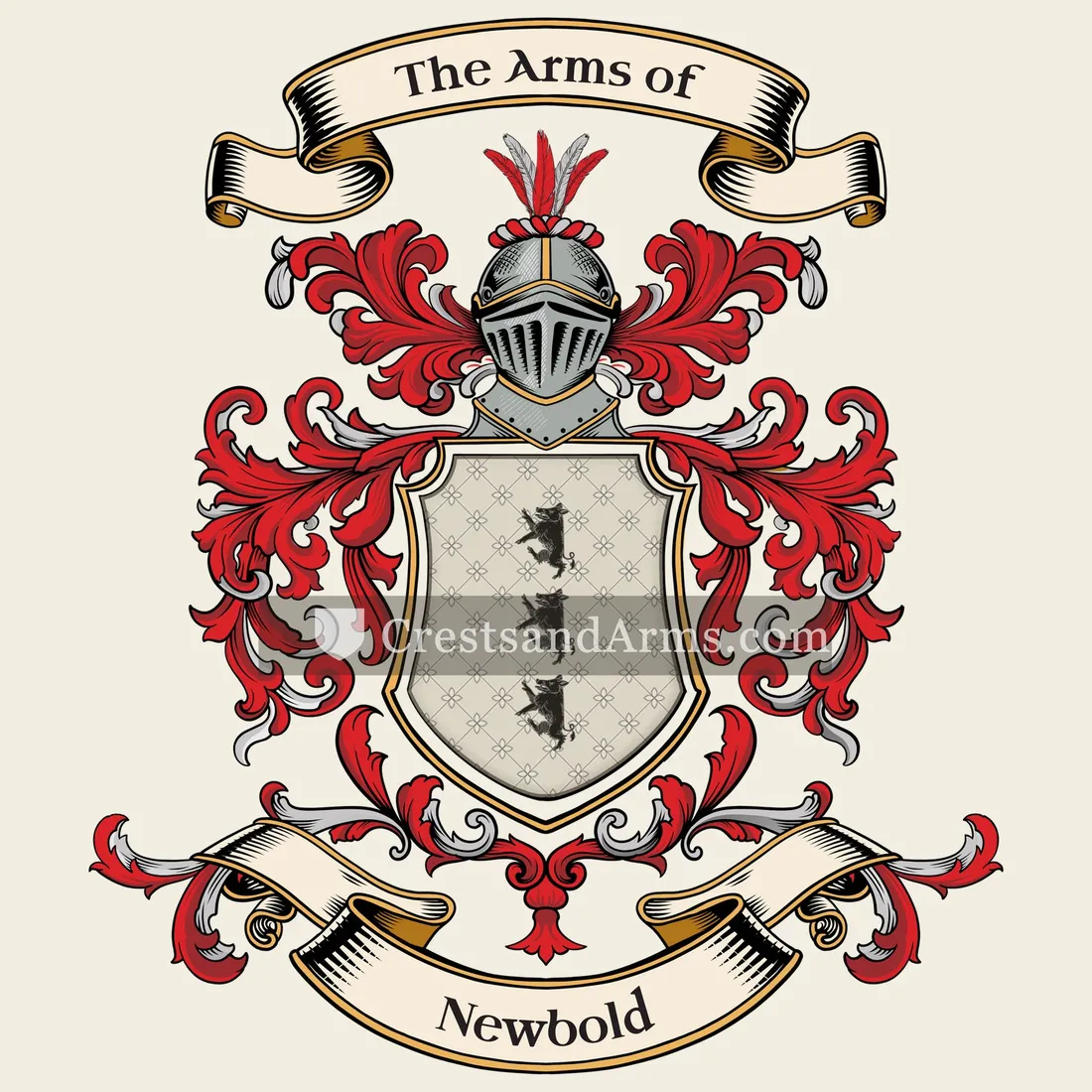
The Newbold arms were recorded in York, c. 1620.
Yorkshire is the largest of the English counties, and it held more gentry families than any other. Land there was split among a great many households rather than a few, so a great many of them carried arms.
This is where the arms were entered in the register. Families often moved to other parts of the country, so the same name can turn up in more than one region.
The body that granted and recorded arms in England in this period.
James VI and I
Sovereign of the period
James VI and I
1603–1625
Reigning in England when the Newbold arms are first recorded.
How Arms Worked in England
English heraldry allowed arms to be shared by all legitimate descendants of the original owner. These symbols were treated as personal property that moved through the generations to all children. While the eldest son kept the original design, other family members could use the same shield without needing to change it or register their own unique versions.
Granting authority
The College of Arms in London has regulated the use of coats of arms throughout England and Wales since 1484.
How they got arms
Families typically obtained their coats of arms through a formal grant from the Crown or by proving their ancient right to them.
Where arms were recorded
All official coats of arms are recorded in the registers kept at the College of Arms, which date back to the fifteenth century.
The family's standing
Recorded among the armigerous families of York.
Origin & History of the Newbold Family in England
The surname Newbold is a locational name that originated in England, derived from the Old English words "niwe," meaning new, and "bold," meaning a dwelling or building. This suggests that the earliest families to carry the name were likely residents of a newly established settlement or a specific farmstead. By the early 17th century, the family had established a notable presence in the historic city of York. Records from 1620 confirm that members of the Newbold family were active within this urban center, which served as a major hub for trade and administration in Northern England. During this period, families with this name were often integrated into the local merchant or artisan classes, contributing to the growth and daily life of the city during the transition into the Stuart era.
Newbold Meaning & Related Branches
Root word
niwe and bold
Old English for new and a dwelling or building.
This name
NewboldRefers to someone who lived at a newly established settlement or building.
also spelled
Newbald
Newbolt
Related arms
Newbaldvariant spelling
Documented Sources
Sir Bernard Burke, The General Armory of England, Scotland, Ireland and Wales, London: Harrison & Sons, 1884
Reaney, P.H. and Wilson, R.M., A Dictionary of English Surnames, 1991
Bardsley, Charles Wareing, A Dictionary of English and Welsh Surnames, 1901
Borthwick Institute for Archives, York, Archbishop of York’s Diocesan Records
Digital archive packCoat of arms PNG, gold border print PDF, vector SVG and the certificate of authenticity. Sent to your email in minutes.


 boarA fierce fighter who battles to the end
 boarA fierce fighter who battles to the end