Map of Germany showing where the Nhem arms are recorded
The Nhem arms were recorded in Westphalia, c. 1765.
Westphalia was a land of small estates and fortified farmhouses in western Germany. Its families were numerous and not especially rich, but each held its own ground, and holding ground was what brought arms.
This is where the arms were entered in the register. Families often moved to other parts of the country, so the same name can turn up in more than one region.
The body that granted and recorded arms in Germany in this period.
Francis I, Holy Roman Emperor
Sovereign of the period
Francis I, Holy Roman Emperor
1745–1765
Reigning in Germany when the Nhem arms are first recorded.
How Arms Worked in Germany
In the Holy Roman Empire, coats of arms were often granted to individuals by the Emperor or his representatives. These arms were then passed down through the generations to all legitimate descendants of the original holder. Younger branches of a family usually kept the same shield design without needing to change it, as the arms belonged to the entire lineage.
Granting authority
The Holy Roman Emperor held the sole power to grant new coats of arms throughout his vast imperial territories.
How they got arms
Families typically obtained their coats of arms through a formal imperial grant or by proving their noble status to the authorities.
Where arms were recorded
These grants were officially recorded in the Imperial Chancery registers, which began keeping formal records of such honors during the Middle Ages.
The family's standing
Recorded among the armigerous families of Westphalia.
Origin & History of the Nhem Family in Germany
The family name Nhem traces its early documented roots to the region of Westphalia in present-day Germany. By the year 1765, records confirm that members of the family were established residents within this area, which was then part of the Holy Roman Empire. During this period, Westphalia was a landscape defined by small agricultural villages and growing trade centers. Families like the Nhems often lived in tight-knit rural communities where they contributed to the local economy through farming or craftsmanship. While the name remains relatively rare, its presence in eighteenth-century parish registers suggests that the family was well-integrated into the social and religious life of the Westphalian countryside. Over time, the name persisted as these early ancestors navigated the shifting political borders and economic changes that defined Central Europe during the late Enlightenment era.
Nhem Meaning & Related Branches
Root word
Nehemiah
Hebrew origin meaning comforted or consoled by God.
This name
NhemA German variant derived from the biblical name Nehemiah, signifying divine consolation.
also spelled
Neheym
Documented Sources
J. B. Rietstap, Armorial Général, Gouda: G. B. van Goor Zonen, 1884–87
Landesarchiv Nordrhein-Westfalen, Kirchenbücher der evangelischen und katholischen Kirchengemeinden in Westfalen, 1765
Westfälisches Landesmuseum, Bevölkerungslisten und Steuerregister der Provinz Westfalen, 1765
Digital archive packCoat of arms PNG, gold border print PDF, vector SVG and the certificate of authenticity. Sent to your email in minutes.


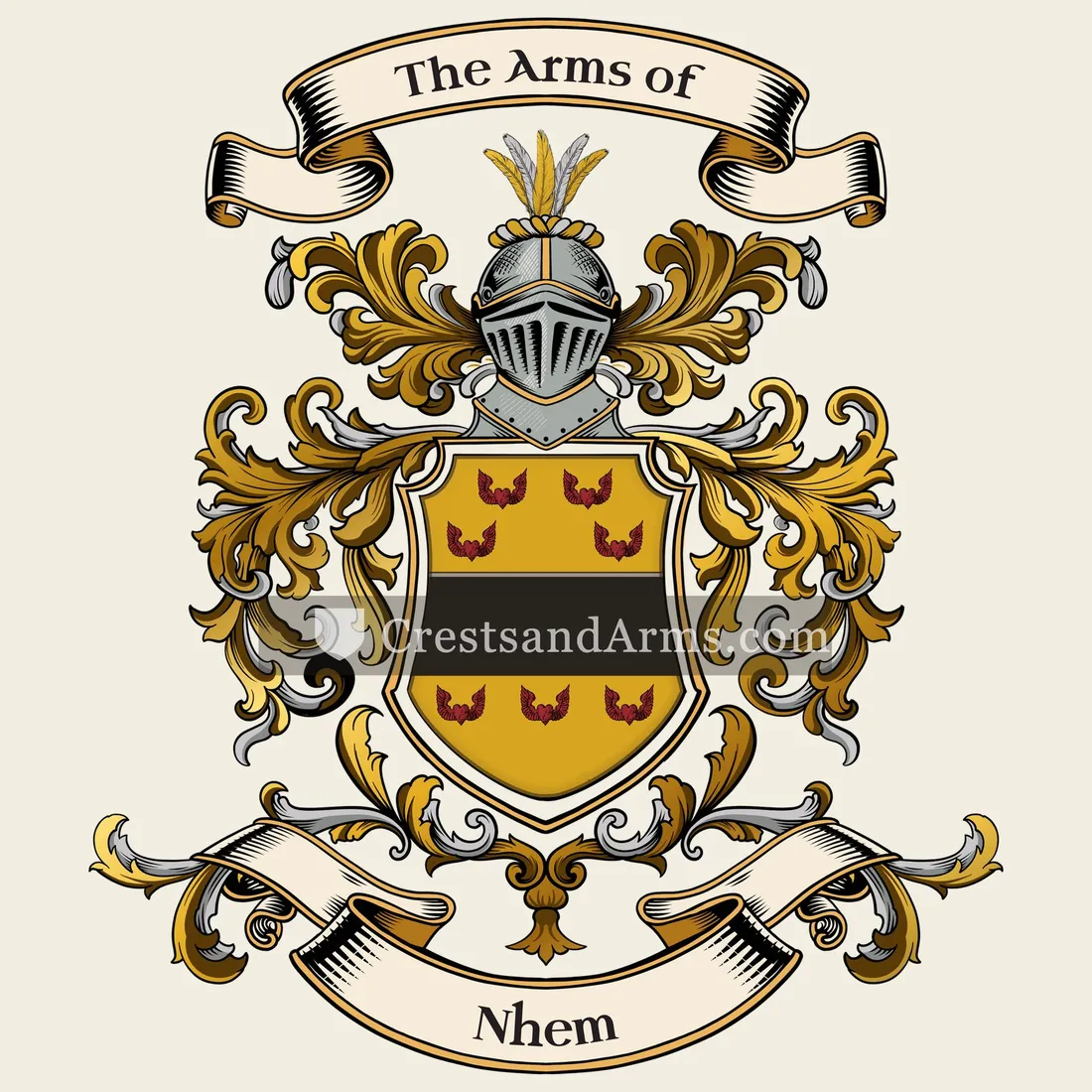
 fessThe military belt, and readiness to serve
 heartSincerity, charity and true affection
 fessThe military belt, and readiness to serve
 heartSincerity, charity and true affection