Map of Netherlands showing where the Niedermeier arms are recorded
The Niedermeier arms were recorded in Netherlands, c. 1815.
Arms such as these were typically recorded in Friesland.
Friesland was low, wet country on the northern coast of the Netherlands, farmed by families who had held the same land for centuries. Free landholders were unusually common there, and a free landholder could carry arms.
This is where the arms were entered in the register. Families often moved to other parts of the country, so the same name can turn up in more than one region.
Region
Friesland
First recorded
1815
Granting Authority for the Niedermeier Arms
Hoge Raad van Adel
Photograph made by me · CC BY-SA 3.0
The body that granted and recorded arms in Netherlands in this period.
William I of the Netherlands
Sovereign of the period
William I of the Netherlands
1815–1840
Reigning in Netherlands when the Niedermeier arms are first recorded.
How Arms Worked in Netherlands
In the Netherlands, coats of arms were often used by noble families and those who held specific public offices. These arms were passed down through the generations to legitimate descendants. Younger branches of a family usually kept the original design without needing to add special marks. This system ensured that the family identity remained clear and consistent over many years.
Granting authority
The Hoge Raad van Adel is the official body that regulates and manages noble titles and coats of arms in the Netherlands.
How they got arms
Families typically obtained their coats of arms through official royal grants or by proving their long-standing historical use of the symbols.
Where arms were recorded
Coats of arms are officially recorded in the registers held by the Hoge Raad van Adel, which began its work in 1814.
The family's standing
Recorded among the armigerous families of Netherlands.
Origin & History of the Niedermeier Family in Netherlands
The surname Niedermeier is a topographic name that originated in the German-speaking regions of Europe. It is composed of the words "nieder," meaning lower, and "meier," which refers to a steward, bailiff, or tenant farmer. Historically, this name identified a person who lived or worked on a farm located at a lower elevation or in the lower part of a village compared to others. By 1815, families carrying this name were well-established in the region of Friesland. During this period, the name served as a way to distinguish individuals based on their specific landholdings and their role within the local agricultural community. As families moved or expanded their holdings, the name remained a permanent link to their ancestral connection to the land and their traditional social status as managers of rural estates.
Related Branches & Arms
Root word
nieder
Germanic term meaning low, down, or situated in a valley.
This name
NiedermeierRefers to someone who lived on a lower farm or in a lower valley.
also spelled
Nedermeier
Nedermayer
Documented Sources
J. B. Rietstap, Armorial Général, Gouda: G. B. van Goor Zonen, 1884–87
Bahlow, Hans, Deutsches Namenlexikon: Familien- und Vornamen nach Ursprung und Sinn erklärt, 1967
Heintze, Albert, Die deutschen Familiennamen: geschichtlich, geographisch, sprachlich, 1903
Lower Saxony State Archives (Niedersächsisches Landesarchiv), Bestand Rep 3: Ämter und Vogteien, 1815
Digital archive packCoat of arms PNG, gold border print PDF, vector SVG and the certificate of authenticity. Sent to your email in minutes.


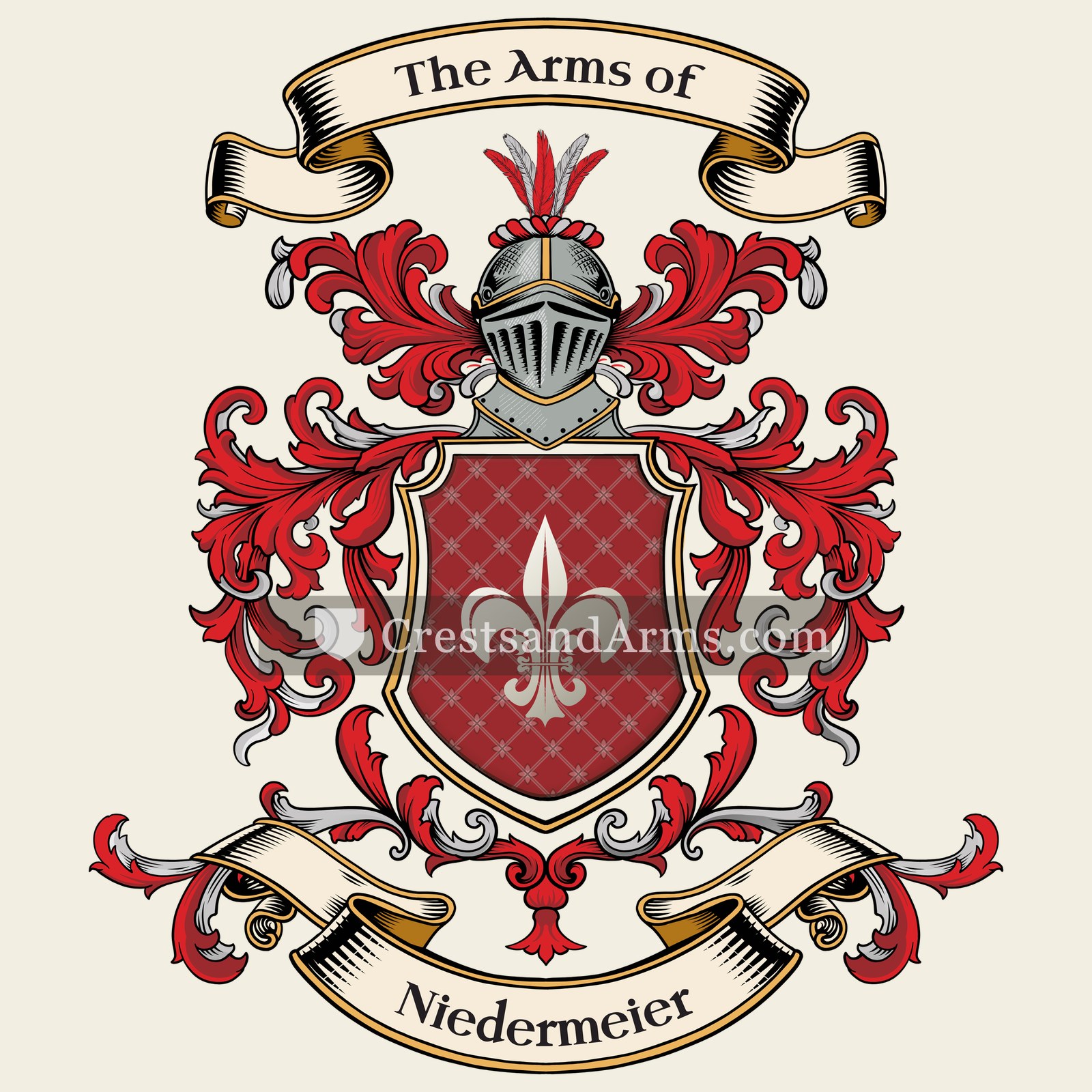
 fleur de lisPurity, light, and the sixth son
 fleur de lisPurity, light, and the sixth son