Map of France showing where the No arms are recorded
The No arms were recorded in Anjou, c. 1663.
Anjou was rich valley country along the Loire, with a dense scatter of small manors. Its gentry were numerous rather than wealthy, and even a modest holding was enough to justify a shield of one's own.
This is where the arms were entered in the register. Families often moved to other parts of the country, so the same name can turn up in more than one region.
The body that granted and recorded arms in France in this period.
Louis XIV of France
Sovereign of the period
Louis XIV of France
1643–1715
Reigning in France when the No arms are first recorded.
How Arms Worked in France
In France, a coat of arms was a mark of honor that passed down through the male line to all legitimate descendants. Families often used the same shield without changes to show their shared heritage. If a branch wanted to stand out, they could add a small mark to their shield to show their specific place in the family tree.
Granting authority
The Juge d'armes de France acted as the official authority that regulated and verified coats of arms across the country.
How they got arms
Families typically inherited their arms from ancestors, though they could also receive them through royal grants or by proving their noble status.
Where arms were recorded
Coats of arms were officially recorded in the Armorial Général de France, which began its main collection in the year 1696.
The family's standing
Recorded among the armigerous families of Anjou.
Origin & History of the No Family in France
The family name No has roots that trace back to the historic province of Anjou in western France. By the year 1663, records confirm that members of the family were firmly established in this region, which was known for its fertile river valleys and strong agricultural traditions. During the seventeenth century, families in Anjou often lived in small rural communities where they were deeply connected to the land and the local parish church. The name itself is short and distinct, which suggests it may have originated as a descriptive term or a shortened form of a longer place name common to the Loire Valley. As the family grew, they participated in the typical life of the French countryside, likely working as farmers or skilled tradespeople who helped sustain the local economy. Their presence in the historical registers of Anjou provides a clear window into the lives of provincial families during the reign of King Louis XIV.
Meaning of the No family crest colors & symbols
Symbols on this shield
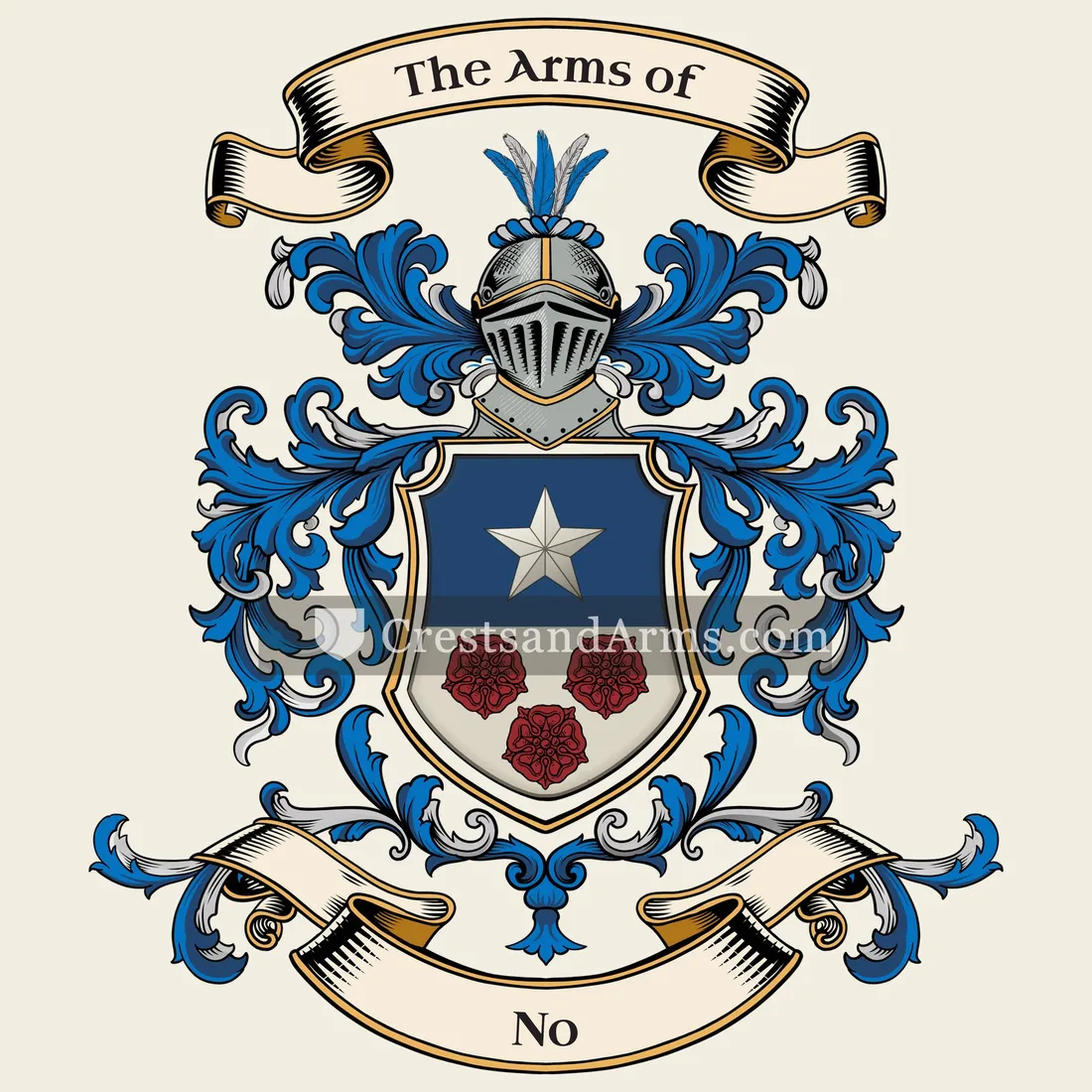
mulletThe third son, and a divine quality from above
roseThe seventh son, and beauty with grace
Colours
Blue (Azure)Means: Loyalty and truth
Silver (Argent)Means: Peace and sincerity
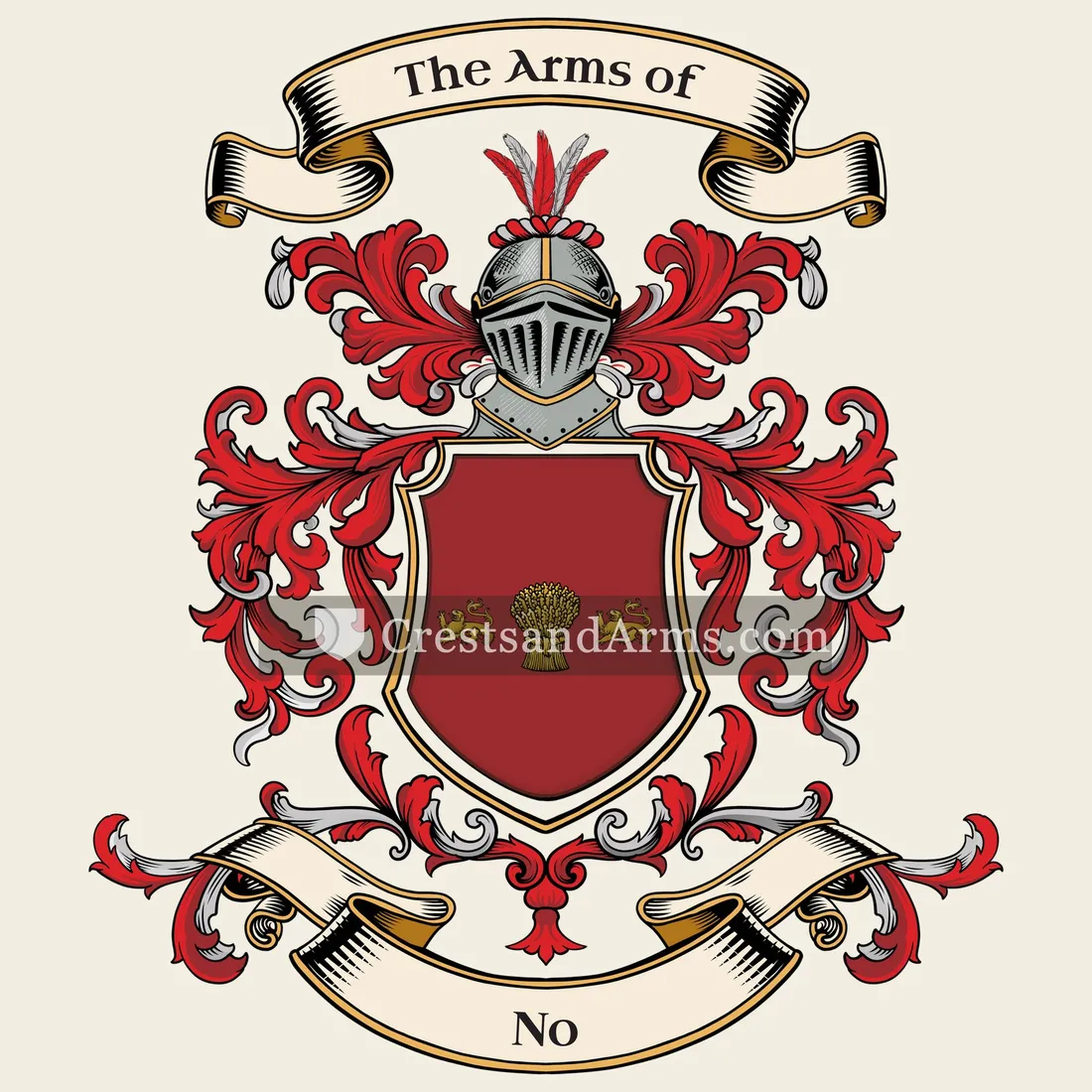
Red (Gules)Means: Military strength
Historical info
Source
J. B. Rietstap, Armorial Général, Gouda: G. B. van Goor Zonen, 1884–87
Blazon (the actual original written record)
“Coupé: au 1 d'azur à une étoile d'arg.; au 2 d'arg. à trois roses de gu., bout. d'or. C.: une étoile d'arg., entre un vol d'azur. L.: à dextre d'arg. et d'azur, à sen. d'arg. et de gu.”
BavariaBavaria, c. 1814
Digital archive packCoat of arms PNG, gold border print PDF, vector SVG and the certificate of authenticity. Sent to your email in minutes.
Map of Germany showing where the No arms are recorded
The No arms were recorded in Bavaria, c. 1814.
Bavaria was a country of old landed families and walled market towns. Estates passed down the same line for centuries, and both the landowners and the leading townsmen kept arms, which is why so many Bavarian names sit in the registers.
This is where the arms were entered in the register. Families often moved to other parts of the country, so the same name can turn up in more than one region.
The body that granted and recorded arms in Germany in this period.
Frederick William III of Prussia
Sovereign of the period
Frederick William III of Prussia
1797–1840
Reigning in France when the No arms are first recorded.
How Arms Worked in Germany
Prussian heraldry was strictly tied to social rank and noble status rather than being a free choice for every citizen. These symbols were treated as permanent family property that moved through the generations to all legitimate heirs. If a family branch wanted to change their design to stand out, they had to apply for official permission to alter their specific version of the shield.
Granting authority
The Prussian Heroldsamt acted as the central state office that managed and strictly controlled all noble titles and coats of arms.
How they got arms
Families usually obtained their arms through formal royal grants or by proving their long-standing noble status to the state authorities.
Where arms were recorded
All official coats of arms were kept in the rolls of the Prussian Heroldsamt, which functioned from 1706 until 1918.
The family's standing
Recorded among the armigerous families of Bavaria.
Origin & History of the No Family in Germany
The family name No has deep roots in the historical region of Bavaria, where records confirm members of the family were established by 1814. During this period, Bavaria was undergoing significant political changes as it transitioned from a kingdom within the Confederation of the Rhine to a sovereign state following the Napoleonic Wars. Families living in this area were often tied to the land through agriculture or local trade, as the economy was heavily centered on rural production and small-scale craftsmanship. Because the name is short and distinct, it likely emerged as a localized identifier for a specific household or a group of individuals living in a particular village. As the Bavarian government began to modernize its civil registration systems in the early 19th century, families like the No line became more formally documented in church books and municipal records. This transition helped solidify the family identity as they navigated the social and economic shifts of 19th-century German life.
No Meaning & Related Branches
Root word
Nod
Derived from the Latin nodus meaning a knot or swelling.
This name
NoA topographic name for someone living near a knot-like junction or a prominent hill.
also spelled
Naud
Naux
Naue
No
Now
Documented Sources
J. B. Rietstap, Armorial Général, Gouda: G. B. van Goor Zonen, 1884–87
Archives départementales de Maine-et-Loire, Registres paroissiaux et d'état civil, 1663
Port, Célestin, Dictionnaire historique, géographique et biographique de Maine-et-Loire, 1874
Digital archive packCoat of arms PNG, gold border print PDF, vector SVG and the certificate of authenticity. Sent to your email in minutes.


 wheatsheafPlenty, and the harvest of one's own labour
 lionCourage, strength and royalty
 wheatsheafPlenty, and the harvest of one's own labour
 lionCourage, strength and royalty


 mulletThe third son, and a divine quality from above
 roseThe seventh son, and beauty with grace