Map of France showing where the Nolasco arms are recorded
The Nolasco arms were recorded in Beaujolais, c. 1776.
Beaujolais was wine country in eastern France, small but prosperous. Its landowners were modest and numerous, and even a single vineyard estate was enough to justify a coat of arms.
This is where the arms were entered in the register. Families often moved to other parts of the country, so the same name can turn up in more than one region.
The body that granted and recorded arms in France in this period.
Louis XVI of France
Sovereign of the period
Louis XVI of France
1774–1791
Reigning in France when the Nolasco arms are first recorded.
How Arms Worked in France
In France, a coat of arms was a mark of honor that passed down through the male line to all legitimate descendants. Families often used the same shield without changes to show their shared heritage. If a branch wanted to stand out, they could add a small mark to their shield to show their specific place in the family tree.
Granting authority
The Juge d'armes de France acted as the official authority that regulated and verified coats of arms across the country.
How they got arms
Families typically inherited their arms from ancestors, though they could also receive them through royal grants or by proving their noble status.
Where arms were recorded
Coats of arms were officially recorded in the Armorial Général de France, which began its main collection in the year 1696.
The family's standing
Recorded among the armigerous families of Beaujolais.
Origin & History of the Nolasco Family in France
The surname Nolasco carries a rich history that traces its roots back to the medieval period, primarily through its association with Saint Peter Nolasco, a thirteenth-century figure who founded the Order of the Blessed Virgin Mary of Mercy. While the name is deeply connected to Spanish and Mediterranean origins, it eventually spread across Europe through religious and social migration. By 1776, members of the family were firmly established in the Beaujolais region of France. During this era, the Beaujolais area was a hub of agricultural prosperity and local trade, suggesting that the Nolasco family likely integrated into the rural society of the time as landowners or skilled artisans. This relocation highlights the movement of families across borders during the eighteenth century, as individuals sought new opportunities in the fertile valleys of eastern France. The presence of the name in regional records from that period serves as a testament to the family's long-standing roots in the local community.
Nolasco Meaning & Related Branches
Root word
Nola
Derived from the Latin name of the Italian city Nola.
This name
NolascoRefers to a person originating from the city of Nola in Italy.
also spelled
Nolhas
Nolak
Nolhack
Documented Sources
J. B. Rietstap, Armorial Général, Gouda: G. B. van Goor Zonen, 1884–87
Pellegrin, François. Histoire du Beaujolais. 1964
Digital archive packCoat of arms PNG, gold border print PDF, vector SVG and the certificate of authenticity. Sent to your email in minutes.


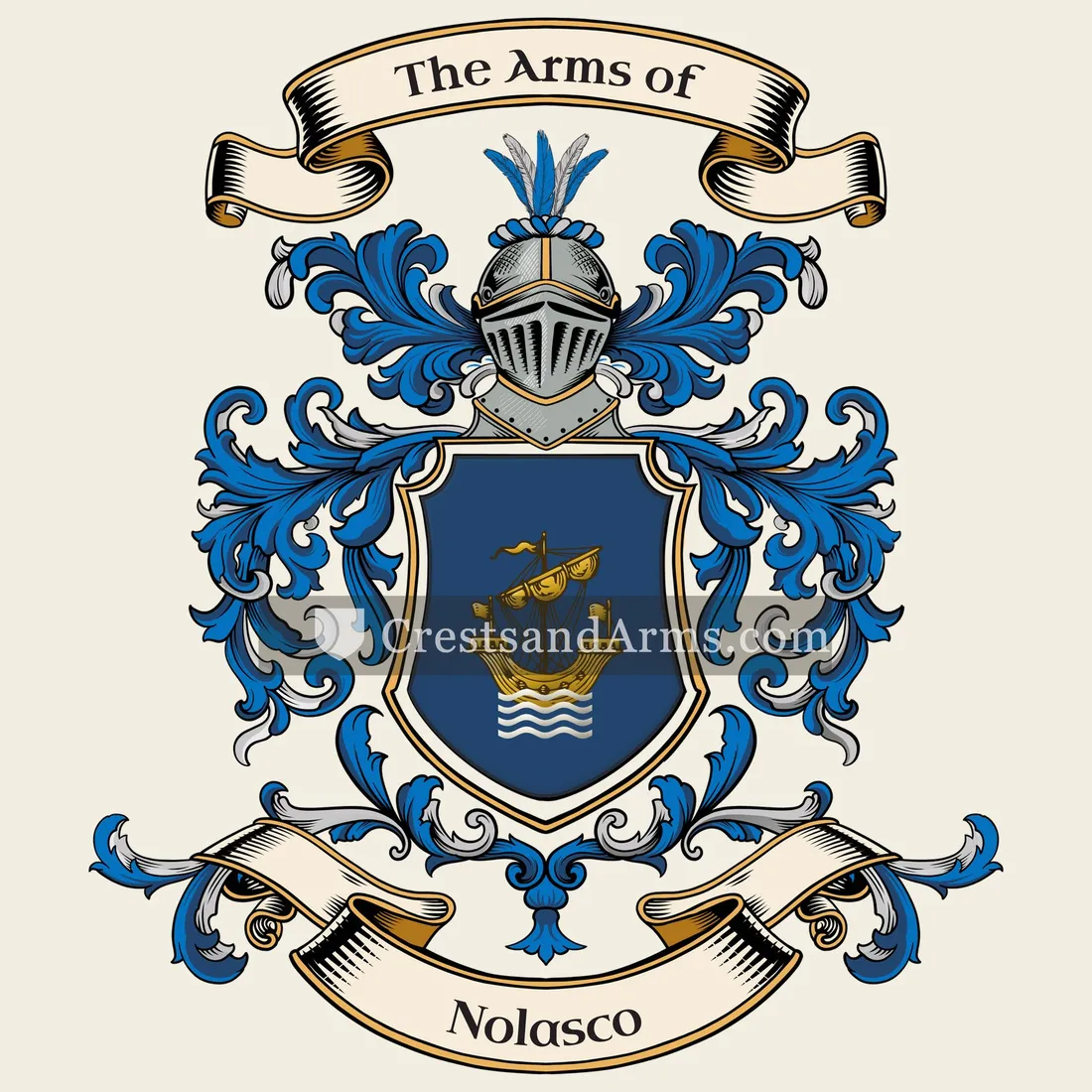
 shipEnterprise, and a great voyage undertaken
 riverThe bounds of a land, and life carried through it
 shipEnterprise, and a great voyage undertaken
 riverThe bounds of a land, and life carried through it