Map of England showing where the Norrish arms are recorded
The Norrish arms were recorded in Oxford, c. 1566.
Oxfordshire was farming country with the university at its centre, and both produced families of standing. Scholars and lawyers who did well bought manors nearby, and holding a manor was the ordinary route to a coat of arms.
This is where the arms were entered in the register. Families often moved to other parts of the country, so the same name can turn up in more than one region.
The body that granted and recorded arms in England in this period.
Elizabeth I of England
Sovereign of the period
Elizabeth I of England
1558–1603
Reigning in England when the Norrish arms are first recorded.
How Arms Worked in England
English heraldry allowed arms to be shared by all legitimate descendants of the original owner. These symbols were treated as personal property that moved through the generations to all children. While the eldest son kept the original design, other family members could use the same shield without needing to change it or register their own unique versions.
Granting authority
The College of Arms in London has regulated the use of coats of arms throughout England and Wales since 1484.
How they got arms
Families typically obtained their coats of arms through a formal grant from the Crown or by proving their ancient right to them.
Where arms were recorded
All official coats of arms are recorded in the registers kept at the College of Arms, which date back to the fifteenth century.
The family's standing
Recorded among the armigerous families of Oxford.
Origin & History of the Norrish Family in England
The surname Norrish is a locative name that likely originated as a way to describe someone who lived to the north of a specific town or landmark. In Middle English, the term "norreis" was used to identify a person who came from the north, and over several centuries, this evolved into the modern spelling of the family name. By the mid-16th century, the family had established a notable presence in the university city of Oxford. Records from 1566 confirm that members of the Norrish family were living and working in this academic hub during the reign of Queen Elizabeth I. Because Oxford was a center for trade and scholarship, these early family members were likely integrated into the professional life of the city, serving as craftsmen, merchants, or university staff. This early documented residency suggests that the family was well-settled in the region long before the modern era, contributing to the local history of Oxfordshire through their daily work and community involvement.
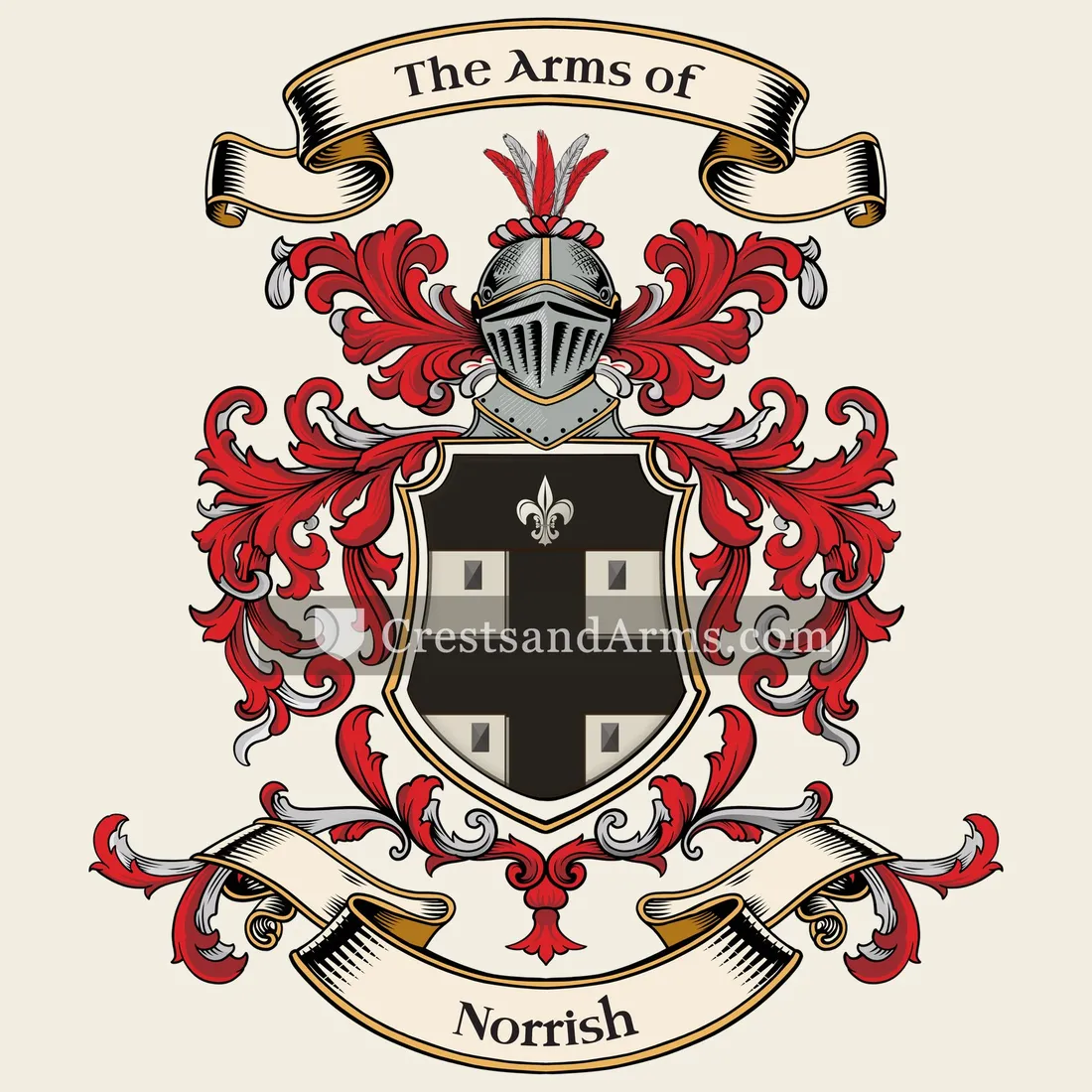
Meaning of the Norrish family crest colors & symbols
Symbols on this shield
cross symbolChristian faith and service
chiefAuthority, wisdom and dominion
billetThe sealed letter, and a message delivered
fleur de lisPurity, light, and the sixth son
Colours
Silver (Argent)Means: Peace and sincerity
Black (Sable)Means: Constancy
Historical info
Source
Sir Bernard Burke, The General Armory of England, Scotland, Ireland and Wales, London: Harrison & Sons, 1884
Blazon (the actual original written record)
“Ar. a cross betw. four billets sa. on a chief of the second a fleur-de-lis of the first”
DublinLettice · Dublin, c. 1642
Digital archive packCoat of arms PNG, gold border print PDF, vector SVG and the certificate of authenticity. Sent to your email in minutes.
Map of Ireland showing where the Norrish arms are recorded
The Norrish arms were recorded in Dublin, c. 1642.
Dublin was the seat of government in Ireland and the place where grants were sought and recorded. Families with business at the castle or the courts settled nearby, and settling there put their arms on record.
This is where the arms were entered in the register. Families often moved to other parts of the country, so the same name can turn up in more than one region.
The body that granted and recorded arms in Ireland in this period.
Charles I of England
Sovereign of the period
Charles I of England
1625–1649
Reigning in England when the Norrish arms are first recorded.
How Arms Worked in Ireland
The Ulster King of Arms granted coats of arms to individuals who proved their social standing and good character. These symbols were typically inherited by all legitimate descendants of the original holder. If a family branch wanted a unique look, they could apply for a specific change to their design through the office to ensure their identity remained distinct.
Granting authority
The Ulster King of Arms acted as the official body that regulated and issued all coats of arms throughout Ireland.
How they got arms
Families obtained their arms through formal grants issued by the office after proving their eligibility and paying the required fees.
Where arms were recorded
All official grants were recorded in the registers held by the Ulster King of Arms starting from the year 1552.
The family's standing
Recorded among the armigerous families of Dublin.
Origin & History of the Norrish Family in Ireland
The Norrish family name has a distinct history in Ireland that traces back to the mid-seventeenth century. Records confirm that members of the family were established in Dublin by 1642, a period marked by significant political upheaval and the outbreak of the Irish Rebellion. During this time, the name likely arrived in Ireland as part of the broader movement of settlers from England who were seeking new opportunities or serving in administrative roles within the capital city. As the family integrated into the local society of Dublin, they became part of the urban fabric of a city transitioning through major historical shifts. Over the following generations, the family name persisted in the region, reflecting the complex patterns of migration and settlement that defined the seventeenth-century Irish landscape.
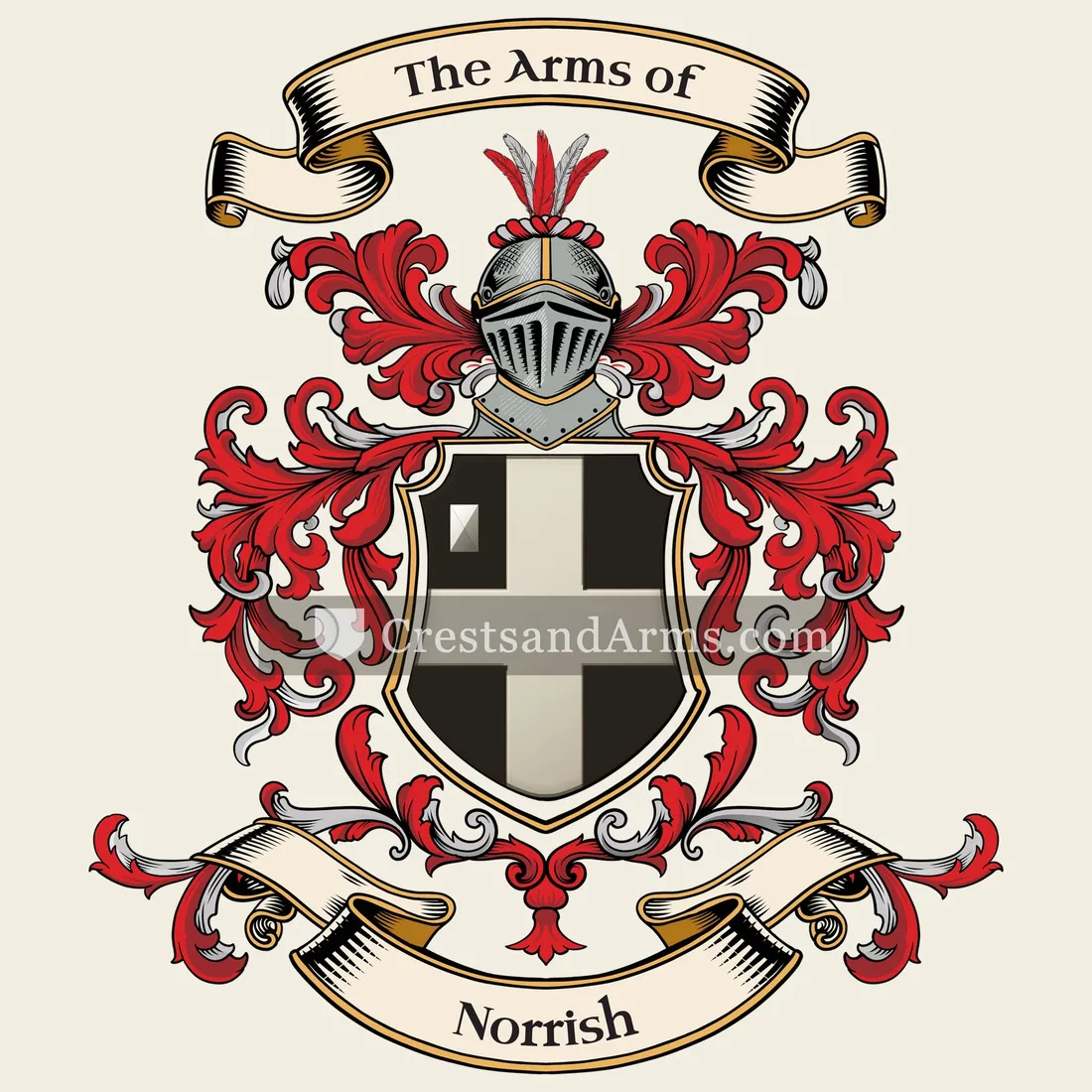
Meaning of the Norrish family crest colors & symbols
Symbols on this shield
cross symbolChristian faith and service
billetThe sealed letter, and a message delivered
Colours
Black (Sable)Means: Constancy
Silver (Argent)Means: Peace and sincerity
Historical info
Source
Sir Bernard Burke, The General Armory of England, Scotland, Ireland and Wales, London: Harrison & Sons, 1884
Blazon (the actual original written record)
“Sa. billettée ar. a cross flory of the last”
GlamorganPenlyne · Glamorgan, c. 1647
Digital archive packCoat of arms PNG, gold border print PDF, vector SVG and the certificate of authenticity. Sent to your email in minutes.
Map of Wales showing where the Norrish arms are recorded
The Norrish arms were recorded in Glamorgan, c. 1647.
Glamorgan was the richest part of Wales, with good coastal farmland and Norman castles along it. The families who held those castles kept their land for centuries, and long holding brought recorded arms.
This is where the arms were entered in the register. Families often moved to other parts of the country, so the same name can turn up in more than one region.
The body that granted and recorded arms in Wales in this period.
Charles I of England
Sovereign of the period
Charles I of England
1625–1649
Reigning in England when the Norrish arms are first recorded.
How Arms Worked in Wales
English heraldry allowed arms to be shared by all legitimate descendants of the original owner. These symbols were treated as personal property that moved through the generations to all children. While the eldest son kept the original design, other family members could use the same shield without needing to change it or register their own unique versions.
Granting authority
The College of Arms in London has regulated the use of coats of arms throughout England and Wales since 1484.
How they got arms
Families typically obtained their coats of arms through a formal grant from the Crown or by proving their ancient right to them.
Where arms were recorded
All official coats of arms are recorded in the registers kept at the College of Arms, which date back to the fifteenth century.
The family's standing
Recorded among the armigerous families of Glamorgan.
Origin & History of the Norrish Family in Wales
The Norrish family name has deep roots in the coastal landscape of Glamorgan, where records confirm their presence as early as 1647. During the seventeenth century, the region was a place of significant social change as families navigated the transition from traditional agricultural life to the early stages of industrial development. The name itself likely originated as a descriptive term for someone living to the north of a specific landmark or settlement, reflecting how people were identified by their geography in a time before formal surnames were strictly standardized. By establishing themselves in Glamorgan, the Norrish family became part of the local fabric of Welsh society, participating in the community life of a county that was rapidly becoming a center for trade and coal production. Their early history is a testament to the resilience of families who built their lives in the valleys and coastal plains of South Wales during a period of great national transformation.
Norrish Meaning & Related Branches
Root word
North
A cardinal direction indicating the northern region or point.
This name
NorrishA topographical name for someone who lived in the northern part of a settlement.
also spelled
Norreys
Norries
Norrys
Noris
Norres
Documented Sources
Sir Bernard Burke, The General Armory of England, Scotland, Ireland and Wales, London: Harrison & Sons, 1884
Bardsley, Charles Wareing, A Dictionary of English and Welsh Surnames, 1901
Reaney, Percy Hide, A Dictionary of British Surnames, 1958
Oxfordshire History Centre, Records of the University of Oxford: Chancellor’s Court Registers, 1566
Digital archive packCoat of arms PNG, gold border print PDF, vector SVG and the certificate of authenticity. Sent to your email in minutes.


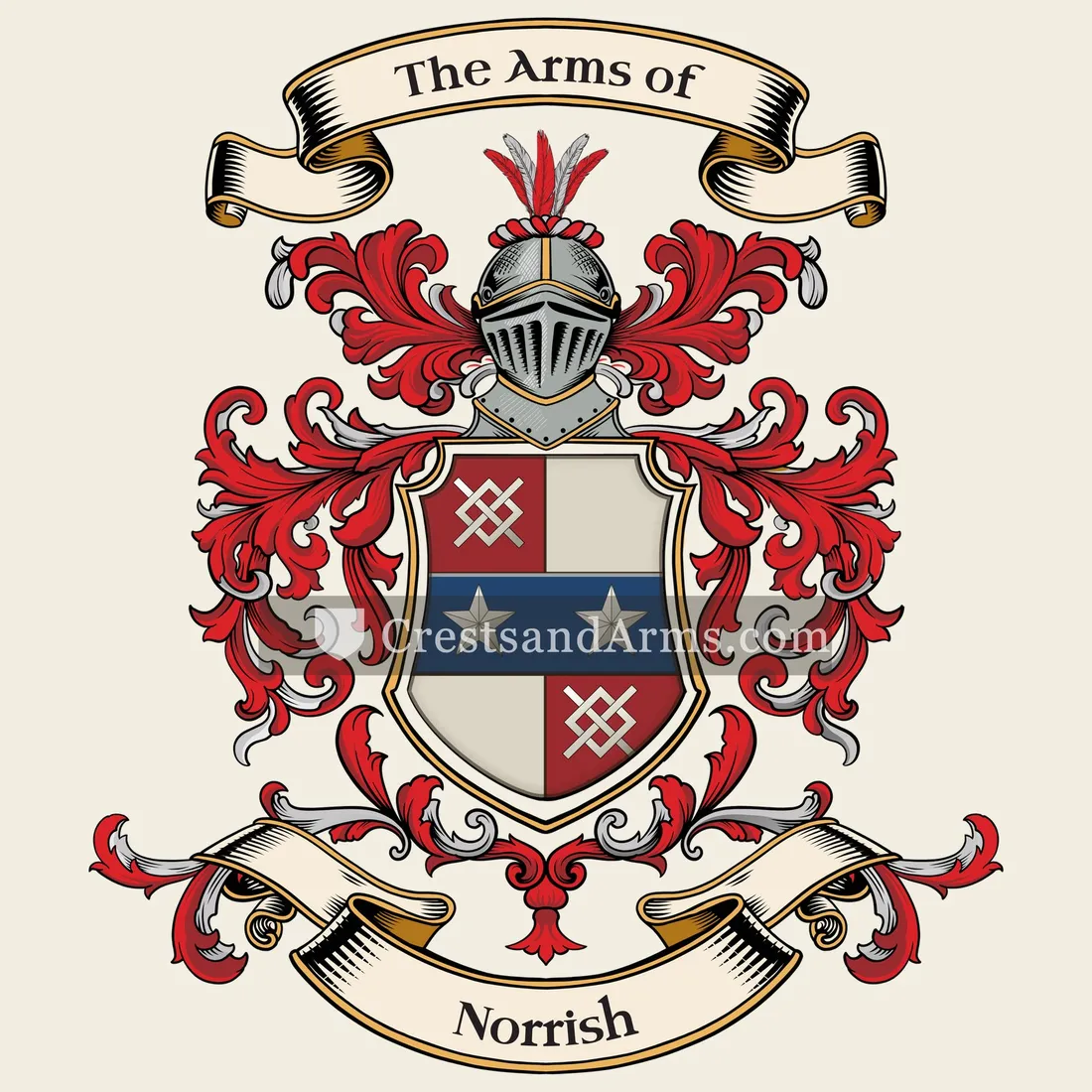
 fessThe military belt, and readiness to serve
 mulletThe third son, and a divine quality from above
 fretPersuasion, and the net that holds
 fessThe military belt, and readiness to serve
 mulletThe third son, and a divine quality from above
 fretPersuasion, and the net that holds


 cross symbolChristian faith and service
 chiefAuthority, wisdom and dominion
 billetThe sealed letter, and a message delivered
 fleur de lisPurity, light, and the sixth son