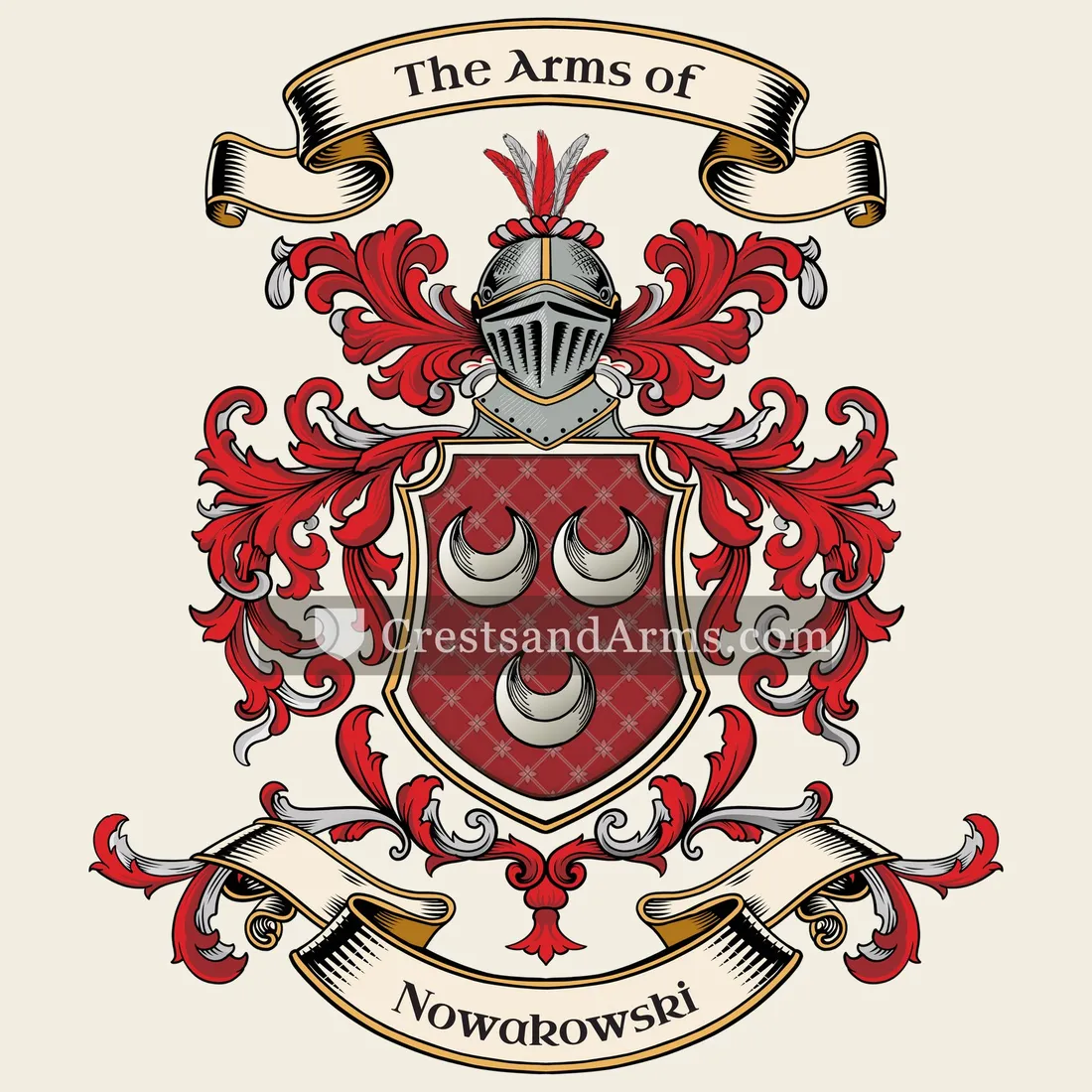
A record of documented arms, meaning and origin, researched for the Nowakowski family lines. Documented in 2 countries.
Reg. 0630 · German, M–O
Meaning of the Nowakowski family crest colors & symbols
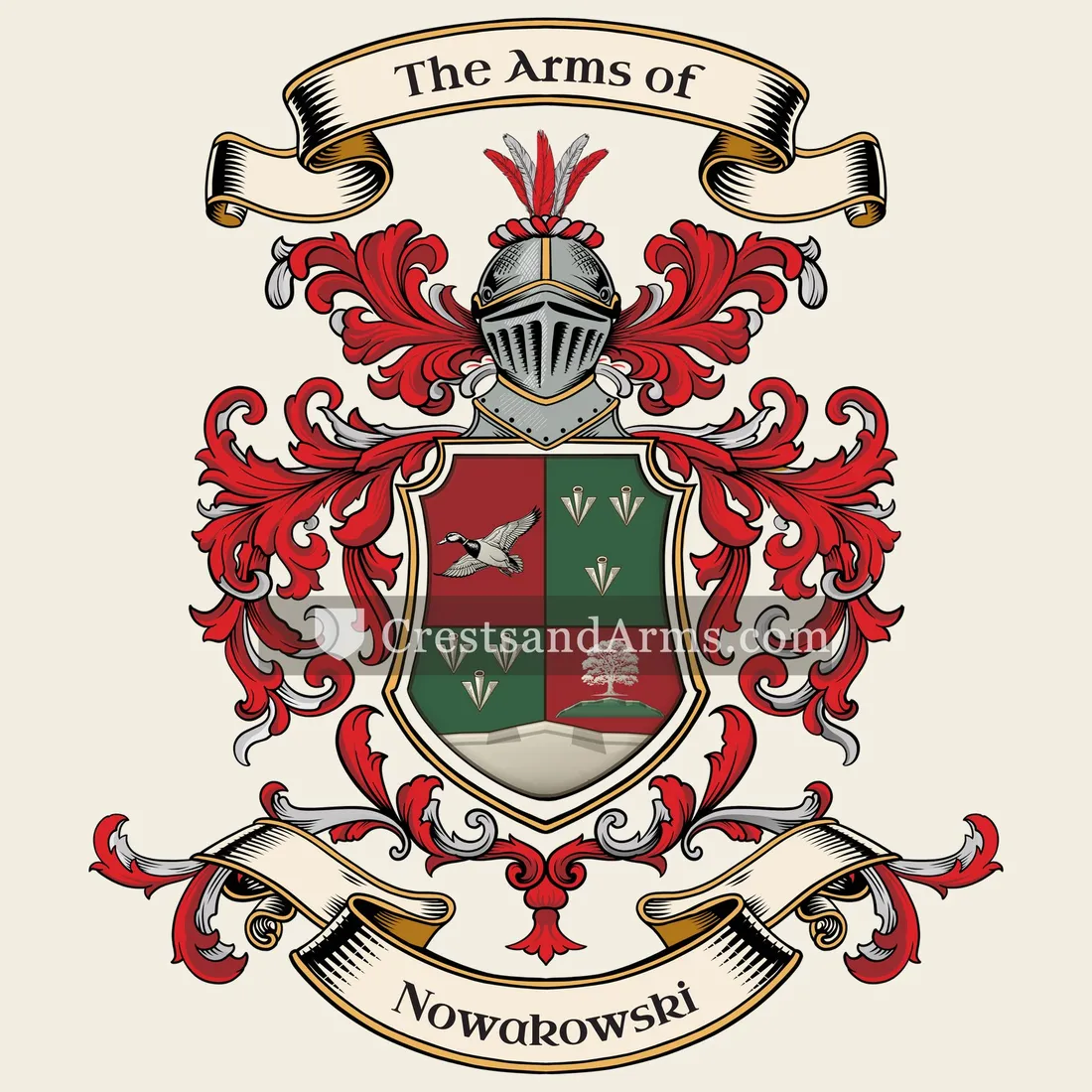
Symbols on this shield
mountThe ground held, and steadfastness upon it
duckResourcefulness on land and water
arrowReadiness for battle, and affliction endured
treeLife, endurance and deep roots
Colours
Red (Gules)Means: Military strength
Silver (Argent)Means: Peace and sincerity
Green (Vert)Means: Hope
Historical info
Source
J. B. Rietstap, Armorial Général, Gouda: G. B. van Goor Zonen, 1884–87
Blazon (the actual original written record)
“Ec.: au 1 de gu. à une oie cont. d'arg.; aux 2 et 3 de sin. à trois flèches accostées d'arg.; au 4 d'azur à un arbre d'arg., terrassé du même. Cq. cour. C.: une oie d'arg., tournée à dextre.”
Germanyc. 1765
Digital archive packCoat of arms PNG, gold border print PDF, vector SVG and the certificate of authenticity. Sent to your email in minutes.
Map of Germany showing where the Nowakowski arms are recorded
The Nowakowski arms were recorded in Germany, c. 1765.
Arms such as these were typically recorded in Bavaria.
Bavaria was a country of old landed families and walled market towns. Estates passed down the same line for centuries, and both the landowners and the leading townsmen kept arms, which is why so many Bavarian names sit in the registers.
This is where the arms were entered in the register. Families often moved to other parts of the country, so the same name can turn up in more than one region.
The body that granted and recorded arms in Germany in this period.
Francis I, Holy Roman Emperor
Sovereign of the period
Francis I, Holy Roman Emperor
1745–1765
Reigning in Germany when the Nowakowski arms are first recorded.
How Arms Worked in Germany
In the Holy Roman Empire, coats of arms were often granted to individuals by the Emperor or his representatives. These arms were then passed down through the generations to all legitimate descendants of the original holder. Younger branches of a family usually kept the same shield design without needing to change it, as the arms belonged to the entire lineage.
Granting authority
The Holy Roman Emperor held the sole power to grant new coats of arms throughout his vast imperial territories.
How they got arms
Families typically obtained their coats of arms through a formal imperial grant or by proving their noble status to the authorities.
Where arms were recorded
These grants were officially recorded in the Imperial Chancery registers, which began keeping formal records of such honors during the Middle Ages.
The family's standing
Recorded among the armigerous families of Germany.
Origin & History of the Nowakowski Family in Germany
The surname Nowakowski originates from the Slavic word "nowak," which translates to a newcomer or a person who has recently settled in a new area. While the name is most commonly associated with Polish roots, its presence in Bavaria by 1765 highlights the movement of families across Central European borders during the eighteenth century. At that time, Bavaria was a hub for trade and migration, drawing in people from neighboring regions who sought new opportunities in agriculture or craftsmanship. Families carrying this name likely integrated into local village life by adapting to the German language and customs while maintaining their ancestral identity. Over time, the name became a permanent fixture in the region, reflecting the steady integration of migrant families into the social and economic fabric of southern Germany.
Meaning of the Nowakowski family crest colors & symbols
Symbols on this shield
crescentHonour by the sovereign, and the second son
Colours
Red (Gules)Means: Military strength
Silver (Argent)Means: Peace and sincerity
Historical info
Source
J. B. Rietstap, Armorial Général, Gouda: G. B. van Goor Zonen, 1884–87
Blazon (the actual original written record)
“De gu. à trois croiss. d'arg. Cq. cour. C.: trois pl. d'aut. d'arg.”
GaliciaGalicia, c. 1772
Digital archive packCoat of arms PNG, gold border print PDF, vector SVG and the certificate of authenticity. Sent to your email in minutes.
Map of Austria showing where the Nowakowski arms are recorded
The Nowakowski arms were recorded in Galicia, c. 1772.
Galicia was eastern country of large estates and small farming villages, held by families who had been there for a very long time. Land was what entitled a family to arms, and land there rarely changed hands.
This is where the arms were entered in the register. Families often moved to other parts of the country, so the same name can turn up in more than one region.
Region
Galicia
First recorded
1772
Granting Authority for the Nowakowski Arms
Imperial and Royal chancery
Sodacan · CC BY-SA 3.0
The body that granted and recorded arms in Austria in this period.
Joseph II, Holy Roman Emperor
Sovereign of the period
Joseph II, Holy Roman Emperor
1765–1790
Reigning in Germany when the Nowakowski arms are first recorded.
How Arms Worked in Austria
Austrian coats of arms were often linked directly to noble titles granted by the Emperor. These symbols belonged to the entire family line rather than just one individual. When a family grew, new branches kept the original design without needing to change it. This system allowed all members of a noble house to share the same identity across many generations.
Granting authority
The Imperial and Royal chancery managed all heraldic matters and controlled the official granting of arms throughout the Austrian lands.
How they got arms
Families typically received their arms through a formal imperial decree that often accompanied the elevation of a person to noble status.
Where arms were recorded
Official records of these grants were kept in the Imperial Register of Nobility which began its formal documentation process in 1453.
The family's standing
Recorded among the armigerous families of Galicia.
Origin & History of the Nowakowski Family in Austria
The surname Nowakowski is a classic example of a locative name, which means it was originally used to identify someone who came from a specific place. In the Polish language, the root word "nowak" refers to a newcomer or a person who has recently settled in a village. When the suffix "-owski" is added, it indicates a connection to a particular location, suggesting that the family likely originated from a town or estate named Nowakowo. By 1772, when the region of Galicia became part of the Austrian Empire following the First Partition of Poland, the Nowakowski family was already well-established in the area. Under Austrian rule, the family became part of a complex administrative system that required meticulous record-keeping for taxes and military conscription. Because Galicia served as a cultural crossroads between the Polish population and the Austrian bureaucracy, the family name was preserved in official census records and land registers that tracked the movement and property of citizens during this era of imperial expansion.
Nowakowski Meaning & Related Branches
Root word
Nowak
A Slavic term meaning newcomer or someone who is new.
This name
NowakowskiRefers to a person who originates from a place associated with a newcomer or a new settler.
also spelled
Nowakowsky
Novakowski
Related arms
Trzyksienzycesame arms
Documented Sources
J. B. Rietstap, Armorial Général, Gouda: G. B. van Goor Zonen, 1884–87
Bahlow, Hans. Deutsches Namenlexikon: Familien- und Vornamen nach Ursprung und Sinn erklärt. 1967


 mountThe ground held, and steadfastness upon it
 duckResourcefulness on land and water
 arrowReadiness for battle, and affliction endured
 treeLife, endurance and deep roots
 mountThe ground held, and steadfastness upon it
 duckResourcefulness on land and water
 arrowReadiness for battle, and affliction endured
 treeLife, endurance and deep roots


 crescentHonour by the sovereign, and the second son