Map of Italy showing where the Nyari arms are recorded
The Nyari arms were recorded in Tuscany, c. 1775.
Tuscany's cities were run by merchant and banking families rather than landowners. Florence and Siena both kept formal records of their leading houses, and a house on those lists carried arms.
This is where the arms were entered in the register. Families often moved to other parts of the country, so the same name can turn up in more than one region.
The body that granted and recorded arms in Italy in this period.
Alvise Giovanni Mocenigo
Sovereign of the period
Alvise Giovanni Mocenigo
1763–1778
Reigning in Italy when the Nyari arms are first recorded.
How Arms Worked in Italy
In the Italian states, coats of arms were often used by noble families to show their status and history. These symbols were passed down through the generations to all legitimate male descendants. Younger branches of a family usually kept the original design but sometimes added small changes to distinguish their specific line from the main branch.
Granting authority
Various local rulers and city governments controlled the use of coats of arms across the different Italian states.
How they got arms
Families often assumed their own arms or received them as official grants from local lords, popes, or city councils.
Where arms were recorded
Arms were recorded in local city archives or private family books rather than in one single national register.
The family's standing
Recorded among the armigerous families of Tuscany.
Origin & History of the Nyari Family in Italy
The family name Nyari possesses a distinct history that traces back to the vibrant cultural landscape of Tuscany during the late eighteenth century. By 1775, records confirm that members of the family were established within this Italian region, participating in the social and economic life of the era. While the name itself carries linguistic roots that suggest connections to broader European migratory patterns, its presence in Tuscany highlights a period of stability and integration for the family. During this time, families in the region often centered their lives around local land ownership, trade, or service to the community. The Nyari family likely navigated the shifting political climate of the Italian peninsula by maintaining strong local ties and contributing to the local traditions of their home province. This early documentation serves as a foundation for understanding their transition from local residents to a recognized part of the regional history.
Related Branches & Arms
Root word
Nigellus
Latin term meaning black or dark-colored.
This name
NyariA surname derived from a nickname for someone with a dark complexion or black hair.
also spelled
Narie
Naris
Nary
Documented Sources
J. B. Rietstap, Armorial Général, Gouda: G. B. van Goor Zonen, 1884–87
Archivio di Stato di Firenze, Stato civile della restaurazione
Archivio di Stato di Firenze, Registri delle denunce di beni e redditi
Digital archive packCoat of arms PNG, gold border print PDF, vector SVG and the certificate of authenticity. Sent to your email in minutes.


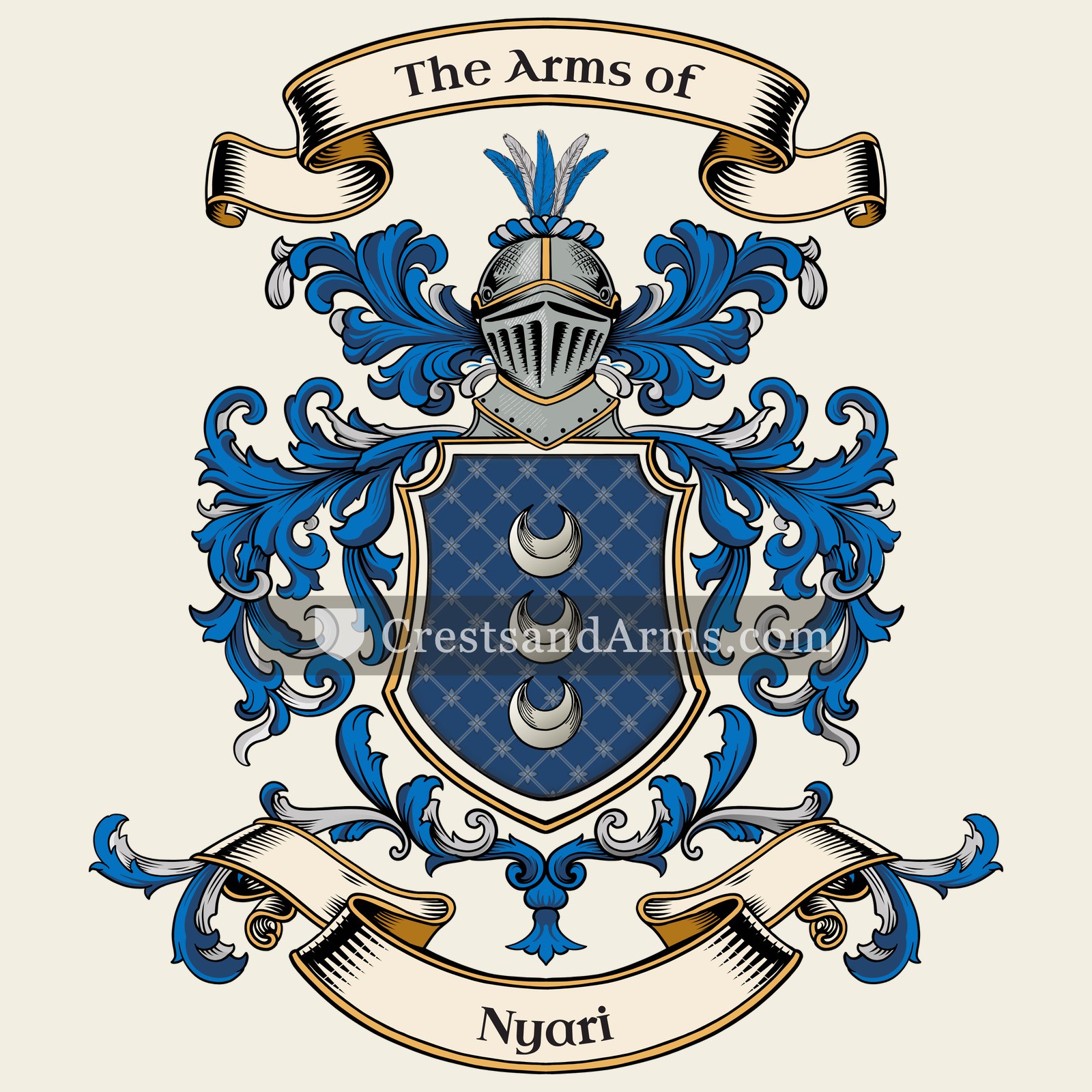
 crescentHonour by the sovereign, and the second son
 crescentHonour by the sovereign, and the second son