A record of documented arms, meaning and origin, researched for the Obrian family lines. Documented in 2 countries.
Reg. 2329 · French, M–O
Meaning of the Obrian family crest colors & symbols
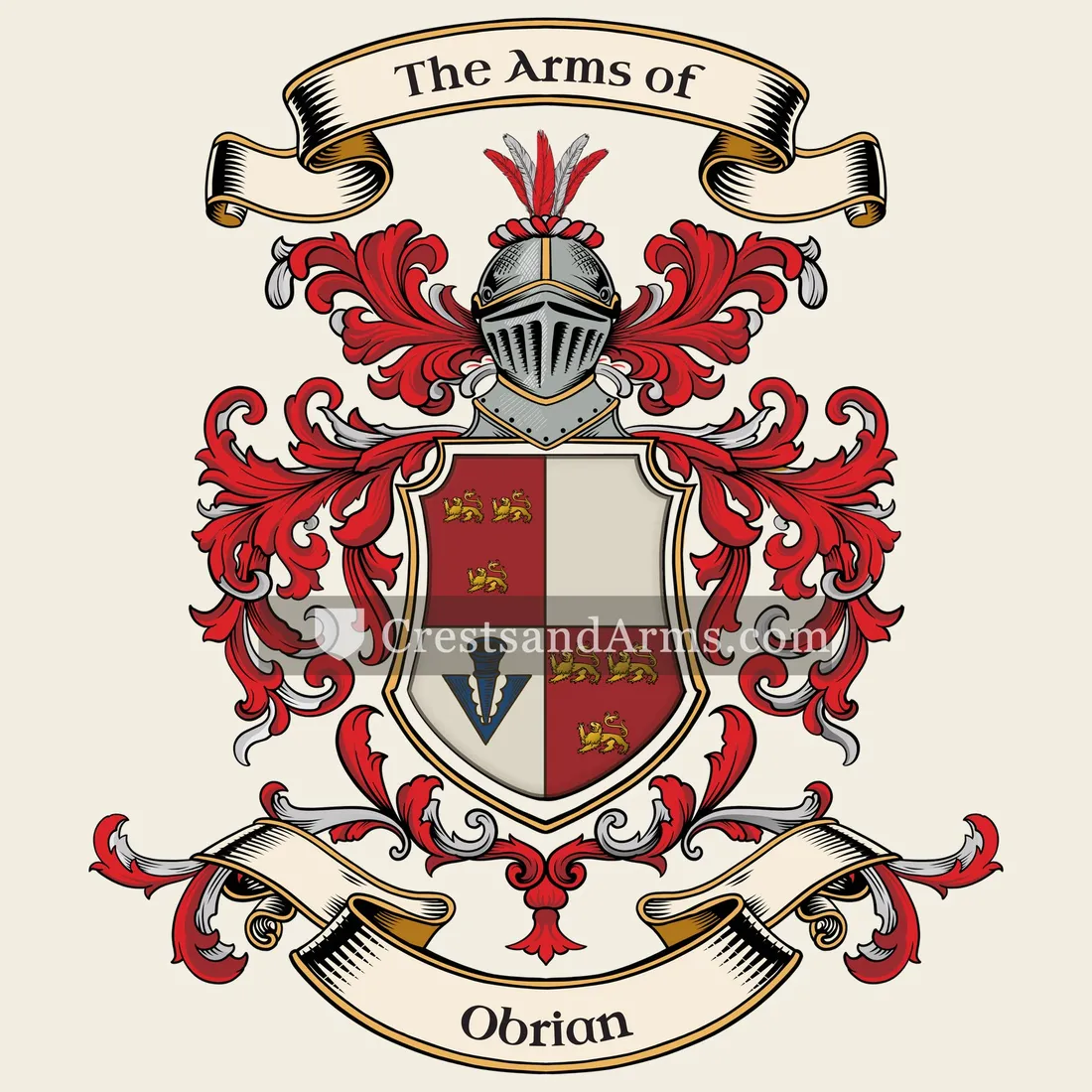
Symbols on this shield
lionCourage, strength and royalty
arms pheon arrowheadReadiness for battle, and the broad arrow of the sovereign
Colours
Red (Gules)Means: Military strength
Silver (Argent)Means: Peace and sincerity
Gold (Or)Means: Generosity
Blue (Azure)Means: Loyalty and truth
Historical info
Source
J. B. Rietstap, Armorial Général, Gouda: G. B. van Goor Zonen, 1884–87
Blazon (the actual original written record)
“Ec.: aux 1 et 4 de gu. à trois léopards partis d'or et d'arg., l'un sur l'autre (O'Bryen); au 2 d'arg. à trois piles de gu., dirigées vers la p.; au 3 d'or à un phéon d'azur. C.: un bras, arm. au nat., la main de carn. brandissant une épée d'arg., garnie d'or. S.: deux léopards lionnés coupés d'or sur arg. D.: VIGUEUR DE DESSUS.”
Francec. 1686
Digital archive packCoat of arms PNG, gold border print PDF, vector SVG and the certificate of authenticity. Sent to your email in minutes.
Map of France showing where the Obrian arms are recorded
The Obrian arms were recorded in France, c. 1686.
Arms such as these were typically recorded in Bretagne.
More families held coats of arms in Bretagne than anywhere else in France. The land was divided into many small estates rather than a few large ones, so far more households counted as gentry, and each needed a shield of its own to be told apart.
This is where the arms were entered in the register. Families often moved to other parts of the country, so the same name can turn up in more than one region.
The body that granted and recorded arms in France in this period.
Louis XIV of France
Sovereign of the period
Louis XIV of France
1643–1715
Reigning in France when the Obrian arms are first recorded.
How Arms Worked in France
In France, a coat of arms was a mark of honor that passed down through the male line to all legitimate descendants. Families often used the same shield without changes to show their shared heritage. If a branch wanted to stand out, they could add a small mark to their shield to show their specific place in the family tree.
Granting authority
The Juge d'armes de France acted as the official authority that regulated and verified coats of arms across the country.
How they got arms
Families typically inherited their arms from ancestors, though they could also receive them through royal grants or by proving their noble status.
Where arms were recorded
Coats of arms were officially recorded in the Armorial Général de France, which began its main collection in the year 1696.
The family's standing
Recorded among the armigerous families of France.
Origin & History of the Obrian Family in France
The history of the O’Brien name in France is closely tied to the movement of families across the English Channel during the late seventeenth century. While the name is famously rooted in Irish history, members of the family established a notable presence in the region of Bretagne by 1686. During this period, France served as a sanctuary for those fleeing political and religious instability in the British Isles. Settling in Bretagne allowed these individuals to integrate into local society while maintaining their distinct cultural identity. Over time, the family adapted to the French environment, often appearing in local parish registers and legal documents as they transitioned into their new lives. This migration reflects a broader pattern of European families seeking stability in new territories during a time of significant continental change.
Meaning of the Obrian family crest colors & symbols
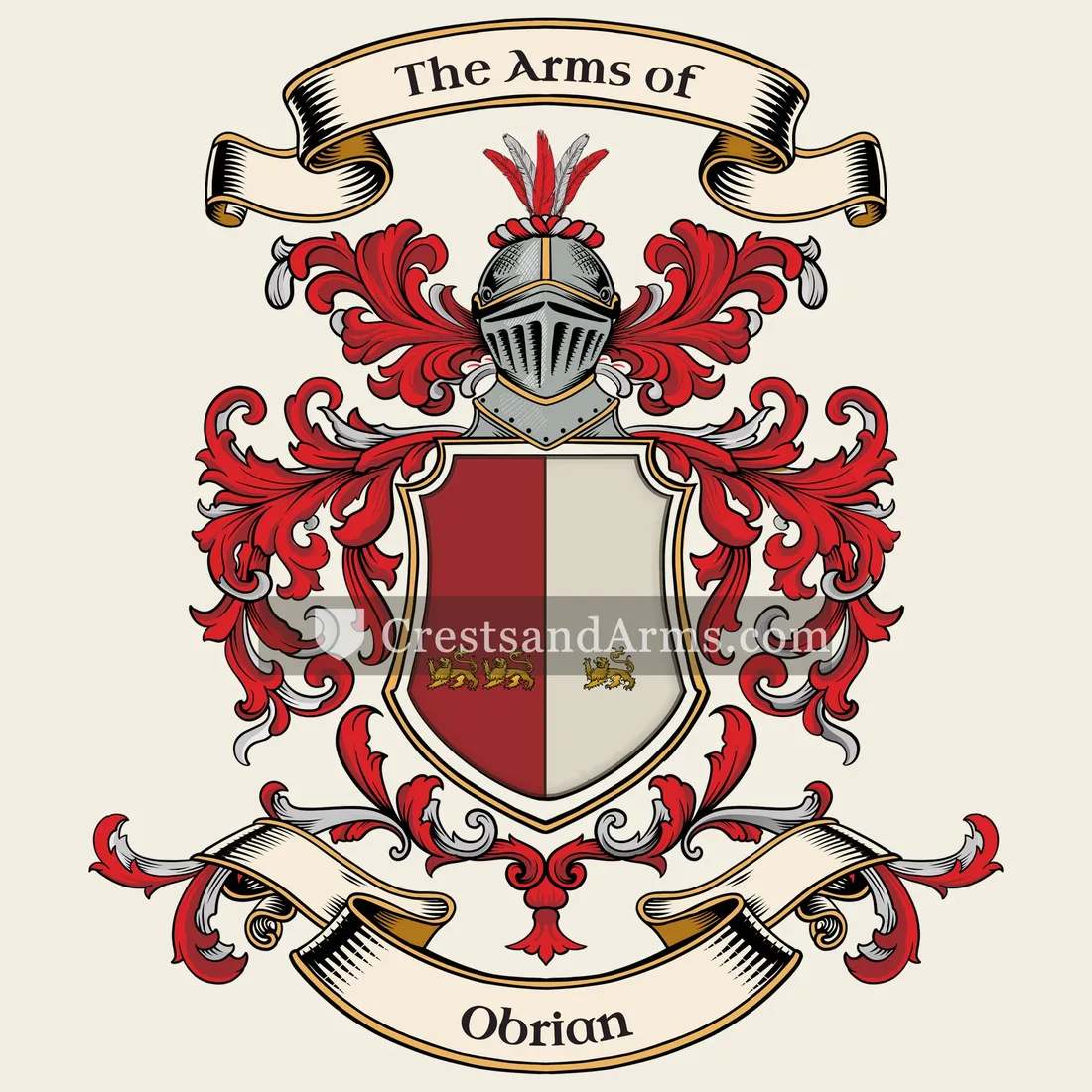
Symbols on this shield
lionCourage, strength and royalty
Colours
Red (Gules)Means: Military strength
Silver (Argent)Means: Peace and sincerity
Gold (Or)Means: Generosity
Historical info
Source
Sir Bernard Burke, The General Armory of England, Scotland, Ireland and Wales, London: Harrison & Sons, 1884
Blazon (the actual original written record)
“Gu. three lions pass. guard. in pale per pale or and ar”
IrelandMunster, c. 1645
Digital archive packCoat of arms PNG, gold border print PDF, vector SVG and the certificate of authenticity. Sent to your email in minutes.
Map of Ireland showing where the Obrian arms are recorded
The Obrian arms were recorded in Munster, c. 1645.
This is where the arms were entered in the register. Families often moved to other parts of the country, so the same name can turn up in more than one region.
The body that granted and recorded arms in Ireland in this period.
Charles I of England
Sovereign of the period
Charles I of England
1625–1649
Reigning in France when the Obrian arms are first recorded.
How Arms Worked in Ireland
The Ulster King of Arms granted coats of arms to individuals who proved their social standing and good character. These symbols were typically inherited by all legitimate descendants of the original holder. If a family branch wanted a unique look, they could apply for a specific change to their design through the office to ensure their identity remained distinct.
Granting authority
The Ulster King of Arms acted as the official body that regulated and issued all coats of arms throughout Ireland.
How they got arms
Families obtained their arms through formal grants issued by the office after proving their eligibility and paying the required fees.
Where arms were recorded
All official grants were recorded in the registers held by the Ulster King of Arms starting from the year 1552.
The family's standing
Recorded among the armigerous families of Ireland.
Origin & History of the Obrian Family in Ireland
The surname O’Brien, or Ó Briain in its original form, is deeply rooted in the history of the province of Munster. The name translates to mean descendant of Brian, specifically referring to the famous High King of Ireland, Brian Boru, who ruled during the early eleventh century. By the time the family was firmly established in Munster in 1645, they were already recognized as one of the most powerful and influential dynasties in the region. Their influence was built on a long tradition of leadership that spanned several centuries across the southern part of the island. Throughout the medieval period, members of the family held significant political and social authority, often acting as kings and chieftains who governed large territories. This legacy of leadership helped the family maintain a strong presence in local history long before the mid-seventeenth century. Even as political landscapes shifted, the O’Brien name remained a symbol of the ancient Gaelic nobility that shaped the cultural identity of Munster.
Obrian Meaning & Related Branches
Root word
Brian
Derived from the Celtic word for high or noble.
This name
ObrianA patronymic surname meaning descendant of the noble or high one.
also spelled
O'Bryan
Obryen
Obryin
Obryon
Documented Sources
J. B. Rietstap, Armorial Général, Gouda: G. B. van Goor Zonen, 1884–87
Archives départementales du Finistère, Série B: Cours et juridictions
Archives départementales d'Ille-et-Vilaine, Série G: Clergé séculier
Cullen, L.M., The Irish Diaspora in the Seventeenth and Eighteenth Centuries, 1992
Loez, André, Les réfugiés irlandais en Bretagne au XVIIe siècle, 1985
Digital archive packCoat of arms PNG, gold border print PDF, vector SVG and the certificate of authenticity. Sent to your email in minutes.


 lionCourage, strength and royalty
 arms pheon arrowheadReadiness for battle, and the broad arrow of the sovereign
 lionCourage, strength and royalty
 arms pheon arrowheadReadiness for battle, and the broad arrow of the sovereign