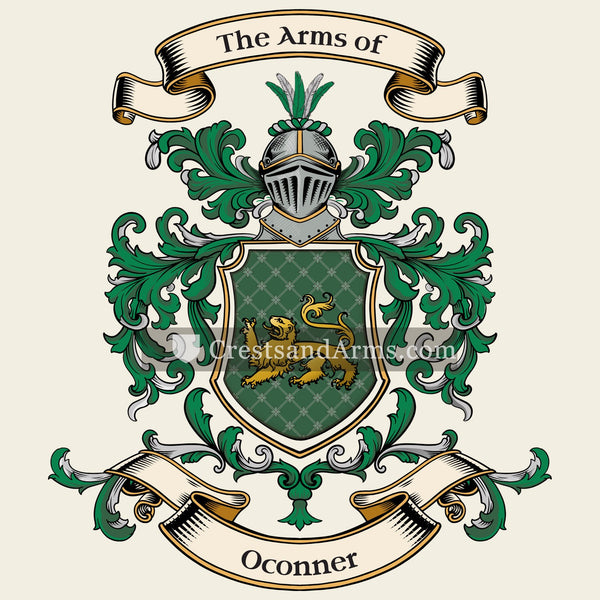
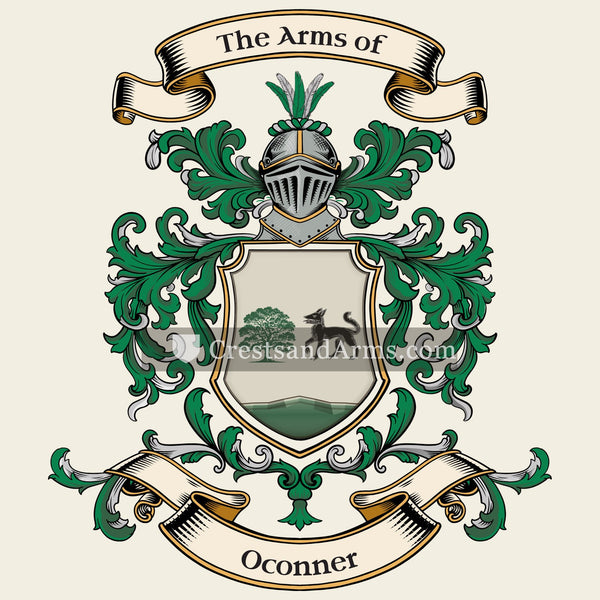
A record of documented arms, meaning and origin, researched for the Oconner family lines. Documented in 2 countries.
Reg. 4133 · Britain, M–O
Coat of Arms & Family Crest Details
Symbols on this shield
lionCourage, strength and royalty
Colours
Green (Vert)Means: Hope
Gold (Or)Means: Generosity
Historical info
Source
J. B. Rietstap, Armorial Général, Gouda: G. B. van Goor Zonen, 1884–87
Blazon (the actual original written record)
“De sin. au lion d'or, cour. du même. C.: un bras arm., brandissant une épée, le tout au nat.”
Britainc. 1700
Where the Oconner Arms Were Recorded
Kent
Map of Britain showing where the Oconner arms are recorded
The Oconner arms were recorded in Britain, c. 1700.
Arms such as these were typically recorded in Kent.
Kent sits between London and the short crossing to Europe, and the trade passing through made it wealthy. Merchant families bought land with that money, and it was landowners who took coats of arms.
This is where the arms were entered in the register. Families often moved to other parts of the country, so the same name can turn up in more than one region.
The body that granted and recorded arms in Britain in this period.
William III of England
Sovereign of the period
William III of England
1694–1702
Reigning in Britain when the Oconner arms are first recorded.
How Arms Worked in Britain
English heraldry allowed arms to be shared by all legitimate descendants of the original owner. These symbols were treated as personal property that moved through the generations to all children. While the eldest son kept the original design, other family members could use the same shield without needing to change it or register their own unique versions.
Granting authority
The College of Arms in London has regulated the use of coats of arms throughout England and Wales since 1484.
How they got arms
Families typically obtained their coats of arms through a formal grant from the Crown or by proving their ancient right to them.
Where arms were recorded
All official coats of arms are recorded in the registers kept at the College of Arms, which date back to the fifteenth century.
The family's standing
Recorded among the armigerous families of Britain.
Origin & History of the Oconner Family in Britain
The surname O'Connor is traditionally associated with Ireland, but the family’s presence in England dates back several centuries. By the year 1700, records confirm that members of the O'Connor family had established themselves in the county of Kent. During this era, families often moved across the Irish Sea to England for trade, military service, or to seek new opportunities in the growing urban centers of the British Isles. Those who settled in Kent likely integrated into the local community by working in agriculture or skilled trades, which were the primary drivers of the regional economy at the time. As they settled into English life, the family name remained a link to their ancestral heritage while they adapted to the social and economic structures of their new home. This migration pattern reflects the broader movement of people between Ireland and Britain that helped shape the diverse cultural landscape of the eighteenth century.
Coat of Arms & Family Crest Details
Symbols on this shield
mountThe ground held, and steadfastness upon it
treeLife, endurance and deep roots
wolfReward from long service and hard work
Colours
Silver (Argent)Means: Peace and sincerity
Green (Vert)Means: Hope
Black (Sable)Means: Constancy
Historical info
Source
J. B. Rietstap, Armorial Général, Gouda: G. B. van Goor Zonen, 1884–87
Blazon (the actual original written record)
“D'arg. à un arbre de sin., acc. d'un loup assis de sa., br. sur le pied de l'arbre; le tout soutenu d'une terrasse isolée du sec. C.: un bras arm., brandissant une épée, le tout au nat. Cri: FALIABO. S.: deux lions au nat. D.: VALORE ET FORTITUDINE.”
CastileCastile, c. 1722
Where the Oconner Arms Were Recorded
Castile
Map of Spain showing where the Oconner arms are recorded
The Oconner arms were recorded in Castile, c. 1722.
Castile was the heart of Spain and the source of most of its noble families. Land won in the long wars against the Moors was granted out to fighting men, and a man granted land was granted arms along with it.
This is where the arms were entered in the register. Families often moved to other parts of the country, so the same name can turn up in more than one region.
The body that granted and recorded arms in Spain in this period.
Philip V of Spain
Sovereign of the period
Philip V of Spain
1714–1724
Reigning in Britain when the Oconner arms are first recorded.
How Arms Worked in Spain
In Spain, a coat of arms was considered a form of property that belonged to the entire family line. These arms were passed down from a father to all his children equally. Younger branches of the family usually kept the original design without needing to add any special marks to distinguish their specific line.
Granting authority
The Cronista Rey de Armas was the official body that regulated and granted coats of arms throughout Spain.
How they got arms
Families often obtained their arms through royal grants or by proving their noble status to the official heraldic authority.
Where arms were recorded
Coats of arms were officially recorded in the registers of the Cronista Rey de Armas starting in 1496.
The family's standing
Recorded among the armigerous families of Castile.
Origin & History of the Oconner Family in Spain
The history of the O'Connor family in Spain is deeply connected to the migration of Irish nobility during the eighteenth century. By 1722, members of this family had established a notable presence in Castile, where they integrated into the military and administrative structures of the Spanish Crown. These individuals were part of a larger group known as the Wild Geese, who left Ireland due to political and religious instability. Upon arriving in Spain, they often served as high-ranking officers in the Irish regiments of the Spanish army. Their transition into Castilian society was marked by their ability to maintain their ancestral identity while adopting the customs and language of their new home. This period represents a unique chapter where the family name became synonymous with loyal service to the Spanish monarchy, bridging the gap between their Gaelic roots and their new life in the Iberian Peninsula.
Related Branches & Arms
Root word
Ó Conchobhair
Descendant of the hound of desire or patron of warriors.
This name
OconnerDerived from Gaelic, signifying a lineage associated with a fierce or noble warrior.
also spelled
Oconner
Okonor
Connor
Conner
Documented Sources
J. B. Rietstap, Armorial Général, Gouda: G. B. van Goor Zonen, 1884–87
The National Archives, Parish registers for the county of Kent, series P
Kent History and Library Centre, Quarter Sessions records and local administrative papers, series Q/S
MacLysaght, Edward, The Surnames of Ireland, 1985
Cottle, Basil, The Penguin Dictionary of Surnames, 1967
Digital archive packCoat of arms PNG, gold border print PDF, vector SVG and the certificate of authenticity. Sent to your email in minutes.


 lionCourage, strength and royalty
 lionCourage, strength and royalty

 mountThe ground held, and steadfastness upon it
 treeLife, endurance and deep roots
 wolfReward from long service and hard work