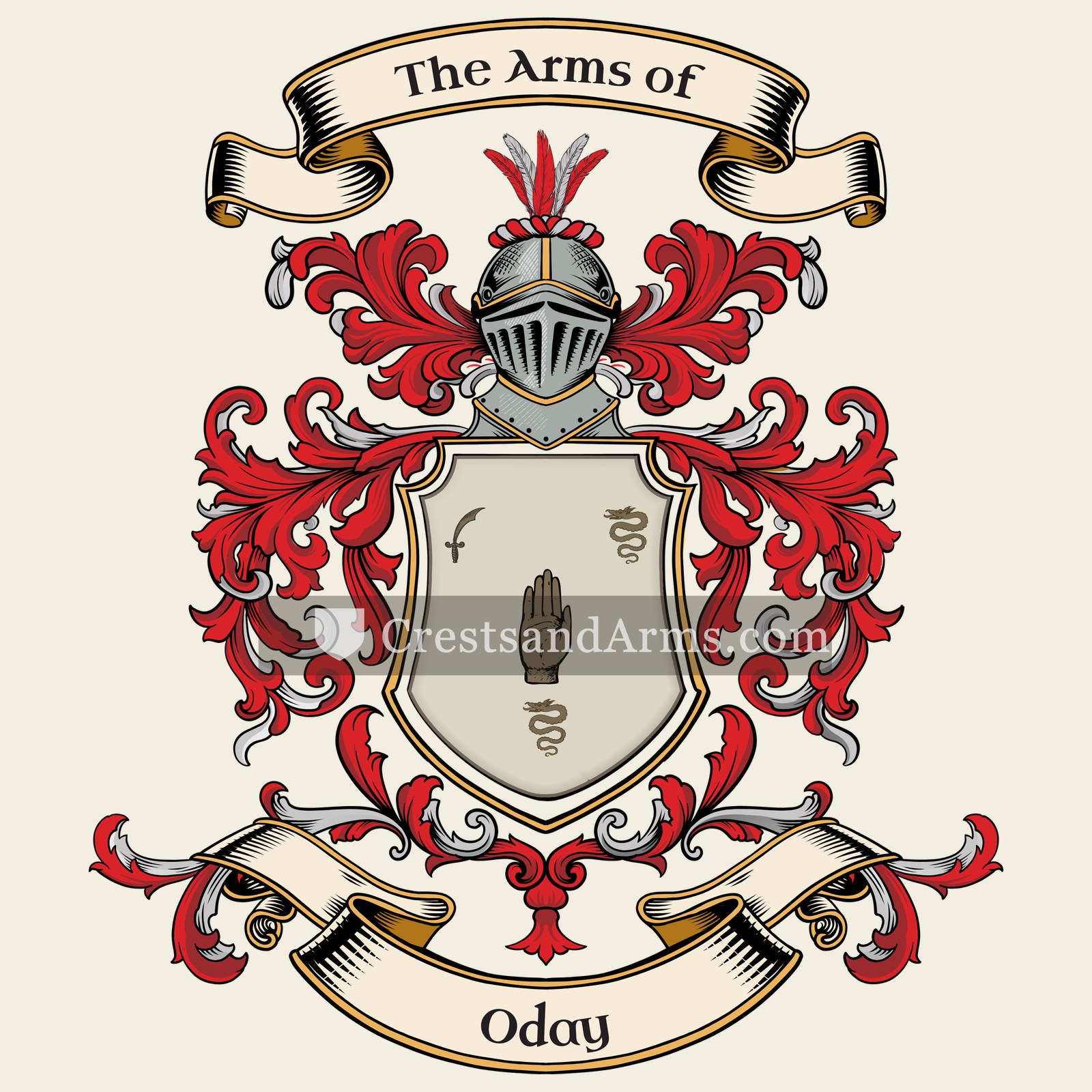
A record of documented arms, meaning and origin, researched for the Oday family of Britain.
Reg. 3539 · Britain, M–O
Coat of Arms & Family Crest Details
Symbols on this shield
handFaith, sincerity and justice
swordJustice, and military honour
serpentWisdom, healing and prudence
Colours
Silver (Argent)Means: Peace and sincerity
Historical info
Source
J. B. Rietstap, Armorial Général, Gouda: G. B. van Goor Zonen, 1884–87
Blazon (the actual original written record)
“D'arg. à une main hab., posée en fasce, mise en p., tenant une épée en pal, accostée en chef de deux serpents affr., ondoyant en pals; le tout au nat.”
Britainc. 1700
Digital archive packCoat of arms PNG, gold border print PDF, vector SVG and the certificate of authenticity. Sent to your email in minutes.
Map of Britain showing where the Oday arms are recorded
The Oday arms were recorded in Britain, c. 1700.
Arms such as these were typically recorded in Kent.
Kent sits between London and the short crossing to Europe, and the trade passing through made it wealthy. Merchant families bought land with that money, and it was landowners who took coats of arms.
This is where the arms were entered in the register. Families often moved to other parts of the country, so the same name can turn up in more than one region.
The body that granted and recorded arms in Britain in this period.
William III of England
Sovereign of the period
William III of England
1694–1702
Reigning in Britain when the Oday arms are first recorded.
How Arms Worked in Britain
English heraldry allowed arms to be shared by all legitimate descendants of the original owner. These symbols were treated as personal property that moved through the generations to all children. While the eldest son kept the original design, other family members could use the same shield without needing to change it or register their own unique versions.
Granting authority
The College of Arms in London has regulated the use of coats of arms throughout England and Wales since 1484.
How they got arms
Families typically obtained their coats of arms through a formal grant from the Crown or by proving their ancient right to them.
Where arms were recorded
All official coats of arms are recorded in the registers kept at the College of Arms, which date back to the fifteenth century.
The family's standing
Recorded among the armigerous families of Britain.
Origin & History of the Oday Family in Britain
The family name Oday has deep roots in the county of Kent, where records confirm members of the family were living as early as the year 1700. During this period, Kent was a bustling region shaped by its proximity to London and its vital agricultural economy. Families with this surname were likely part of the local working class, often involved in farming or skilled trades that supported the rural villages of the English countryside. The name itself is thought to be a variation of older occupational or locational surnames that evolved through local pronunciation over several generations. As the family grew, they became woven into the fabric of Kentish life, contributing to the development of the local parishes and the steady growth of the regional population throughout the eighteenth century.
Related Branches & Arms
Root word
Ead
Old English element meaning wealth, riches, or prosperity.
This name
OdayA locational or patronymic surname derived from Old English roots signifying a wealthy or prosperous person.
also spelled
Oday
Dea
Day
Documented Sources
J. B. Rietstap, Armorial Général, Gouda: G. B. van Goor Zonen, 1884–87
Kent Archives, Archdeaconry Court of Canterbury, Probate Records (1650-1750)
Kent Archives, Parish Registers of Kent (1680-1720)
Reaney, P.H., A Dictionary of British Surnames, 1958
Digital archive packCoat of arms PNG, gold border print PDF, vector SVG and the certificate of authenticity. Sent to your email in minutes.


 handFaith, sincerity and justice
 swordJustice, and military honour
 serpentWisdom, healing and prudence
 handFaith, sincerity and justice
 swordJustice, and military honour
 serpentWisdom, healing and prudence