A record of documented arms, meaning and origin, researched for the O'Dea family lines. Documented in 2 countries.
Reg. 2488 · Britain, M–O
Coat of Arms & Family Crest Details
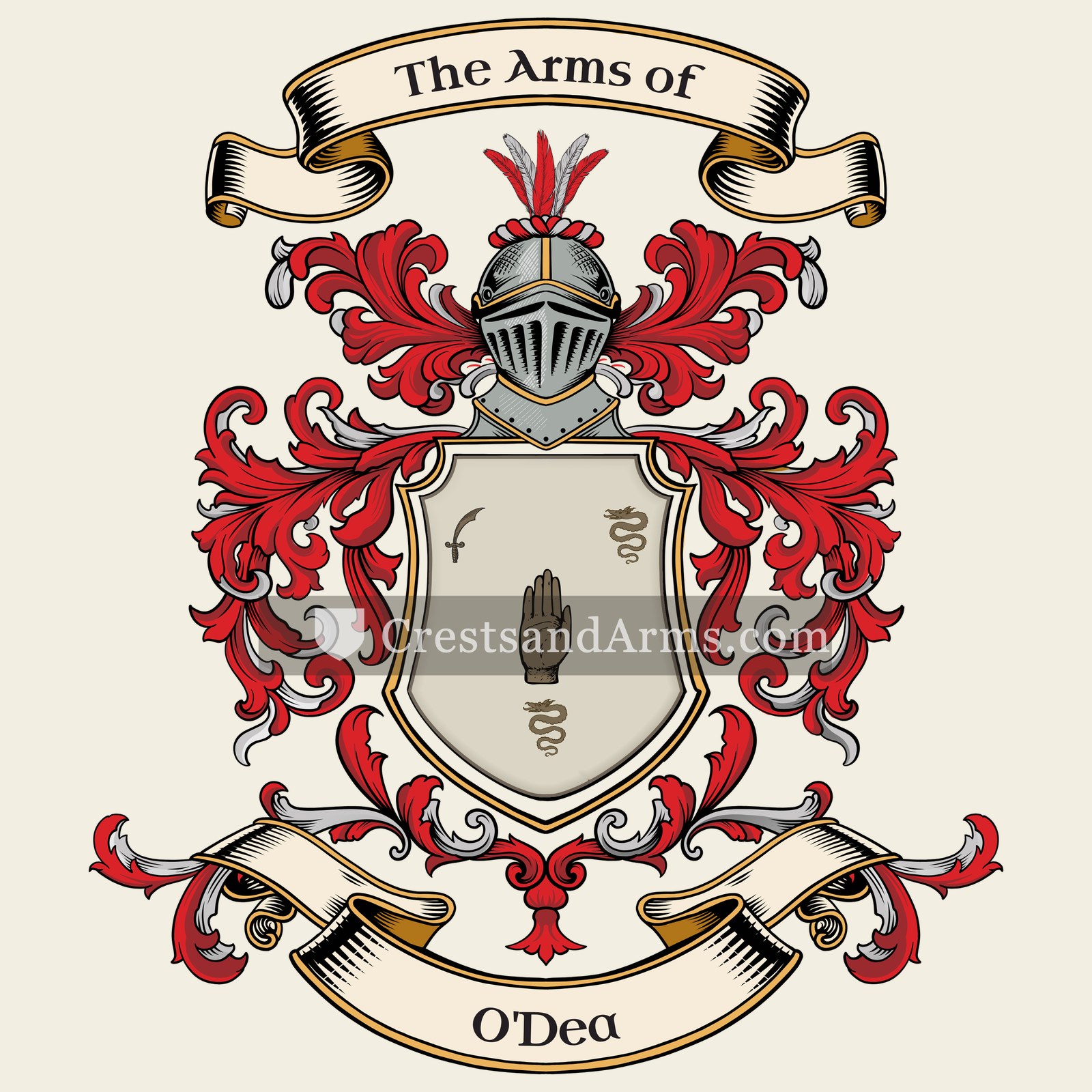
Symbols on this shield
handFaith, sincerity and justice
swordJustice, and military honour
serpentWisdom, healing and prudence
Colours
Silver (Argent)Means: Peace and sincerity
Historical info
Source
J. B. Rietstap, Armorial Général, Gouda: G. B. van Goor Zonen, 1884–87
Blazon (the actual original written record)
“D'arg. à une main hab., posée en fasce, mise en p., tenant une épée en pal, accostée en chef de deux serpents affr., ondoyant en pals; le tout au nat.”
Britainc. 1700
Digital archive packCoat of arms PNG, gold border print PDF, vector SVG and the certificate of authenticity. Sent to your email in minutes.
Map of Britain showing where the O'Dea arms are recorded
The O'Dea arms were recorded in Britain, c. 1700.
Arms such as these were typically recorded in Kent.
Kent sits between London and the short crossing to Europe, and the trade passing through made it wealthy. Merchant families bought land with that money, and it was landowners who took coats of arms.
This is where the arms were entered in the register. Families often moved to other parts of the country, so the same name can turn up in more than one region.
The body that granted and recorded arms in Britain in this period.
William III of England
Sovereign of the period
William III of England
1694–1702
Reigning in Britain when the O'Dea arms are first recorded.
How Arms Worked in Britain
English heraldry allowed arms to be shared by all legitimate descendants of the original owner. These symbols were treated as personal property that moved through the generations to all children. While the eldest son kept the original design, other family members could use the same shield without needing to change it or register their own unique versions.
Granting authority
The College of Arms in London has regulated the use of coats of arms throughout England and Wales since 1484.
How they got arms
Families typically obtained their coats of arms through a formal grant from the Crown or by proving their ancient right to them.
Where arms were recorded
All official coats of arms are recorded in the registers kept at the College of Arms, which date back to the fifteenth century.
The family's standing
Recorded among the armigerous families of Britain.
Origin & History of the O'Dea Family in Britain
The O’Dea family name originates from the Gaelic term Ó Deághaidh, which translates to a descendant of Deághaidh. While the name is deeply rooted in the history of County Clare in Ireland, members of the family began to appear in British records by the early 18th century. By 1700, specific records confirm the presence of O’Dea individuals living in the county of Kent. During this period, the movement of people across the Irish Sea often followed trade routes or military service patterns. These early settlers in Kent likely integrated into the local labor force or maritime industries that defined the coastal region at the time. Their presence in England reflects a broader trend of Irish migration during the late Stuart period, as families sought new opportunities in the growing towns of southern England.
Coat of Arms & Family Crest Details
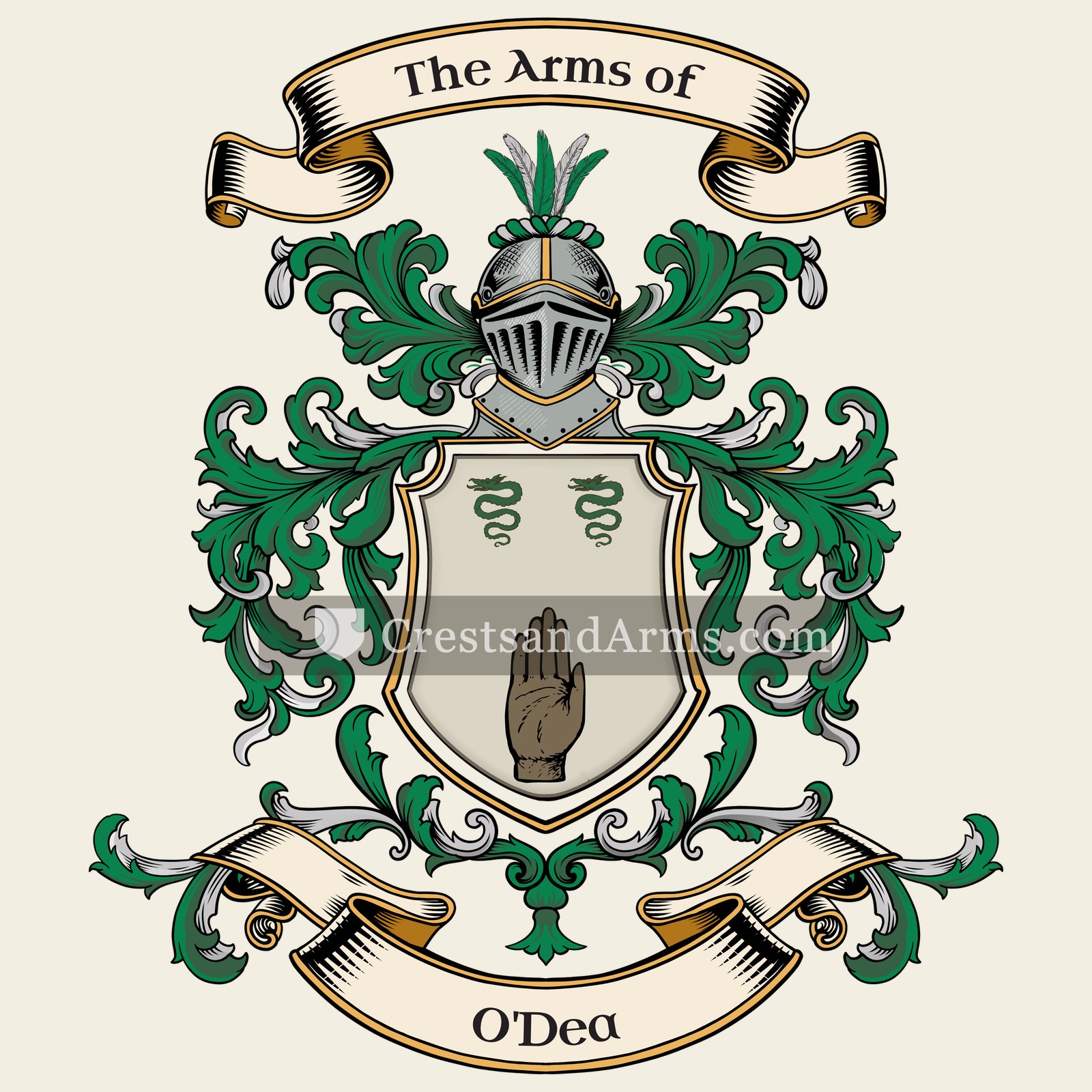
Symbols on this shield
handFaith, sincerity and justice
serpentWisdom, healing and prudence
Colours
Silver (Argent)Means: Peace and sincerity
Green (Vert)Means: Hope
Historical info
Source
Sir Bernard Burke, The General Armory of England, Scotland, Ireland and Wales, London: Harrison & Sons, 1884
Blazon (the actual original written record)
“Ar. a dexter hand lying fessways, couped at the wrist, cuffed indented az. holding a sword in pale all ppr. in chief two snakes embowed vert”
ClareClare, c. 1645
Digital archive packCoat of arms PNG, gold border print PDF, vector SVG and the certificate of authenticity. Sent to your email in minutes.
Map of Ireland showing where the O'Dea arms are recorded
The O'Dea arms were recorded in Clare, c. 1645.
Clare was rocky western Irish country, poor in farmland but held tightly by a few old families. Land there changed hands rarely, and families who stayed put ended up in the records.
This is where the arms were entered in the register. Families often moved to other parts of the country, so the same name can turn up in more than one region.
The body that granted and recorded arms in Ireland in this period.
Charles I of England
Sovereign of the period
Charles I of England
1625–1649
Reigning in Britain when the O'Dea arms are first recorded.
How Arms Worked in Ireland
The Ulster King of Arms granted coats of arms to individuals who proved their social standing and good character. These symbols were typically inherited by all legitimate descendants of the original holder. If a family branch wanted a unique look, they could apply for a specific change to their design through the office to ensure their identity remained distinct.
Granting authority
The Ulster King of Arms acted as the official body that regulated and issued all coats of arms throughout Ireland.
How they got arms
Families obtained their arms through formal grants issued by the office after proving their eligibility and paying the required fees.
Where arms were recorded
All official grants were recorded in the registers held by the Ulster King of Arms starting from the year 1552.
The family's standing
Recorded among the armigerous families of Clare.
Origin & History of the O'Dea Family in Ireland
The O’Dea family name originates from the Gaelic term Ó Deághaidh, which translates to a descendant of Deághaidh. This family rose to prominence in the region of County Clare, where they established themselves as a significant sept within the Dál gCais tribal confederation. By the mid-seventeenth century, the O’Deas were deeply rooted in the landscape of Clare, holding lands and maintaining a strong social standing before the political upheavals of the 1640s. Their history is closely tied to the local geography, particularly around the area of Dysert O’Dea, where they built a stone castle that served as a center for their influence. As members of the Gaelic nobility, they played an active role in the local governance and military affairs of their territory. Their presence in 1645 reflects a long-standing tradition of leadership that defined their identity in the west of Ireland for many generations.
O'Dea Meaning & Related Branches
Root word
Ó Deághaidh
Descendant of the person named Deághaidh, meaning good luck or fortune.
This name
O'DeaRefers to a descendant of a person whose name signifies good fortune.
also spelled
Oday
Dea
Day
Related arms
Dayvariant spelling
Deavariant spelling
Documented Sources
J. B. Rietstap, Armorial Général, Gouda: G. B. van Goor Zonen, 1884–87
MacLysaght, Edward, The Surnames of Ireland, 1985
The National Archives (UK), Parish registers of Kent, 1700
Woulfe, Patrick, Sloinnte Gaedheal is Gall, 1923
Digital archive packCoat of arms PNG, gold border print PDF, vector SVG and the certificate of authenticity. Sent to your email in minutes.


 handFaith, sincerity and justice
 swordJustice, and military honour
 serpentWisdom, healing and prudence
 handFaith, sincerity and justice
 swordJustice, and military honour
 serpentWisdom, healing and prudence