Map of Germany showing where the Odendaal arms are recorded
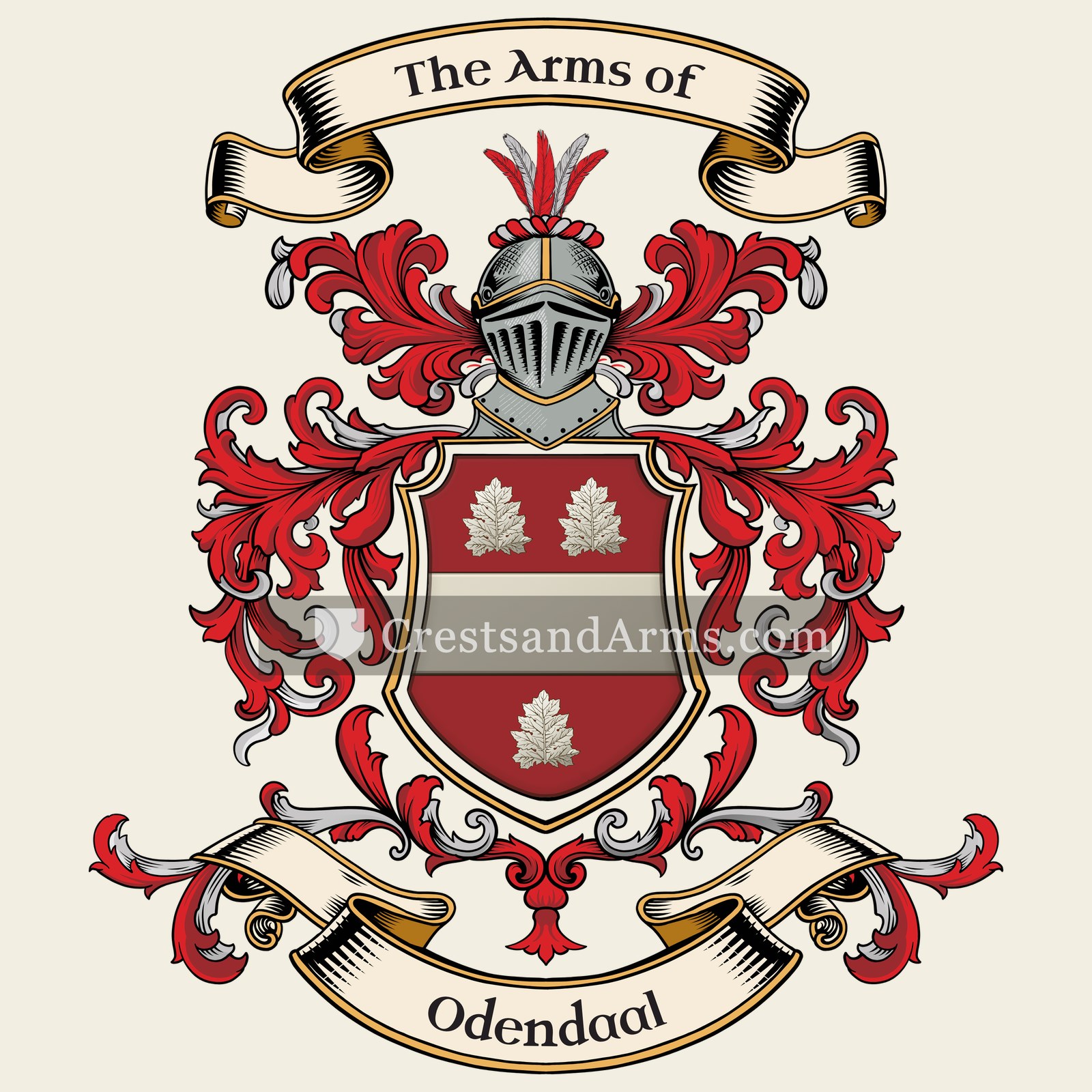
The Odendaal arms were recorded in Westphalia, c. 1765.
Westphalia was a land of small estates and fortified farmhouses in western Germany. Its families were numerous and not especially rich, but each held its own ground, and holding ground was what brought arms.
This is where the arms were entered in the register. Families often moved to other parts of the country, so the same name can turn up in more than one region.
The body that granted and recorded arms in Germany in this period.
Francis I, Holy Roman Emperor
Sovereign of the period
Francis I, Holy Roman Emperor
1745–1765
Reigning in Germany when the Odendaal arms are first recorded.
How Arms Worked in Germany
In the Holy Roman Empire, coats of arms were often granted to individuals by the Emperor or his representatives. These arms were then passed down through the generations to all legitimate descendants of the original holder. Younger branches of a family usually kept the same shield design without needing to change it, as the arms belonged to the entire lineage.
Granting authority
The Holy Roman Emperor held the sole power to grant new coats of arms throughout his vast imperial territories.
How they got arms
Families typically obtained their coats of arms through a formal imperial grant or by proving their noble status to the authorities.
Where arms were recorded
These grants were officially recorded in the Imperial Chancery registers, which began keeping formal records of such honors during the Middle Ages.
The family's standing
Recorded among the armigerous families of Westphalia.
Origin & History of the Odendaal Family in Germany
The Odendaal family name has deep roots in the region of Westphalia, Germany, where records confirm the family was established by at least 1765. The name itself is thought to be a variation of the German word Odenthal, which translates to a valley belonging to a person named Odo. During the eighteenth century, Westphalia was a landscape defined by small farming communities and growing trade towns. Families like the Odendaals were often tied to the land, working as skilled farmers or craftsmen who contributed to the local economy. As the family grew, some members eventually moved beyond these regional borders to seek new opportunities in other parts of Europe and eventually abroad. This migration helped spread the name across different cultures while maintaining the original connection to their Westphalian heritage.
Related Branches & Arms
Root word
Odendahl
A valley belonging to someone named Odo or Otto.
This name
OdendaalDerived from a topographic location indicating a valley associated with the personal name Odo.
also spelled
Odendahl
Documented Sources
J. B. Rietstap, Armorial Général, Gouda: G. B. van Goor Zonen, 1884–87


 fessThe military belt, and readiness to serve
 leafHappiness and abundance
 fessThe military belt, and readiness to serve
 leafHappiness and abundance