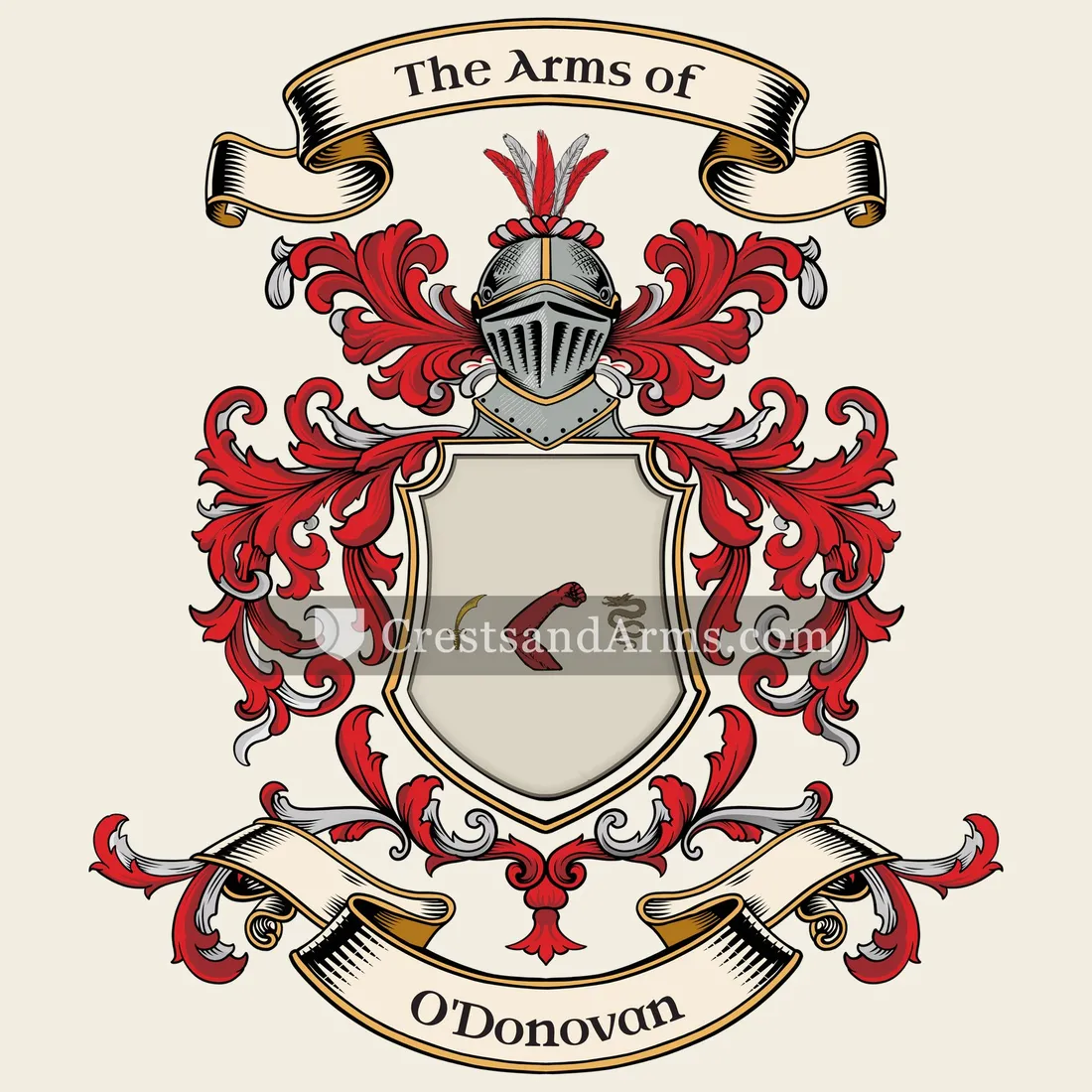
A record of documented arms, meaning and origin, researched for the O'Donovan family lines. Documented in 3 countries.
Reg. 6268 · Britain, M–O
Meaning of the O'Donovan family crest colors & symbols
Symbols on this shield
armA person of action, industrious and laborious
Colours
Silver (Argent)Means: Peace and sincerity
Historical info
Source
J. B. Rietstap, Armorial Général, Gouda: G. B. van Goor Zonen, 1884–87
Blazon (the actual original written record)
“D'arg. à un avant-bras en fasce, mouv. du flanc sen., paré de gu., rebr. d'azur, la main de carn. tenant une épée en pal, accolée d'un serpent au nat. C.: une aigle iss. au nat., soutenue d'un chapeau de tournoi de gu., retr. d'herm. S.: à dextre un léopard lionné, à sen. un griffon, tous deux au nat. D.: ADJUVANTE DEO IN HOSTES; et : VIS SUPER HOSTEM.”
Britainc. 1700
Digital archive packCoat of arms PNG, gold border print PDF, vector SVG and the certificate of authenticity. Sent to your email in minutes.
Map of Britain showing where the O'Donovan arms are recorded
The O'Donovan arms were recorded in Britain, c. 1700.
Arms such as these were typically recorded in Kent.
Kent sits between London and the short crossing to Europe, and the trade passing through made it wealthy. Merchant families bought land with that money, and it was landowners who took coats of arms.
This is where the arms were entered in the register. Families often moved to other parts of the country, so the same name can turn up in more than one region.
The body that granted and recorded arms in Britain in this period.
William III of England
Sovereign of the period
William III of England
1694–1702
Reigning in Britain when the O'Donovan arms are first recorded.
How Arms Worked in Britain
English heraldry allowed arms to be shared by all legitimate descendants of the original owner. These symbols were treated as personal property that moved through the generations to all children. While the eldest son kept the original design, other family members could use the same shield without needing to change it or register their own unique versions.
Granting authority
The College of Arms in London has regulated the use of coats of arms throughout England and Wales since 1484.
How they got arms
Families typically obtained their coats of arms through a formal grant from the Crown or by proving their ancient right to them.
Where arms were recorded
All official coats of arms are recorded in the registers kept at the College of Arms, which date back to the fifteenth century.
The family's standing
Recorded among the armigerous families of Britain.
Origin & History of the O'Donovan Family in Britain
The O’Donovan family name originates from the Gaelic tradition of Ireland, but its presence in Britain dates back several centuries as members of the family migrated for trade, military service, or labor. By the year 1700, records confirm that individuals bearing this surname had established themselves in the county of Kent. During this period, the movement of Irish families into southern England was often linked to the expansion of maritime networks and the search for new economic opportunities in growing urban centers. These early settlers in Kent integrated into local parish life and contributed to the diverse social fabric of the region. Their transition from Ireland to England reflects the broader patterns of migration that defined the British Isles during the early modern era. As these families settled, they maintained their distinct cultural identity while adapting to the customs and community structures of their new home in the English countryside.
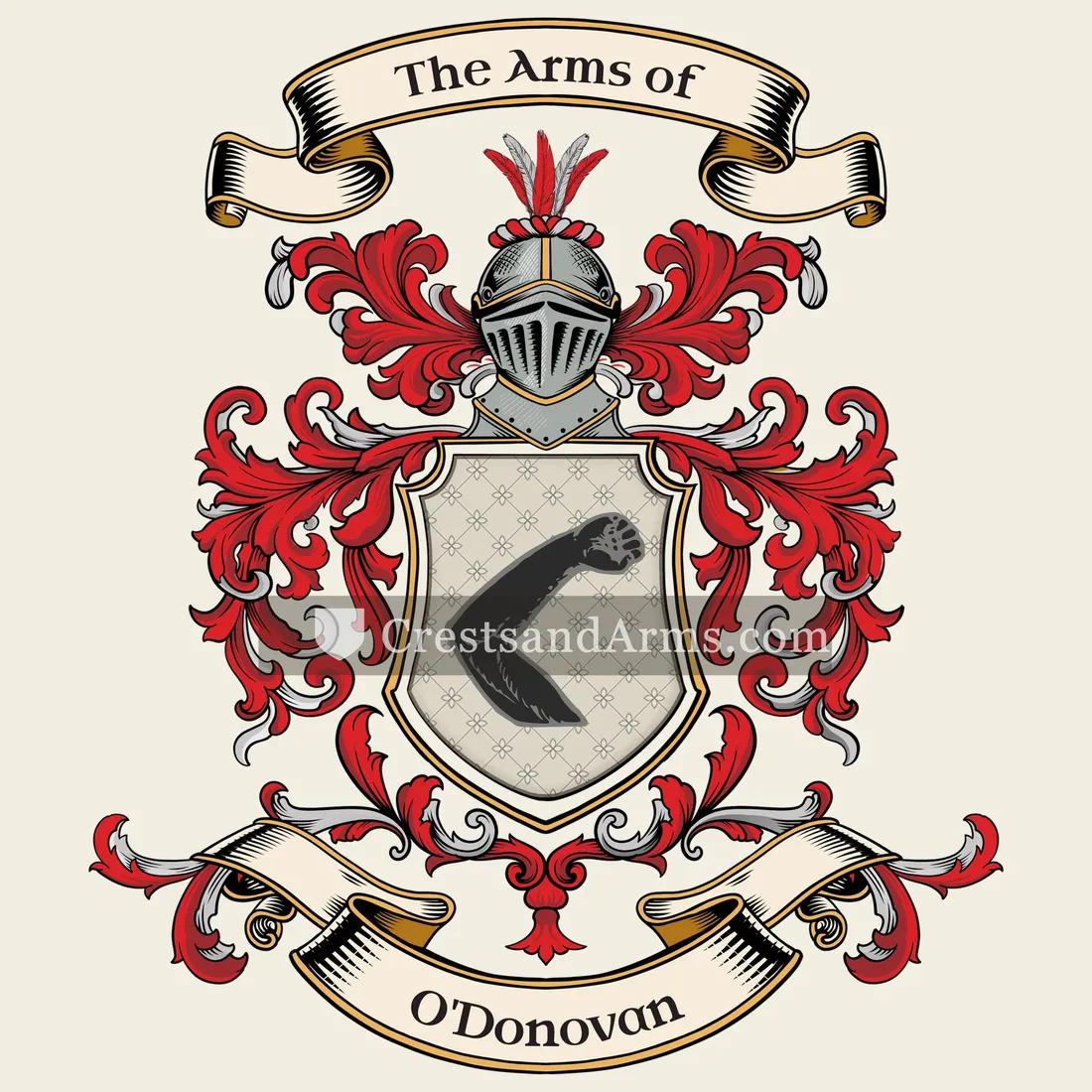
Meaning of the O'Donovan family crest colors & symbols
Symbols on this shield
armA person of action, industrious and laborious
Colours
Silver (Argent)Means: Peace and sincerity
Red (Gules)Means: Military strength
Historical info
Source
Sir Bernard Burke, The General Armory of England, Scotland, Ireland and Wales, London: Harrison & Sons, 1884
Blazon (the actual original written record)
“Ar. a dexter arm couped below the elbow, lying fessways, vested gu. cuffed of the first, holding in the hand a sword in pale entwined with a serpent descending all ppr”
SpainMalaga, c. 1722
Digital archive packCoat of arms PNG, gold border print PDF, vector SVG and the certificate of authenticity. Sent to your email in minutes.
Map of Spain showing where the O'Donovan arms are recorded
The O'Donovan arms were recorded in Malaga, c. 1722.
This is where the arms were entered in the register. Families often moved to other parts of the country, so the same name can turn up in more than one region.
The body that granted and recorded arms in Spain in this period.
Philip V of Spain
Sovereign of the period
Philip V of Spain
1714–1724
Reigning in Britain when the O'Donovan arms are first recorded.
How Arms Worked in Spain
In Spain, a coat of arms was considered a form of property that belonged to the entire family line. These arms were passed down from a father to all his children equally. Younger branches of the family usually kept the original design without needing to add any special marks to distinguish their specific line.
Granting authority
The Cronista Rey de Armas was the official body that regulated and granted coats of arms throughout Spain.
How they got arms
Families often obtained their arms through royal grants or by proving their noble status to the official heraldic authority.
Where arms were recorded
Coats of arms were officially recorded in the registers of the Cronista Rey de Armas starting in 1496.
The family's standing
Recorded among the armigerous families of Spain.
Origin & History of the O'Donovan Family in Spain
The O'Donovan family name carries a rich history that extends far beyond its origins in Ireland, finding a significant foothold in Spain during the early eighteenth century. Following the political upheavals in their homeland, many Irish families sought new opportunities within the Spanish Empire, where their military and administrative skills were highly valued. By 1722, records confirm that members of the O'Donovan family were established in the coastal city of Malaga. This city served as a vital hub for trade and military activity, allowing these expatriates to integrate into the local merchant and professional classes. Their presence in Malaga highlights the broader movement of the Irish Wild Geese, who adapted to life in a new country while maintaining their distinct cultural identity. Over time, these families became deeply embedded in the social fabric of Andalusia, contributing to the vibrant history of the region.
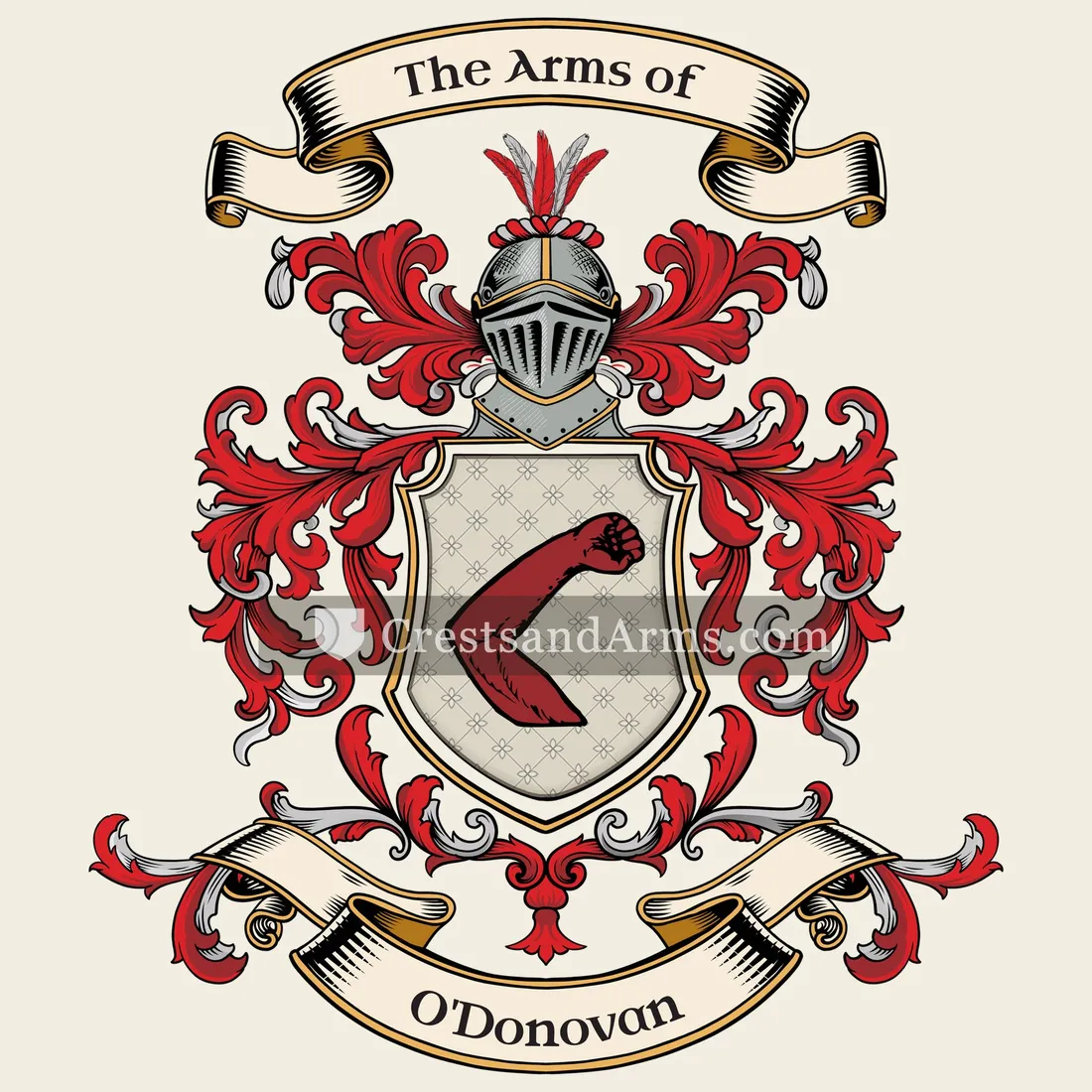
Meaning of the O'Donovan family crest colors & symbols
Symbols on this shield
armA person of action, industrious and laborious
swordJustice, and military honour
serpentWisdom, healing and prudence
Colours
Silver (Argent)Means: Peace and sincerity
Red (Gules)Means: Military strength
Gold (Or)Means: Generosity
Historical info
Source
Sir Bernard Burke, The General Armory of England, Scotland, Ireland and Wales, London: Harrison & Sons, 1884
Blazon (the actual original written record)
“Ar. issuing from the sinister side of the shield a cubit dexter arm vested gu. cuffed of the first, the hand grasping a skein or old Irish sword in pale, the blade entwined with a serpent all ppr”
CorkThe O'Donovan · Cork, c. 1645
Digital archive packCoat of arms PNG, gold border print PDF, vector SVG and the certificate of authenticity. Sent to your email in minutes.
Map of Ireland showing where the O'Donovan arms are recorded
The O'Donovan arms were recorded in Cork, c. 1645.
Cork was the largest county in Ireland, with a great harbour and a wide farming hinterland. Both English settlers and older Irish families held land there, and holding land is what brought a family into the records.
This is where the arms were entered in the register. Families often moved to other parts of the country, so the same name can turn up in more than one region.
The body that granted and recorded arms in Ireland in this period.
Charles I of England
Sovereign of the period
Charles I of England
1625–1649
Reigning in Britain when the O'Donovan arms are first recorded.
How Arms Worked in Ireland
The Ulster King of Arms granted coats of arms to individuals who proved their social standing and good character. These symbols were typically inherited by all legitimate descendants of the original holder. If a family branch wanted a unique look, they could apply for a specific change to their design through the office to ensure their identity remained distinct.
Granting authority
The Ulster King of Arms acted as the official body that regulated and issued all coats of arms throughout Ireland.
How they got arms
Families obtained their arms through formal grants issued by the office after proving their eligibility and paying the required fees.
Where arms were recorded
All official grants were recorded in the registers held by the Ulster King of Arms starting from the year 1552.
The family's standing
Recorded among the armigerous families of Cork.
Origin & History of the O'Donovan Family in Ireland
The O'Donovan family name originates from the Irish Gaelic phrase Ó Donnabháin, which translates to the descendant of Donnabhán. The name first emerged in the southern regions of Ireland, specifically within the ancient Kingdom of Munster. By the time of the mid-seventeenth century, the family held a significant presence in County Cork. They were part of the Uí Fidgenti tribal group, which held power in the area long before the arrival of the Normans. As the political landscape of Ireland shifted during the 1600s, the O'Donovans remained deeply rooted in their ancestral lands. They maintained their social standing through strong ties to the local landscape and their traditional role as a prominent Gaelic sept. Their history is closely linked to the survival of Irish cultural identity during a period of intense historical change.
O'Donovan Meaning & Related Branches
Root word
Donndubhán
Derived from the Gaelic words for dark brown and a diminutive suffix.
This name
O'DonovanDescendant of the dark-haired chieftain or the little dark-brown one.
also spelled
Donovan
Donavan
Related arms
Donovansimilar arms
Documented Sources
J. B. Rietstap, Armorial Général, Gouda: G. B. van Goor Zonen, 1884–87
O’Donovan, John. A Grammar of the Irish Language. 1845
The National Archives (UK). Records of the Prerogative Court of Canterbury, PROB 11
Kent History and Library Centre. Parish Registers of Kent, P200/1/A1
Digital archive packCoat of arms PNG, gold border print PDF, vector SVG and the certificate of authenticity. Sent to your email in minutes.


 armA person of action, industrious and laborious
 armA person of action, industrious and laborious




 swordJustice, and military honour
 serpentWisdom, healing and prudence