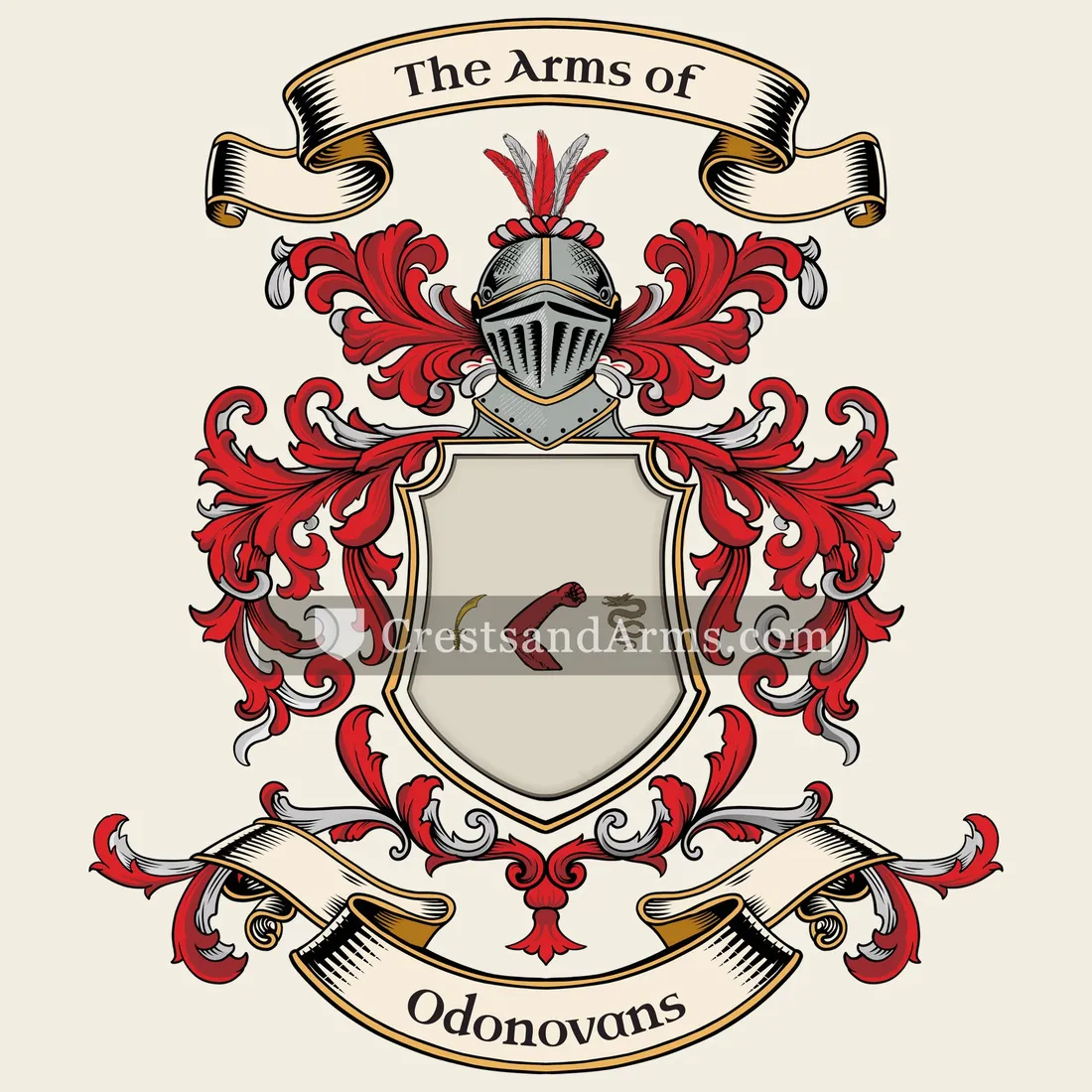
A record of documented arms, meaning and origin, researched for the Odonovans family lines. Documented in 3 countries.
Reg. 7540 · Britain, M–O
Meaning of the Odonovans family crest colors & symbols
Symbols on this shield
armA person of action, industrious and laborious
Colours
Silver (Argent)Means: Peace and sincerity
Historical info
Source
J. B. Rietstap, Armorial Général, Gouda: G. B. van Goor Zonen, 1884–87
Blazon (the actual original written record)
“D'arg. à un avant-bras en fasce, mouv. du flanc sen., paré de gu., rebr. d'azur, la main de carn. tenant une épée en pal, accolée d'un serpent au nat. C.: une aigle iss. au nat., soutenue d'un chapeau de tournoi de gu., retr. d'herm. S.: à dextre un léopard lionné, à sen. un griffon, tous deux au nat. D.: ADJUVANTE DEO IN HOSTES; et : VIS SUPER HOSTEM.”
Britainc. 1700
Digital archive packCoat of arms PNG, gold border print PDF, vector SVG and the certificate of authenticity. Sent to your email in minutes.
Map of Britain showing where the Odonovans arms are recorded
The Odonovans arms were recorded in Britain, c. 1700.
Arms such as these were typically recorded in Kent.
Kent sits between London and the short crossing to Europe, and the trade passing through made it wealthy. Merchant families bought land with that money, and it was landowners who took coats of arms.
This is where the arms were entered in the register. Families often moved to other parts of the country, so the same name can turn up in more than one region.
The body that granted and recorded arms in Britain in this period.
William III of England
Sovereign of the period
William III of England
1694–1702
Reigning in Britain when the Odonovans arms are first recorded.
How Arms Worked in Britain
English heraldry allowed arms to be shared by all legitimate descendants of the original owner. These symbols were treated as personal property that moved through the generations to all children. While the eldest son kept the original design, other family members could use the same shield without needing to change it or register their own unique versions.
Granting authority
The College of Arms in London has regulated the use of coats of arms throughout England and Wales since 1484.
How they got arms
Families typically obtained their coats of arms through a formal grant from the Crown or by proving their ancient right to them.
Where arms were recorded
All official coats of arms are recorded in the registers kept at the College of Arms, which date back to the fifteenth century.
The family's standing
Recorded among the armigerous families of Britain.
Origin & History of the Odonovans Family in Britain
The O'Donovan family name is deeply rooted in Irish history, but its presence in Britain became notable by the turn of the 18th century. While the name originated from the Gaelic *Ó Donnabháin*, meaning descendant of Donndubhan, members of the family began migrating across the Irish Sea for trade, military service, and labor opportunities. By 1700, records indicate that O'Donovan families had established a foothold in the county of Kent. This region was a common destination for travelers arriving from Ireland due to its proximity to major ports and the growing economic activity in the southeast of England. These early settlers often integrated into local parish life, working as skilled tradesmen or farmers while maintaining their distinct cultural identity. Over time, these families helped bridge the gap between their ancestral Irish heritage and the evolving social landscape of Georgian Britain.
Meaning of the Odonovans family crest colors & symbols
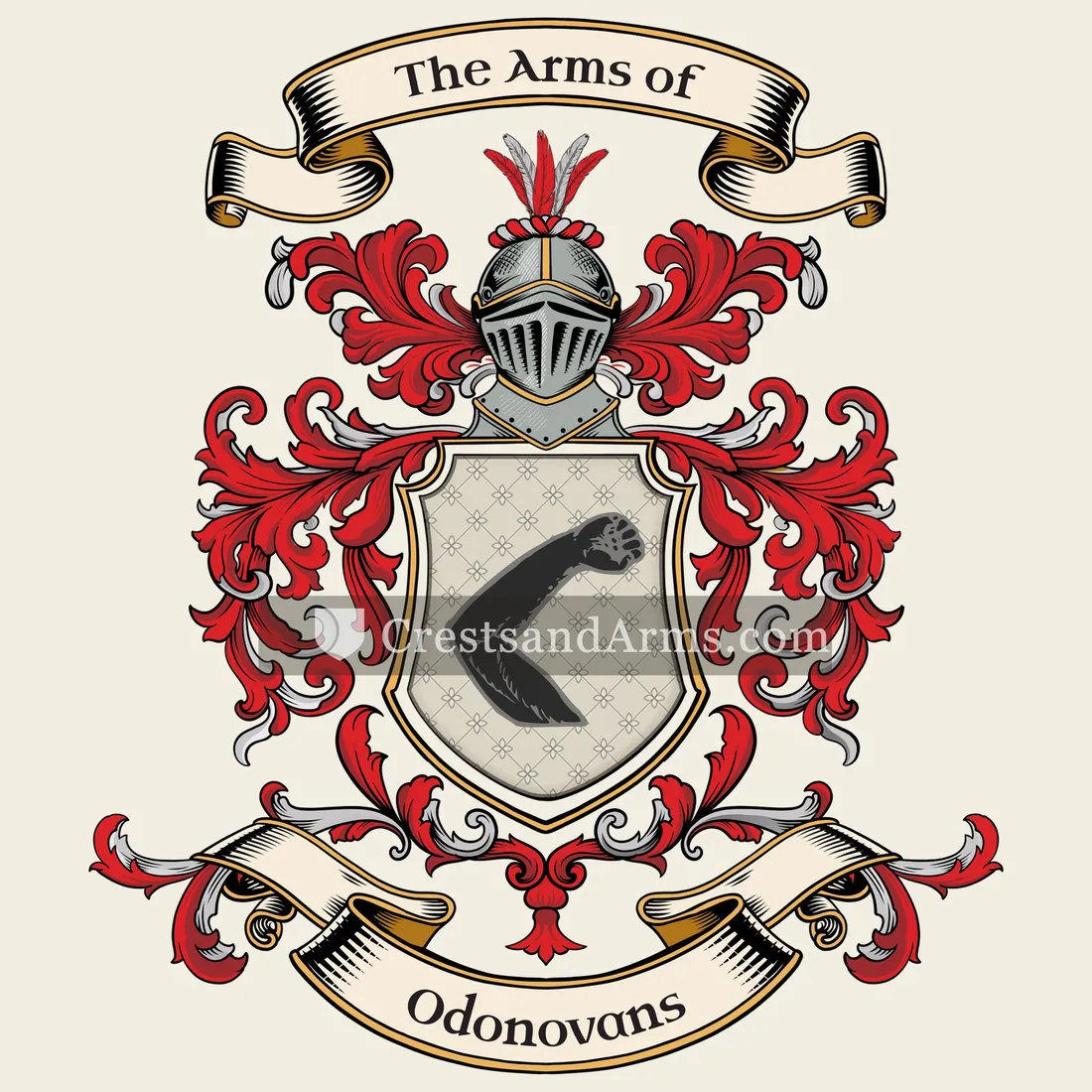
Symbols on this shield
armA person of action, industrious and laborious
Colours
Silver (Argent)Means: Peace and sincerity
Red (Gules)Means: Military strength
Historical info
Source
Sir Bernard Burke, The General Armory of England, Scotland, Ireland and Wales, London: Harrison & Sons, 1884
Blazon (the actual original written record)
“Ar. a dexter arm couped below the elbow, lying fessways, vested gu. cuffed of the first, holding in the hand a sword in pale entwined with a serpent descending all ppr”
SpainMalaga, c. 1722
Digital archive packCoat of arms PNG, gold border print PDF, vector SVG and the certificate of authenticity. Sent to your email in minutes.
Map of Spain showing where the Odonovans arms are recorded
The Odonovans arms were recorded in Malaga, c. 1722.
This is where the arms were entered in the register. Families often moved to other parts of the country, so the same name can turn up in more than one region.
The body that granted and recorded arms in Spain in this period.
Philip V of Spain
Sovereign of the period
Philip V of Spain
1714–1724
Reigning in Britain when the Odonovans arms are first recorded.
How Arms Worked in Spain
In Spain, a coat of arms was considered a form of property that belonged to the entire family line. These arms were passed down from a father to all his children equally. Younger branches of the family usually kept the original design without needing to add any special marks to distinguish their specific line.
Granting authority
The Cronista Rey de Armas was the official body that regulated and granted coats of arms throughout Spain.
How they got arms
Families often obtained their arms through royal grants or by proving their noble status to the official heraldic authority.
Where arms were recorded
Coats of arms were officially recorded in the registers of the Cronista Rey de Armas starting in 1496.
The family's standing
Recorded among the armigerous families of Spain.
Origin & History of the Odonovans Family in Spain
The O’Donovan family name, while deeply rooted in Irish history, established a notable presence in Spain during the early eighteenth century. By 1722, members of the family were documented as residents of Malaga, a bustling port city that served as a vital gateway for trade and military service between Ireland and the Spanish Empire. These individuals were part of a broader movement of Irish families who sought new opportunities in Catholic Europe following political upheaval at home. In Malaga, they integrated into the local merchant and professional classes, utilizing their connections to maintain links with both their ancestral homeland and their new Mediterranean surroundings. This period marked a significant chapter in the family history, as they adapted to Spanish life while preserving their distinct cultural identity within the vibrant society of Andalusia.
Meaning of the Odonovans family crest colors & symbols
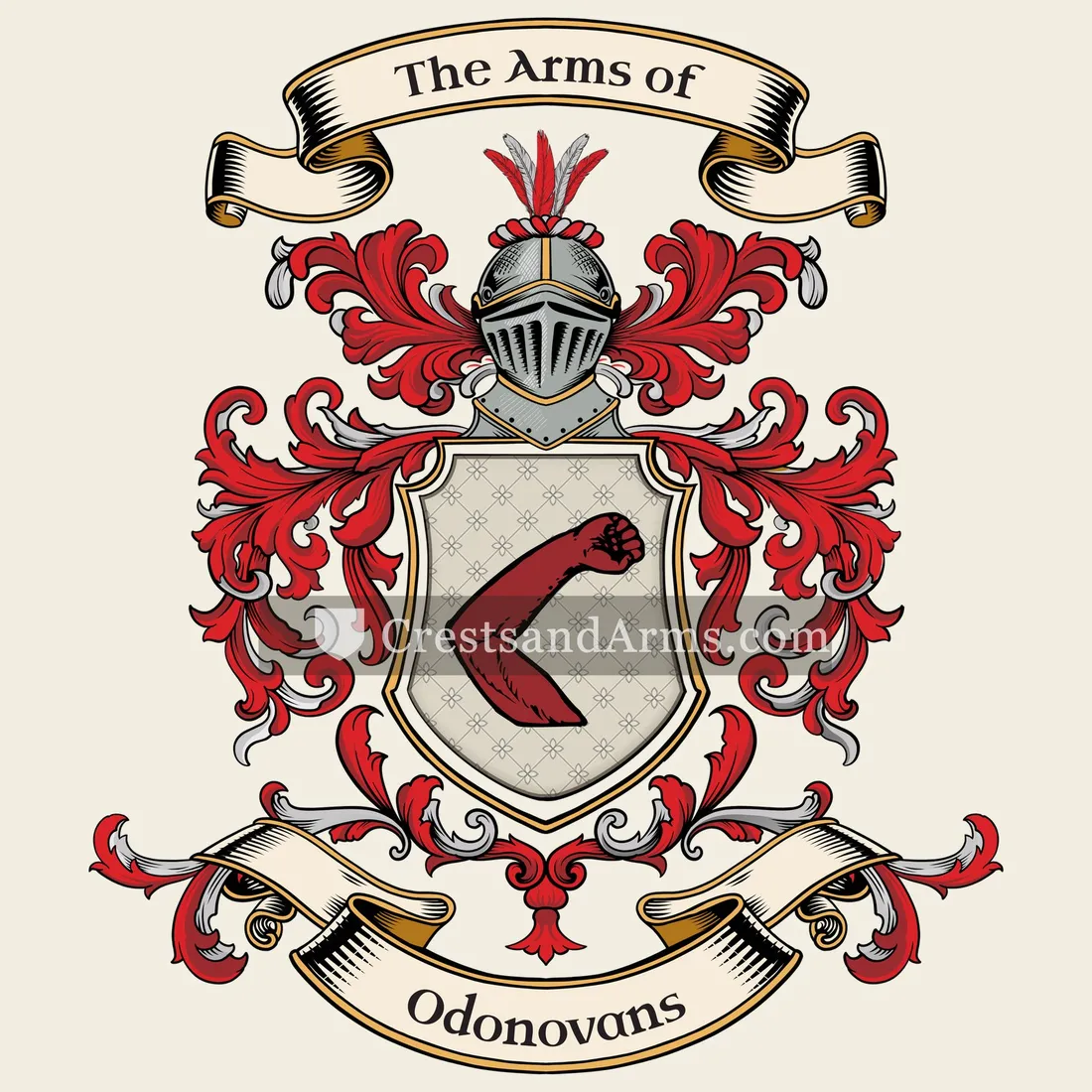
Symbols on this shield
armA person of action, industrious and laborious
swordJustice, and military honour
serpentWisdom, healing and prudence
Colours
Silver (Argent)Means: Peace and sincerity
Red (Gules)Means: Military strength
Gold (Or)Means: Generosity
Historical info
Source
Sir Bernard Burke, The General Armory of England, Scotland, Ireland and Wales, London: Harrison & Sons, 1884
Blazon (the actual original written record)
“Ar. issuing from the sinister side of the shield a cubit dexter arm vested gu. cuffed of the first, the hand grasping a skein or old Irish sword in pale, the blade entwined with a serpent all ppr”
CorkThe O'Donovan · Cork, c. 1645
Digital archive packCoat of arms PNG, gold border print PDF, vector SVG and the certificate of authenticity. Sent to your email in minutes.
Map of Ireland showing where the Odonovans arms are recorded
The Odonovans arms were recorded in Cork, c. 1645.
Cork was the largest county in Ireland, with a great harbour and a wide farming hinterland. Both English settlers and older Irish families held land there, and holding land is what brought a family into the records.
This is where the arms were entered in the register. Families often moved to other parts of the country, so the same name can turn up in more than one region.
The body that granted and recorded arms in Ireland in this period.
Charles I of England
Sovereign of the period
Charles I of England
1625–1649
Reigning in Britain when the Odonovans arms are first recorded.
How Arms Worked in Ireland
The Ulster King of Arms granted coats of arms to individuals who proved their social standing and good character. These symbols were typically inherited by all legitimate descendants of the original holder. If a family branch wanted a unique look, they could apply for a specific change to their design through the office to ensure their identity remained distinct.
Granting authority
The Ulster King of Arms acted as the official body that regulated and issued all coats of arms throughout Ireland.
How they got arms
Families obtained their arms through formal grants issued by the office after proving their eligibility and paying the required fees.
Where arms were recorded
All official grants were recorded in the registers held by the Ulster King of Arms starting from the year 1552.
The family's standing
Recorded among the armigerous families of Cork.
Origin & History of the Odonovans Family in Ireland
The O’Donovan family name originates from the Irish Gaelic *Ó Donnabháin*, which translates to the descendant of Donnabhán. The name first emerged in the tenth century within the Kingdom of Munster, specifically among the Uí Fidgenti people. By the early medieval period, the family established themselves as a powerful ruling dynasty in what is now County Cork. Their influence was deeply tied to the land, and they held significant territories in the southwestern part of the province for several centuries. By 1645, the O’Donovans were well-entrenched in the political and social fabric of West Cork, surviving through generations of regional conflict and shifting power structures. Their history is defined by their resilience as a Gaelic noble family that maintained a strong connection to their ancestral home despite the many political upheavals that reshaped Irish society during the seventeenth century.
Odonovans Meaning & Related Branches
Root word
Donndubhán
Derived from the Gaelic elements for dark brown and little.
This name
OdonovansRefers to the descendant of the dark-haired or dark-complexioned chieftain.
also spelled
Donovan
Donavan
Documented Sources
J. B. Rietstap, Armorial Général, Gouda: G. B. van Goor Zonen, 1884–87
MacLysaght, Edward. The Surnames of Ireland. 1985
O'Donovan, John. Annals of the Kingdom of Ireland by the Four Masters. 1856
The National Archives (UK), Parish registers for the county of Kent
Digital archive packCoat of arms PNG, gold border print PDF, vector SVG and the certificate of authenticity. Sent to your email in minutes.


 armA person of action, industrious and laborious
 armA person of action, industrious and laborious




 swordJustice, and military honour
 serpentWisdom, healing and prudence