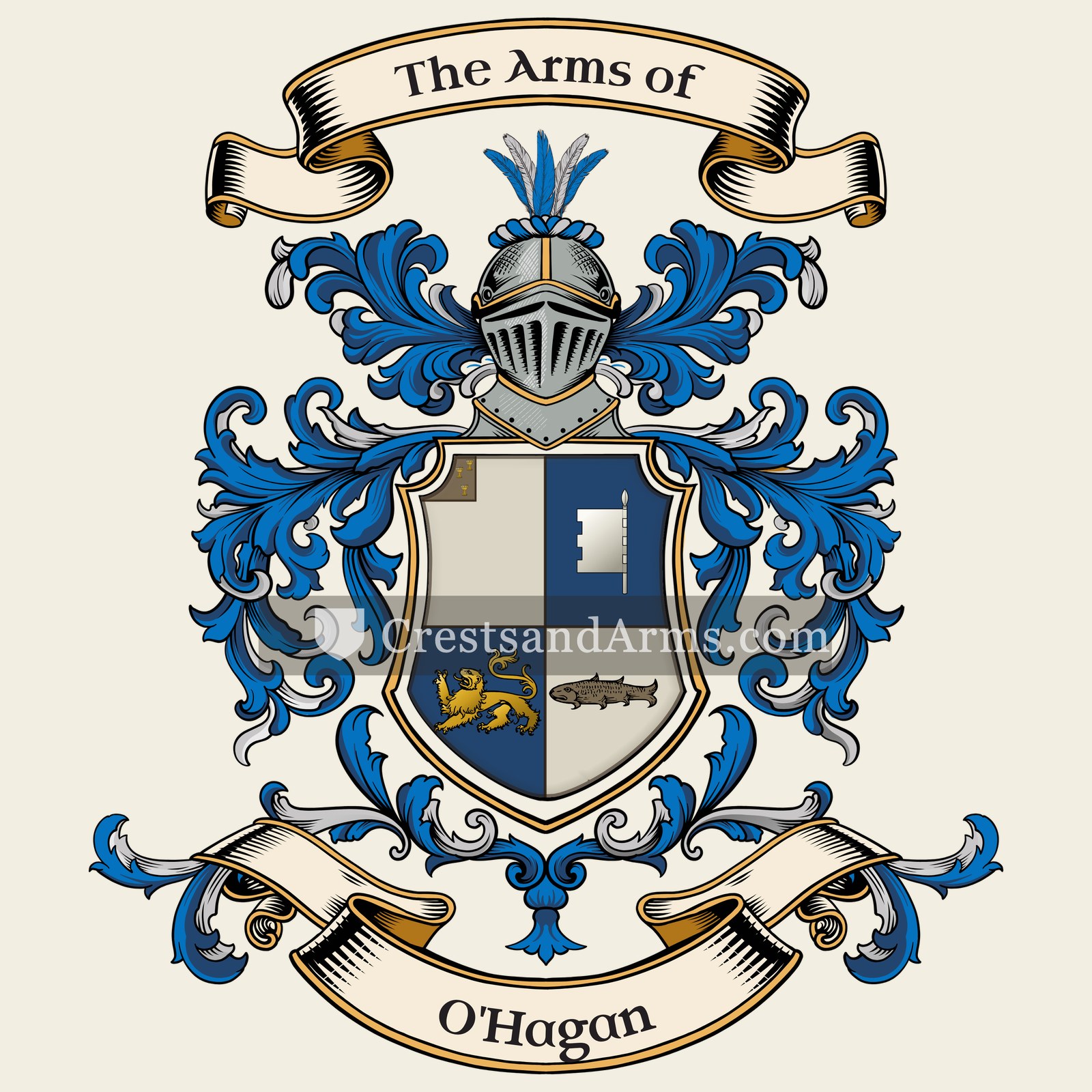
A record of documented arms, meaning and origin, researched for the O'Hagan family lines. Documented in 2 countries.
Reg. 7078 · French, M–O
Coat of Arms & Family Crest Details
Symbols on this shield
cantonA mark of honour granted by the sovereign
cupFaith, office, and a trust discharged
flag / pennantA command held, and a following kept
lionCourage, strength and royalty
fishA true and generous mind, and Christian faith
Colours
Silver (Argent)Means: Peace and sincerity
Blue (Azure)Means: Loyalty and truth
Gold (Or)Means: Generosity
Historical info
Source
J. B. Rietstap, Armorial Général, Gouda: G. B. van Goor Zonen, 1884–87
Blazon (the actual original written record)
“Ec.: au 1 d'arg. à un soulier au nat.; au canton divisé en chev. de gu. sur herm., le gu. ch. de trois coupes couvertes d'or accostées; au 2 d'azur à une bannière d'arg., flottant à sen., ch. d'une main dextre appaumée de gu., en pal; au 3 d'azur au lion d'or; au 4 d'arg. à un poisson nageant au nat. C.: un avant-bras, en pal, paré de gu., rebr. d'herm., la main de carn. tenant un poignard en pal; ledit bras mouv. d'un faisceau des licteurs, au nat., posé en fasce, la hache à dextre, le tranchant en haut. S.: deux lions d'or, coll. de sa., tenant chacun une bannière pareille à celle du 2. D.: BUAD NO BAR (Vaincre ou mourir).”
Francec. 1870
Digital archive packCoat of arms PNG, gold border print PDF, vector SVG and the certificate of authenticity. Sent to your email in minutes.
Map of France showing where the O'Hagan arms are recorded
The O'Hagan arms were recorded in France, c. 1870.
Arms such as these were typically recorded in Bretagne.
More families held coats of arms in Bretagne than anywhere else in France. The land was divided into many small estates rather than a few large ones, so far more households counted as gentry, and each needed a shield of its own to be told apart.
This is where the arms were entered in the register. Families often moved to other parts of the country, so the same name can turn up in more than one region.
The body that granted and recorded arms in France in this period.
Napoleon III
Sovereign of the period
Napoleon III
1852–1870
Reigning in France when the O'Hagan arms are first recorded.
How Arms Worked in France
In France, a coat of arms was a mark of honor that passed down through the male line to all legitimate descendants. Families often used the same shield without changes to show their shared heritage. If a branch wanted to stand out, they could add a small mark to their shield to show their specific place in the family tree.
Granting authority
The Juge d'armes de France acted as the official authority that regulated and verified coats of arms across the country.
How they got arms
Families typically inherited their arms from ancestors, though they could also receive them through royal grants or by proving their noble status.
Where arms were recorded
Coats of arms were officially recorded in the Armorial Général de France, which began its main collection in the year 1696.
The family's standing
Recorded among the armigerous families of France.
Origin & History of the O'Hagan Family in France
The O'Hagan family name originates from the Gaelic tradition of Ireland, but its presence in France reveals a fascinating chapter of migration and cultural integration. By the year 1870, members of the O'Hagan family were documented as residents in the Bretagne region of France. This period was a time of significant social change in Europe, and families often moved across borders for professional opportunities or to escape political instability. In Bretagne, these early family members likely navigated the transition between their Irish heritage and the distinct local customs of northwestern France. Their presence in this coastal region suggests they were part of a broader movement of people who sought new lives in French society during the late nineteenth century. By settling in this area, the O'Hagan family became part of the diverse social fabric that defined the history of the region during that era.
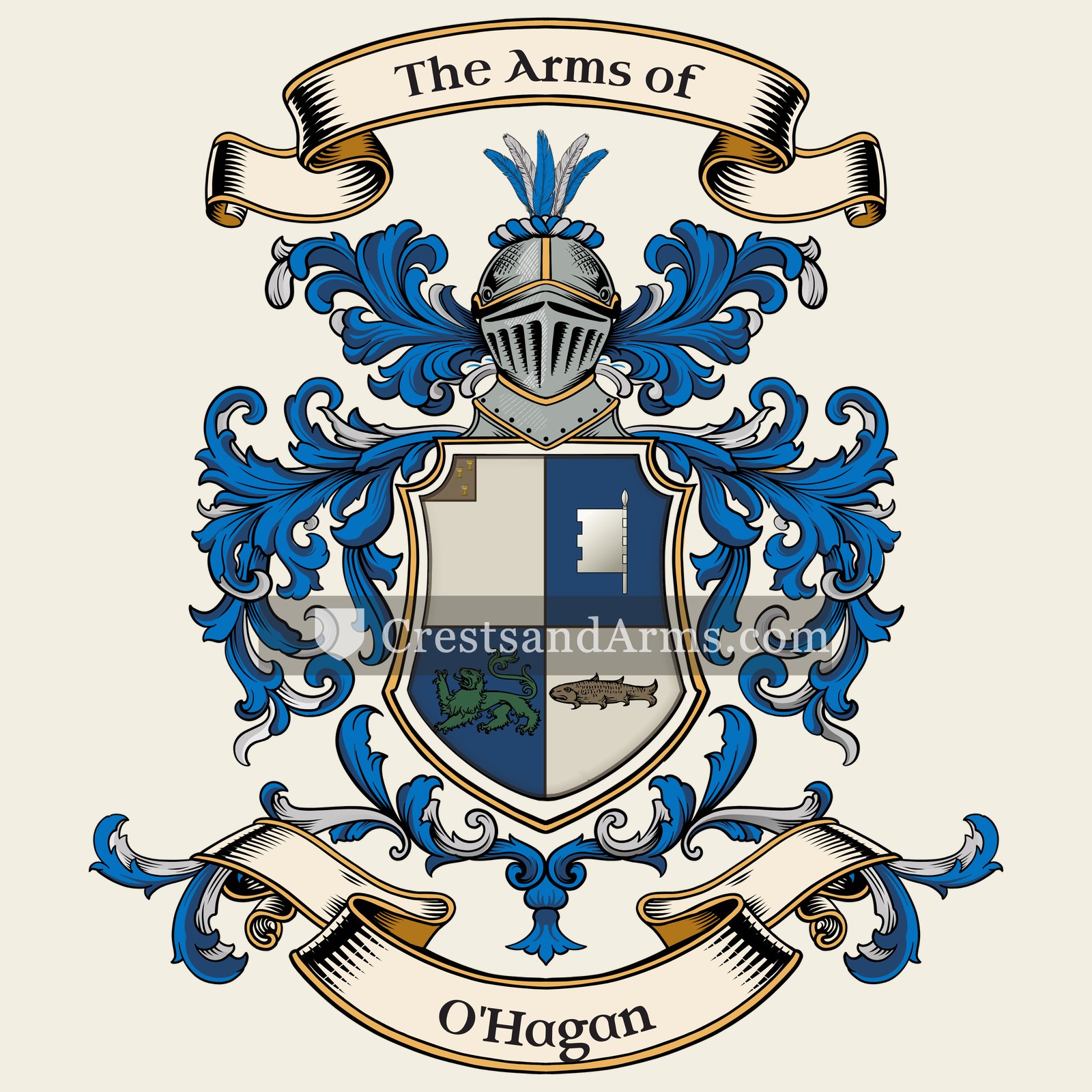
Coat of Arms & Family Crest Details
Symbols on this shield
cantonA mark of honour granted by the sovereign
cupFaith, office, and a trust discharged
flag / pennantA command held, and a following kept
lionCourage, strength and royalty
fishA true and generous mind, and Christian faith
Colours
Silver (Argent)Means: Peace and sincerity
Blue (Azure)Means: Loyalty and truth
Gold (Or)Means: Generosity
Green (Vert)Means: Hope
Historical info
Source
Sir Bernard Burke, The General Armory of England, Scotland, Ireland and Wales, London: Harrison & Sons, 1884
Blazon (the actual original written record)
“Quarterly, ar and az. in 1st quarter a shoe ppr. and on a canton per chev. gu. and erm. three covered cups or; in the 2nd quarter a flag of the first charged with a dexter hand of the fourth; in the 3rd quarter a lion ramp. of the sixth, and in the 4th quarter a fish naiant ppr”
Irelandc. 1868
Digital archive packCoat of arms PNG, gold border print PDF, vector SVG and the certificate of authenticity. Sent to your email in minutes.
Map of Ireland showing where the O'Hagan arms are recorded
The O'Hagan arms were recorded in Ireland, c. 1868.
Arms such as these were typically recorded in Dublin.
Dublin was the seat of government in Ireland and the place where grants were sought and recorded. Families with business at the castle or the courts settled nearby, and settling there put their arms on record.
This is where the arms were entered in the register. Families often moved to other parts of the country, so the same name can turn up in more than one region.
The body that granted and recorded arms in Ireland in this period.
Victoria
Sovereign of the period
Victoria
1837–1901
Reigning in France when the O'Hagan arms are first recorded.
How Arms Worked in Ireland
The Ulster King of Arms granted coats of arms to individuals who proved their social standing and good character. These symbols were typically inherited by all legitimate descendants of the original holder. If a family branch wanted a unique look, they could apply for a specific change to their design through the office to ensure their identity remained distinct.
Granting authority
The Ulster King of Arms acted as the official body that regulated and issued all coats of arms throughout Ireland.
How they got arms
Families obtained their arms through formal grants issued by the office after proving their eligibility and paying the required fees.
Where arms were recorded
All official grants were recorded in the registers held by the Ulster King of Arms starting from the year 1552.
The family's standing
Recorded among the armigerous families of Ireland.
Origin & History of the O'Hagan Family in Ireland
The surname O’Hagan originates from the Gaelic name Ó hÁgáin, which translates to descendant of Ógán. The name is rooted in the Irish word óg, meaning young. Historically, the family was most prominent in the province of Ulster, particularly in County Tyrone, where they served as hereditary lawyers and advisors to the powerful O’Neill clan. As the centuries passed, members of the family migrated across the island for various social and economic reasons. By the mid-nineteenth century, the O’Hagan name was well-established in urban centers like Dublin. Records from 1868 confirm that the family had integrated into the professional and civic life of the capital, reflecting a broader pattern of movement from rural ancestral lands to the growing administrative hubs of Ireland.
Related Branches & Arms
Root word
O hAodhagain
Descendant of the little fiery one
This name
O'HaganDerived from the Gaelic term for a descendant of a person named Aodhagan, meaning little fire.
also spelled
Hagan
Hagen
Haggan
Related arms
Haganvariant spelling
Hagenvariant spelling
Documented Sources
J. B. Rietstap, Armorial Général, Gouda: G. B. van Goor Zonen, 1884–87
Archives départementales d'Ille-et-Vilaine, Série M (Administration générale et économie)
O'Hagan, Henry, The O'Hagan Family: A History of Migration, 1995
Le Gall, Jean, L'immigration irlandaise en Bretagne au XIXe siècle, 2002
Digital archive packCoat of arms PNG, gold border print PDF, vector SVG and the certificate of authenticity. Sent to your email in minutes.


 cantonA mark of honour granted by the sovereign
 cupFaith, office, and a trust discharged
 flag / pennantA command held, and a following kept
 lionCourage, strength and royalty
 fishA true and generous mind, and Christian faith
 cantonA mark of honour granted by the sovereign
 cupFaith, office, and a trust discharged
 flag / pennantA command held, and a following kept
 lionCourage, strength and royalty
 fishA true and generous mind, and Christian faith