Map of Germany showing where the Olea arms are recorded
The Olea arms were recorded in Westphalia, c. 1765.
Westphalia was a land of small estates and fortified farmhouses in western Germany. Its families were numerous and not especially rich, but each held its own ground, and holding ground was what brought arms.
This is where the arms were entered in the register. Families often moved to other parts of the country, so the same name can turn up in more than one region.
The body that granted and recorded arms in Germany in this period.
Francis I, Holy Roman Emperor
Sovereign of the period
Francis I, Holy Roman Emperor
1745–1765
Reigning in Germany when the Olea arms are first recorded.
How Arms Worked in Germany
In the Holy Roman Empire, coats of arms were often granted to individuals by the Emperor or his representatives. These arms were then passed down through the generations to all legitimate descendants of the original holder. Younger branches of a family usually kept the same shield design without needing to change it, as the arms belonged to the entire lineage.
Granting authority
The Holy Roman Emperor held the sole power to grant new coats of arms throughout his vast imperial territories.
How they got arms
Families typically obtained their coats of arms through a formal imperial grant or by proving their noble status to the authorities.
Where arms were recorded
These grants were officially recorded in the Imperial Chancery registers, which began keeping formal records of such honors during the Middle Ages.
The family's standing
Recorded among the armigerous families of Westphalia.
Origin & History of the Olea Family in Germany
The family name Olea carries a deep history rooted in the cultural landscape of Westphalia during the eighteenth century. By 1765, records confirm that members of the family were established within this region of Germany, which was known for its dense forests and strong agricultural traditions. The name itself is often associated with Latin origins, specifically linked to the word for olive, which suggests that ancestors may have been involved in trade or lived in areas where such botanical names were adopted as descriptors. During this era, families in Westphalia were frequently tied to specific landholdings or local crafts, and the Olea name likely emerged as a way to identify a particular lineage within these tight-knit rural communities. As the family moved and grew throughout the following decades, they maintained their connection to the social and economic structures of the German territories, eventually spreading their influence beyond their initial home.
Olea Meaning & Related Branches
Root word
Oleum
Latin term referring to oil or olive oil.
This name
OleaAn occupational name for a merchant or producer of olive oil.
also spelled
Olee
Oleh
Oley
Ola
Documented Sources
J. B. Rietstap, Armorial Général, Gouda: G. B. van Goor Zonen, 1884–87
Westfälisches Landesarchiv, Kirchenbücher der evangelischen Kirchengemeinde Westfalen, 1765
Bielefeld, H., Die Familiennamen in Westfalen, 1922
Landesarchiv Nordrhein-Westfalen, Personenstandsregister der westfälischen Provinzen, 1765
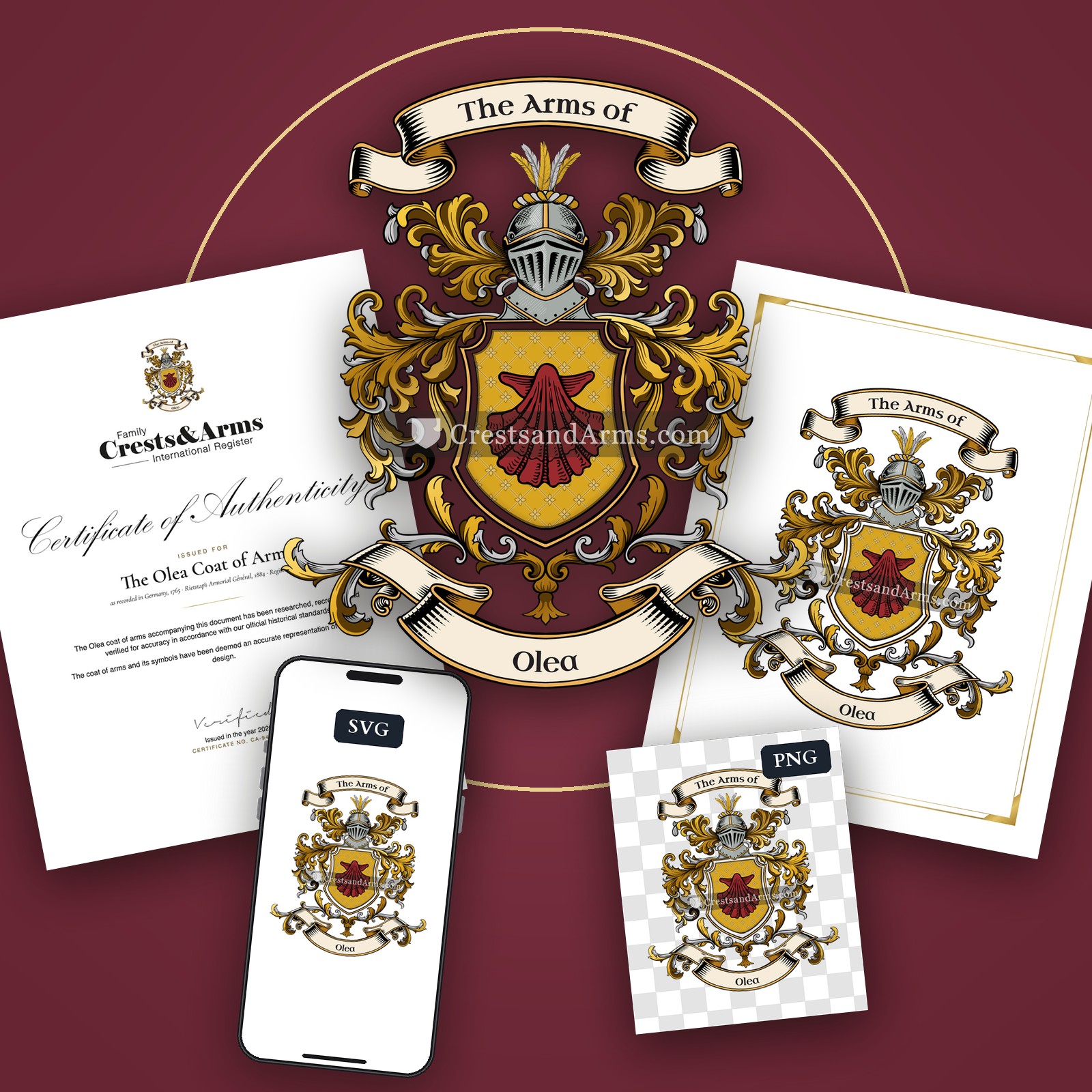
Digital archive packCoat of arms PNG, gold border print PDF, vector SVG and the certificate of authenticity. Sent to your email in minutes.


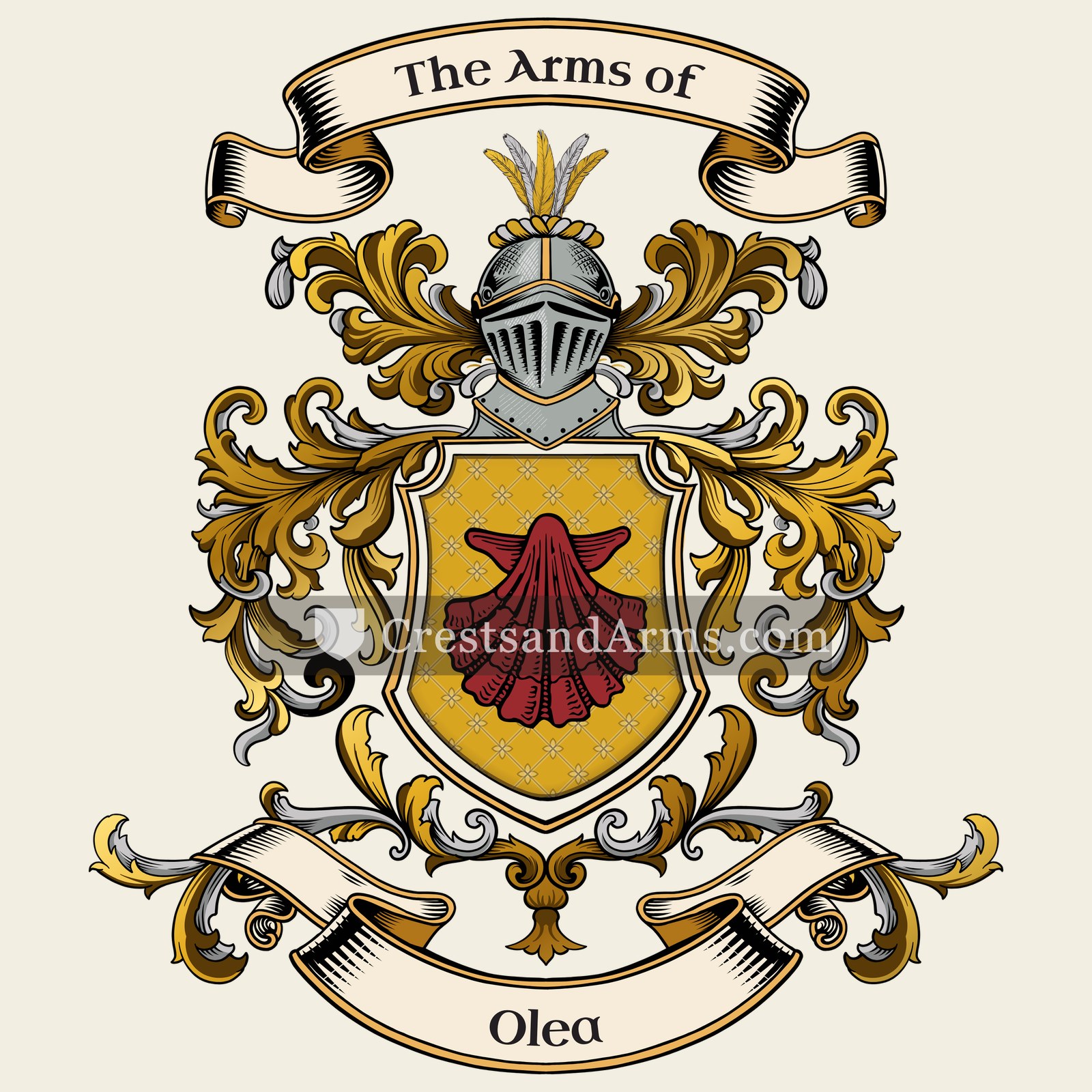
 escallopThe pilgrim's shell, and a long journey made
 escallopThe pilgrim's shell, and a long journey made