Map of Britain showing where the Omara arms are recorded
The Omara arms were recorded in Britain, c. 1700.
Arms such as these were typically recorded in Kent.
Kent sits between London and the short crossing to Europe, and the trade passing through made it wealthy. Merchant families bought land with that money, and it was landowners who took coats of arms.
This is where the arms were entered in the register. Families often moved to other parts of the country, so the same name can turn up in more than one region.
The body that granted and recorded arms in Britain in this period.
William III of England
Sovereign of the period
William III of England
1694–1702
Reigning in Britain when the Omara arms are first recorded.
How Arms Worked in Britain
English heraldry allowed arms to be shared by all legitimate descendants of the original owner. These symbols were treated as personal property that moved through the generations to all children. While the eldest son kept the original design, other family members could use the same shield without needing to change it or register their own unique versions.
Granting authority
The College of Arms in London has regulated the use of coats of arms throughout England and Wales since 1484.
How they got arms
Families typically obtained their coats of arms through a formal grant from the Crown or by proving their ancient right to them.
Where arms were recorded
All official coats of arms are recorded in the registers kept at the College of Arms, which date back to the fifteenth century.
The family's standing
Recorded among the armigerous families of Britain.
Origin & History of the Omara Family in Britain
The history of the O’Mara name in Britain is deeply tied to the movement of people across the Irish Sea during the late seventeenth and early eighteenth centuries. While the name originates from the Gaelic term Ó Meadhra, meaning descendant of the merry or joyful one, its presence in Kent by 1700 suggests a family that had integrated into the local economy of southeastern England. During this period, Kent served as a vital hub for trade and travel, and families arriving from Ireland often settled in these coastal regions to find work in agriculture or maritime industries. These early settlers were part of a broader demographic shift that saw Irish families establishing roots in English communities, gradually adapting their traditions to fit their new surroundings. By the turn of the eighteenth century, the O’Mara family in Kent had transitioned from recent arrivals to established residents, contributing to the local workforce and the evolving social fabric of the English countryside.
Coat of Arms & Family Crest Details
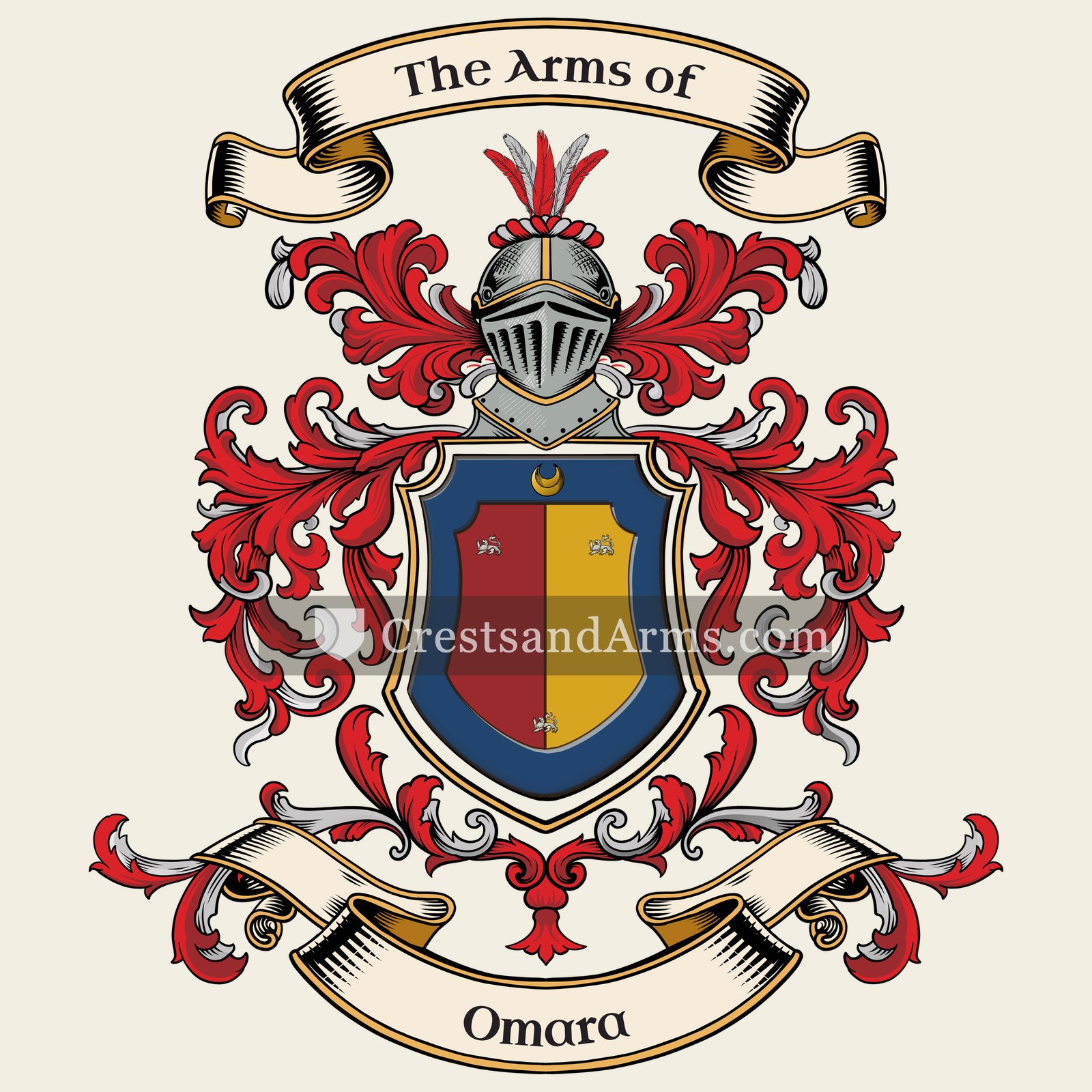
Symbols on this shield
bordureA difference between branches of one family
lionCourage, strength and royalty
crescentHonour by the sovereign, and the second son
Colours
Red (Gules)Means: Military strength
Gold (Or)Means: Generosity
Blue (Azure)Means: Loyalty and truth
Silver (Argent)Means: Peace and sincerity
Historical info
Source
Sir Bernard Burke, The General Armory of England, Scotland, Ireland and Wales, London: Harrison & Sons, 1884
Blazon (the actual original written record)
“Gu. three lions pass. guard. in pale per pale ar. and or, armed and langued az. a border of the last, semée of crescents of the third”
TipperaryLishenuske · Tipperary, c. 1636
Digital archive packCoat of arms PNG, gold border print PDF, vector SVG and the certificate of authenticity. Sent to your email in minutes.
Map of Ireland showing where the Omara arms are recorded
The Omara arms were recorded in Tipperary, c. 1636.
Tipperary was the best grazing land in Ireland, held by a small number of powerful families. Land of that value stayed in the same hands, and unbroken holding is what puts a name in the records.
This is where the arms were entered in the register. Families often moved to other parts of the country, so the same name can turn up in more than one region.
The body that granted and recorded arms in Ireland in this period.
Charles I of England
Sovereign of the period
Charles I of England
1625–1649
Reigning in Britain when the Omara arms are first recorded.
How Arms Worked in Ireland
The Ulster King of Arms granted coats of arms to individuals who proved their social standing and good character. These symbols were typically inherited by all legitimate descendants of the original holder. If a family branch wanted a unique look, they could apply for a specific change to their design through the office to ensure their identity remained distinct.
Granting authority
The Ulster King of Arms acted as the official body that regulated and issued all coats of arms throughout Ireland.
How they got arms
Families obtained their arms through formal grants issued by the office after proving their eligibility and paying the required fees.
Where arms were recorded
All official grants were recorded in the registers held by the Ulster King of Arms starting from the year 1552.
The family's standing
Recorded among the armigerous families of Tipperary.
Origin & History of the Omara Family in Ireland
The name O’Mara, originally spelled Ó Meadhra in Irish, traces its roots to the ancient kingdom of Ormond in what is now County Tipperary. The family belonged to the Dál gCais tribal grouping, which was a powerful dynasty that dominated much of the region during the medieval period. By the early 17th century, the O’Maras were well-established landowners in the barony of Kilnamanagh. Historical records confirm their presence in this area by 1636, a time when the family held significant local influence before the political upheavals of the mid-1600s. As a sept, or clan, they were deeply connected to the landscape of Tipperary, where they served as traditional leaders and stewards of their ancestral territories. Their history reflects the broader experience of Gaelic families who maintained their social standing through generations of shifting political power in Ireland.
Related Branches & Arms
Root word
Ó Meadhra
Descendant of the merry or mirthful one.
This name
OmaraAn anglicized Irish surname signifying a joyful or festive individual.
also spelled
Meara
Omearah
Mearah
Documented Sources
J. B. Rietstap, Armorial Général, Gouda: G. B. van Goor Zonen, 1884–87
Canny, Nicholas. Making Ireland British, 1580-1650. 2001


 lionCourage, strength and royalty
 escallopThe pilgrim's shell, and a long journey made
 lionCourage, strength and royalty
 escallopThe pilgrim's shell, and a long journey made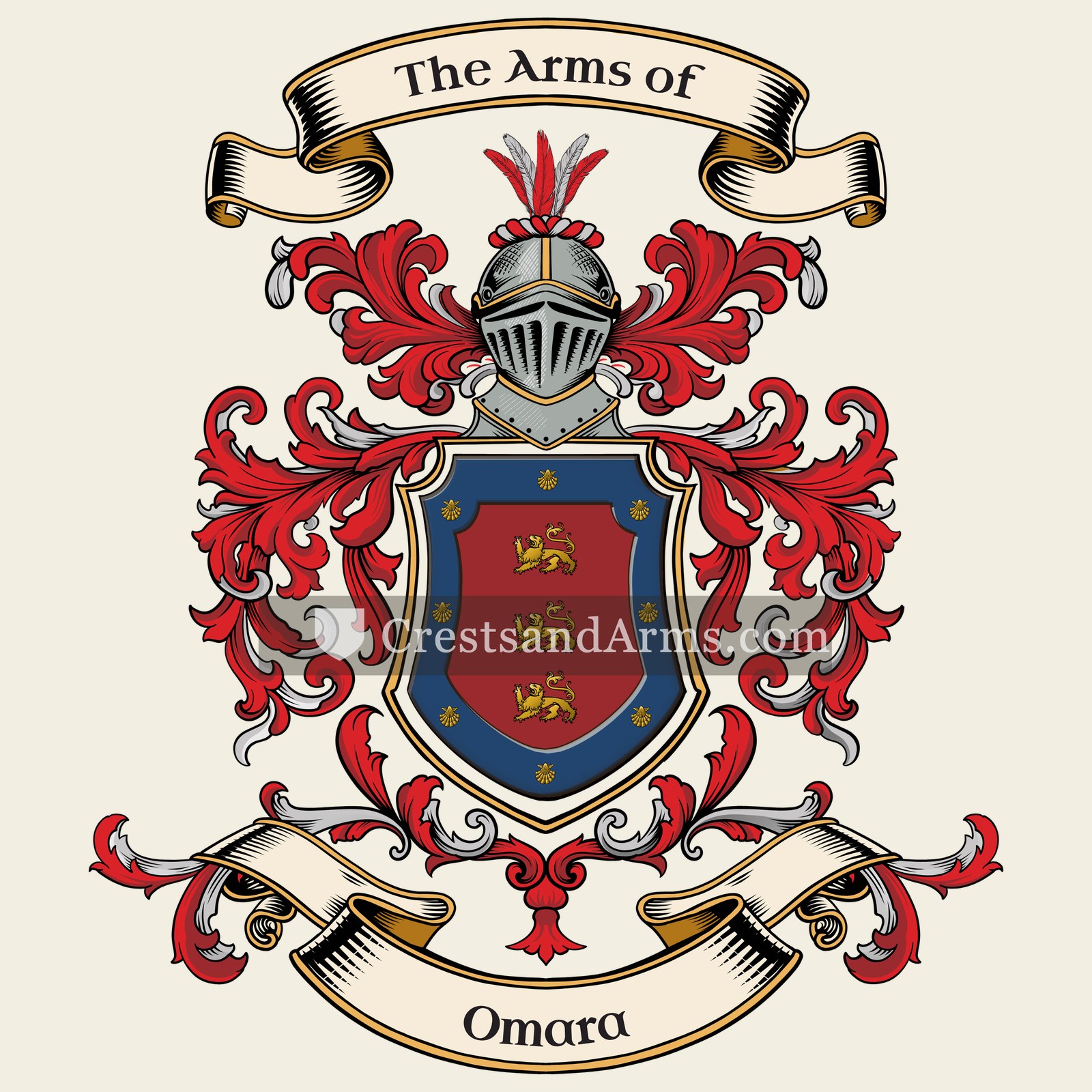


 bordureA difference between branches of one family
 crescentHonour by the sovereign, and the second son